Showing posts with label Front Range. Show all posts

Monday, June 18, 2018

Ancient Ogham Writing in Colorado


What is Ogham (sometimes also spelled as Ogam) Writing? It is an ancient British and Irish alphabet from the fourth to the sixth century, consisting of twenty characters formed by parallel strokes on either side of or across a continuous line. Could it be possible that ancient Celts traveled across the Atlantic Ocean, carried by strong ocean currents into the Gulf of Mexico, where they then sailed up rivers, one of which terminated in Colorado?   If you put the search words "Ogham in Colorado" you will find some fascinating stories and research about the possibility that Ogham writings have been found in different areas of Colorado, as well as in Oklahoma, Wyoming, and even in the east in West Virginia. There are many examples of stones carved with Ogham writing in Ireland, Wales, and Scotland, but I was surprised to learn that Ogham writings were found almost in my backyard in an area along the Front Range of Colorado!
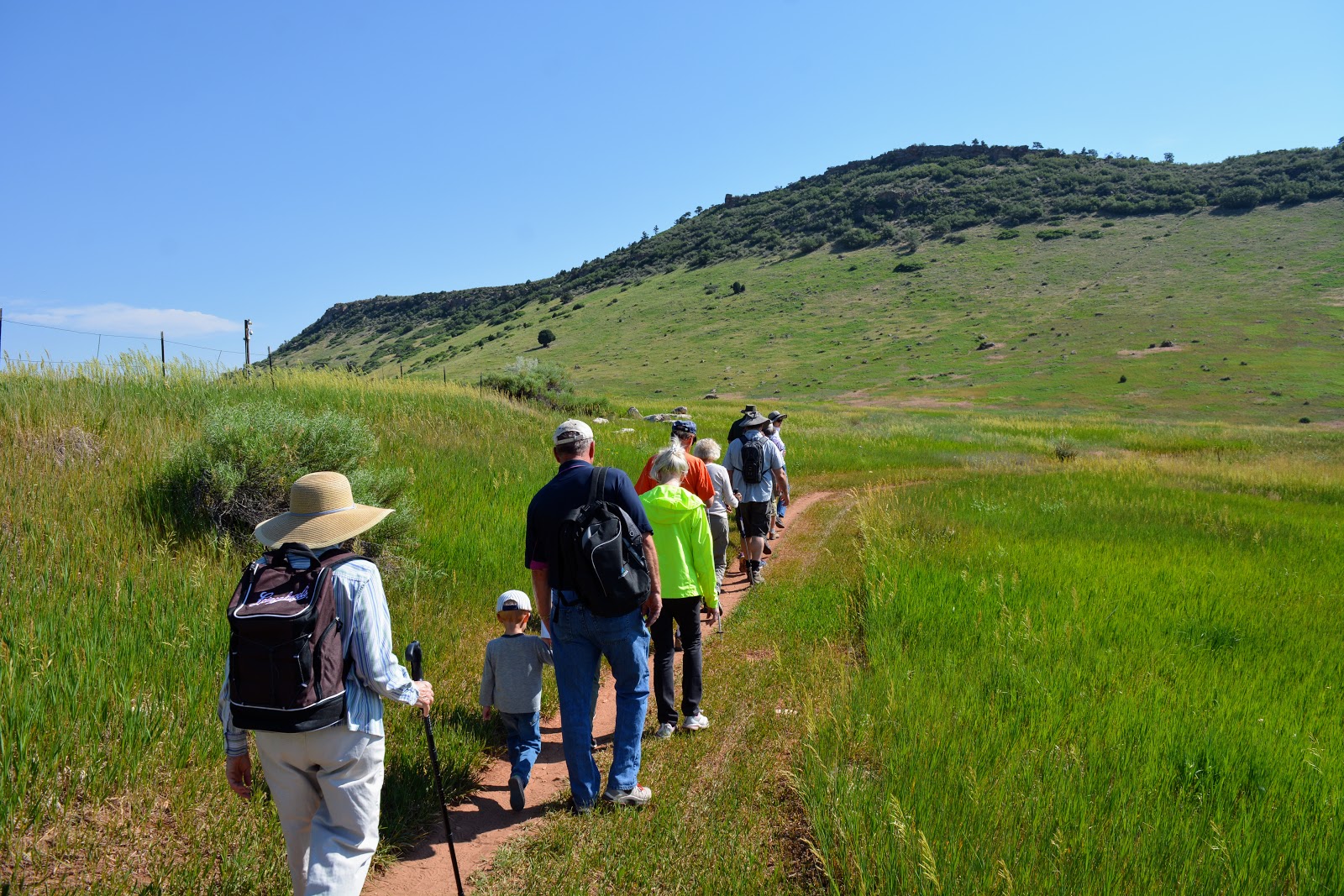

This past weekend my community's historical society, of which my husband and I are both members, left early one morning to take a hike led by another member who is an archeologist, to view the area where the Ogham writings were discovered decades ago. Our area of the front range has always been a favorite place for humans. There has been evidence of humans living here since 10,000 BC, but the thought of ancient Celtic people, or Druids, passing through and possibly settling here was an intriguing idea.

Our hike was over rolling grassland, alongside a creek, and towards a rocky crested hogback.  As we descended in elevation the creek got stronger and the vegetation became thicker with trees and scrub oak.


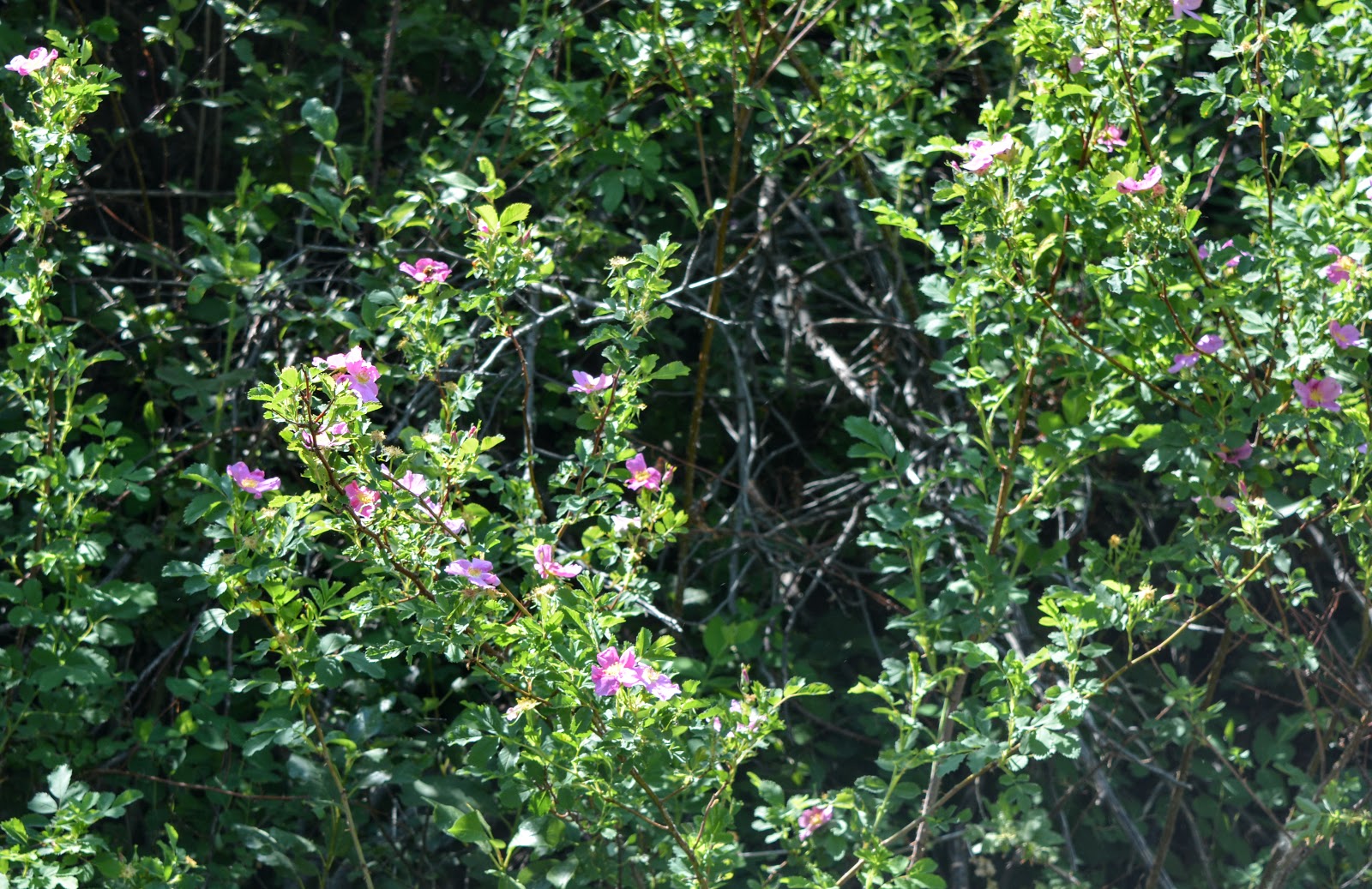
We even saw wild roses growing along the creek banks...


...and even though our spring has been very dry, there were still wildflowers to be seen.


Along the hike, we stopped at key points where the archeologist gave us information about what we were about to see and its significance.


He pointed out how rock outcropping and caves were valuable to the ancient peoples as a form of shelter and warmth, and accessibility to water and game was always a reason people settled in an area.


He pointed out that the rocky protuberance that can be seen in the distance along the side of the hogback in the photos above, is often a sign that indicates Ogham writing will be found. It was a common element in many North American Ogham sites.


You can see how the creek has cut a deep path through the grass and rock as it has flowed from the mountains over millennia.


We finally reached the area where the Ogham writings were located.


We listened to the tale of their discovery, and documentation, as well as an effort by preservationists and our community to protect them from vandalism by backfilling the cave with dirt and covering them up with dirt.  A photograph of what the site looked like then was passed around as well as a photo of the Ogham writings.


The cave once looked like this, with a significant shelter space. The man in the middle is pointing to the location of the Ogham.


Now the cave is completely filled with dirt and the Ogham writings are covered.


This is the photograph of how the Ogham marks looked inside the cave.

If indeed these are Ogham markings then the thought of ancient druids having settled here temporarily in their explorations was exciting. What did they write and why?  Some Ogham writings have been translated to the writings "People of the Sun," and they light up with the sun of the summer solstice, much like the chamber in Newgrange, Ireland.


We pondered, observed, and discussed our observations before hiking back to our cars.  As members of our historical society, we wanted to know the location of this site so we could pass on the information to future members.


The YouTube video above explains in interesting visuals the Ogham story in America. Click here to see it on the YouTube site if the video above does not run. 

There is much controversy around whether the markings are truly Ogham or just spear sharpening marks made by Native Americans. What do you think?  I'd like to believe that the spirit of mankind has always had exploration at its core and that our world may have been traveled and migrated for great distances from the beginning of human life. Mountains were always there to be climbed, oceans crossed, rivers sailed, caves explored, and new horizons always beckoned. Perhaps even in ancient times, it has been a small world!

You can also find me on  Instagram Twitter Facebook Pinterest


Bookmark and Share


Monday, May 1, 2017

Chief Colorow and Colorow Cave

Colorow Cave
When I was a child growing up in Brooklyn, New York, there were the ruins of an old house located a few blocks from my house. Built around 1675, it was the remains of one of the original Dutch settlers in that area of Brooklyn, which was known as the town of Flatlands at that time. Fortunately, when developers came to build more houses in the area in the late 1950's, and that house was slated for demolition, it was dismantled and reconstructed in the Brooklyn Museum to preserve it for all time as part of Brooklyn's history. Remembering this house, the Jan Martense Schenk House, which you can read about more on my blog post--here--was the beginning of my love for local history.  I've always been curious to learn more about the peoples and places that came before me. 

When my husband and I moved to Colorado four years ago, we joined our community's historical society and the History Colorado Center. As Colorado became a state in 1876, its history is relatively new, and we were excited to learn more about it.

Please Click on to enlarge--Photos from a 2016 exhibit at Hiwan House, 
Evergreen Colorado--Chief Colorow on the Left

Native Americans lived in Colorado for thousands of yearsThe earliest traces of Paleo Indians, date back around 13,000 years ago, from artifact evidence found at an area called "Lamb Springs" near Littleton, Colorado. Click here to read my post about my visit to Lamb Springs.  One of the first recorded Native Americans, that was influential during the early 1800's, was Chief Colorow, a member of the Ute Native American tribe that frequented this area that is now known as Jefferson County, along many other areas of Colorado.  He was so well known in this vicinity that many local places are named after him, including an elementary school, a park, a road and trails, a cave and so on. Colorow was one of the most well known Utes in Colorado during his lifetime. Born a Comanche around 1813, he was captured as a child by the Muache Utes in New Mexico, who raised him. He was given the nickname "Colorado" (Red) by the Mexicans living in the San Luis Valley area because his skin had a reddish cast compared to the more brown skin of the Utes, and soon it was shortened even more to "Colorow." Colorow was six feet tall and skilled with horse rearing and training. He soon lead his very large family and tribe all over Colorado, wintering on the plains near red rock formations, where they could hunt deer and bison, as well as hunting and foraging in what he called the "shining mountains." He knew the early Spanish settlers, the fur trappers and traders, and the military men that were in Colorado at the time, and was able to co-exist and trade with them.  When gold was discovered in the Colorado Rocky Mountains, however, and settlers began streaming in from the east in the late 1850's, the Ute way of life was soon to change as their hunting grounds and living areas were slowly being taken away from them. Eventually, defeated by conflicts, broken treaties and being forced to live on a reservation in Utah, Colorow passed away of pneumonia in 1888. 

To read more about Chief Colorow click through here to his biography in the Colorado Encyclopedia.

Please click on to enlarge--more about Chief Colorow from the 2016 Hiwan House exhibit

The school children in Jefferson County learn about Chief Colorow, as part of the local history, and one of the charming legends about him was his voracious appetite.  It is said he grew to be close to three hundred pounds!  He is said to have had a special love for white settlers biscuits and would ride from homestead to homestead demanding the women of the house make biscuits for him and his braves, often stuffing them into his clothes to bring back to his tribe.  


The Ken Caryl Ranch Historical Society recently made an excellent ten minute Youtube video about the Utes and Colorow that you might enjoy watching to learn more about these native people, and specifically Chief Colorow.


One of the places that Colorow and his tribe stayed on the Front Range is a formation of Fountain Formation red rock sandstone called "Colorow Cave." This large formation of rocks is now part of private property, and is called the "Willowbrook Amphitheatre," and used by the Willowbrook Association for special events. Our community history society was invited to visit the cave, which was a very exciting event for all of us.


The top of the formation is open to the sky, but there is enough overhang to provide some shade and shelter from inclement weather. It was easy to imagine Colorow and his tribe seeking shelter here during summer thunderstorms or to escape the mid day sun, and to enjoy the warmth of the stored reflected sun's heat during the cold nights.


You can see how large this "cave" was by noticing one of our society member's grandchildren standing on the left side of the cave.


Although a flagstone floor with electrical outlets were added to make the space conductive to social functions, the rest of the cave formation was left natural.


I was startled by an owl in flight when I walked around the outside of the cave formation.


The owl perched on a distant layer of the rock formation, waiting patiently for me to leave.


The view of the Willowbrook community from the top of the hill, where the cave is located, was very bucolic.  Again, it was easy to imagine Colorow riding his horse down from the surrounding foothills to settle with his tribe to hunt the animals grazing on what was once all grasslands.


Before we left the area we also went to see the remains of a structure that is thought to be from the pioneer days, possibly a stagecoach stop?


Seeing the ruins reminded me of the little Dutch house that was fortunately saved in Brooklyn long ago for future generations to see. It reminded me how important it is for communities to work together to preserve their history, as they progress towards the future, so that their history is not lost to time.  

Do you know your community's early history and most famous resident?  Do you sometimes wander in their footsteps and imagine the life they lead?

Colorow Cave

In my next blog post I'll show you a former pioneer residence that is in my community and the interesting story of the man who built it, and for what reason.  Please visit again soon!

I'm linking this post to the following blog events:


Thank you to all the blog hosts!

Bookmark and Share

Sunday, May 31, 2015

Flood at Chatfield Reservoir in Littleton


The month of May has been an excessively rainy one for Colorado this year.  It rained almost every day, and the high Rockies had snow showers all month long. It is the result of an El Niño weather pattern from the Pacific Ocean and is supposed to last most of the summer.  (All photos and photo collages, in this post, will enlarge for easier viewing if clicked on)


The good news is that the four-year-plus drought that Colorado experienced recently is over, the fire risk is low, and the rain has revitalized the forests and the grasses on the plains that had been affected by the drought, and has filled the reservoirs.


The bad news is the increased risk of flooding if this weather continues longer. As you can see in the photo above, the Chatfield Reservoir is flooded, six to eight feet over its normal level.


The Chatfield Reservoir and dam sit inside Chatfield State Park--a beautiful expanse of open land surrounded by the foothills. There are many miles of hiking and bike trails, a boating marina, fishing, horseback riding, camping, and much wildlife within the park. The reservoir and dam were built by the Army Corps of Engineers, as a response to a disastrous flood that occurred in 1965, and they own and operate it. In addition to flood control, it serves as one of the water supply sources for the city of Denver. Construction of the project began in 1967 and was completed in 1975.


The dam measures approximately 13,136 feet in length, with a maximum height of 147 feet.


The water has a controlled release into the South Platte River on the other side of the dam.


Although it is sad to see many of the park's amenities flooded, as you can see in the photo collage above, I am glad that the reservoir and dam were built so that the combination of excessive rain and snowmelt is not causing the South Platte River to flood. Although the river is running high, so far everything is well controlled. It is sad to see that the same storm system has brought so much flooding and loss of life in the state of Texas and Oklahoma, and the state of California, which is suffering a severe drought, is not getting any of this rainfall.  My house's sump pumps have been working overtime, and I heard a couple of neighbors, who did not have a sump pump, got some water in their basements.  When it rains heavily for hours, flash floods can happen quickly!


Even with the bad weather, there is still beauty to be seen. We spotted a couple of pelicans asleep on a log in the Chatfield Reservoir. They enjoy catching the large and small, wide-mouth bass, crappies, lake trout, and walleye fish that live in the lake.   Over 200 species of birds live or migrate through Chatfield, which makes it a favorite destination for bird watchers.


In my neighborhood, around 7 miles away from the Chatfield Reservoir, we are seeing the creeks and gulches flowing heavily with water from all the rain and mountain snowmelt. Everything in our valley is so beautifully green from all the moisture.  New life is abundant in Spring, and along a trail I spotted a deer, lying under a lilac tree, who was about to give birth!


One thing is for sure: a month of rain makes one yearn for and anticipate seeing blue skies and the shining sun to appear again! I will appreciate the beautiful weather of summer even more than ever this year.

How has the weather been in your area this Spring?

I can also be found on


Sunday, March 1, 2015

March Came In Like A Lion


Snow clouds over our area, of the Front Range of Colorado, tell me that March is coming in like a lion this year. No surprise, as traditionally March is the snowiest month. Spring may be only 19 days away on the calendar, but it takes its time to arrive at our higher elevations.  (All photos will enlarge for easier viewing if clicked on)


When I lived in New York City, my experience taught me not to plant anything outside before the middle of May, even if we had a few weeks of mild weather before.  In our area of Colorado, I wait even a little longer, as rain can turn quickly into a snow shower, even in June! Snow is relished here, as it means moisture for our high desert climate.


Even though the Denver area broke a 103 record for snowfall this year of 22.1 inches, we've had a very mild winter so far with many days in the '60s and even some in the '70s.  The changeable weather keeps life interesting!


Winter holds a beauty all its own!


It pulls its white blanket of snow over the landscape...


...and makes the red rocks look like gingerbread frosted with icing...


...and the deer seek shelter and warmth under the pine trees.


I enjoy Winter's silence, and its message to slow down and be patient. Spring will arrive and the earth will be reborn. In the meantime, I am enjoying this season and its promises of what is to come.


Thank you all for your kind messages of sympathy for the loss of my dear friend Lucie.  There was extra heartbreak in that her son, who was also battling cancer the past two years,  passed away, just two days after Lucie did. Please keep their family in your prayers as they deal with this tremendous loss and their feelings of grief.  Although Lucie and her son's lives were so short, they were lives well lived, and I know that brings their family comfort as they hold onto their precious memories.


I hope you enjoyed my last two posts about a recent visit I made to New York City. I still have more interesting and unusual places to show on that trip. I also returned last week from a quick visit to New Orleans, Louisiana and I will soon be showing some highlights from that delightful city.


How did March arrive in your area? Like a lion or like a lamb? I know we are all looking forward to Spring!


Bookmark and Share