The Colorado State Capitol, located at 200 East Colfax Ave, Denver, Colorado, is one of the most beautiful and historic buildings in Denver. I've taken a tour of the building three times--click here to see a post about my second tour during the Christmas season.
The tour I took this time at the end of May was extra exciting for me, as I was able to see both the chambers of the State Senate and the State House of Representatives, as well as climb up to the viewing platform of the dome!
Information from the Capitol's website: The Capitol building houses the Senate, the House of Representatives, the Office of the Governor, the Office of the Lieutenant Governor, and the Department of the Treasury. The elected officials in the building work to make laws and administer state government. The Capitol building was designed by Elijah E. Myers, and its construction lasted from 1886 through 1901. The Colorado Capitol was designed on an axis in the form of a Greek cross and resembles the basic design of the nation’s Capitol in Washington, D.C. The cost of the construction was about $3 million. The cost of replicating this building today is impossible to determine.
We began our visit by admiring the designs on a metal security barrier outside the building, made up of symbols significant to Colorado.
Next, we climbed the steps leading up to the building entrance. There are 3 "Mile High" (5280 feet) markers on the steps. Our guide told us that the measurements change as new scientific equipment becomes more sophisticated, and also as the sea level rises! I believe the shiniest marker at the top was the most accurate. In the collage above you can also see the views we had from the steps. The Denver City and County Building is across the way and the Front Range and the Rocky Mountains are in the distance. All photos in this post were taken with my cell phone. The dome of the capitol building was recently re-opened after a restoration project which you can read about here. The cast iron exterior of the dome was restored, and the project also included replacing and re-gilding the copper plates underneath the iconic gold-leafed dome. More than 65 ounces of pure gold was donated to the project from the same Teller County source that produced the original gold that adorned the dome a century ago. Tours of the building are free. Information on how to take a tour can be found here. The Colorado State Capitol welcomes about 300,000 visitors annually, with nearly 70,000 visitors taking tours of our beautiful and historic Statehouse.
We found out that the front entrance of the capitol is no longer being used--visitors must enter through a basement entrance where security scanners are located. We then walked upstairs to the main level, where I took the photos in the collage above. The capital interior is really stunning with craftsmanship that echoes past excellence and would be difficult to replicate these days. There is marble, stained glass, brass railings, carved stonework as well as carved doors and lintels and trim, and magnificent chandeliers and light fixtures.

The walls are trimmed in Colorado rose onyx (also known as Beulah red marble), a type of stone so rare that all known reserves were used in the capitol’s construction. Colorado rose onyx itself was quarried in the town of Beulah, Colorado. White Yule Marble from the quarries near Marble, Colorado was also used throughout the capitol for the floors. Even the door handles have the state seal imprinted on them! There are portraits on the walls on the main level of past governors of Colorado.
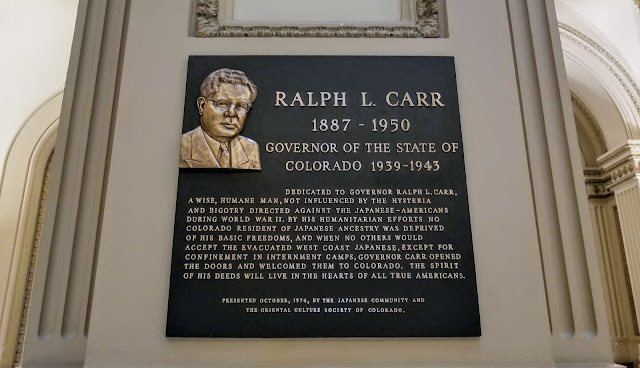
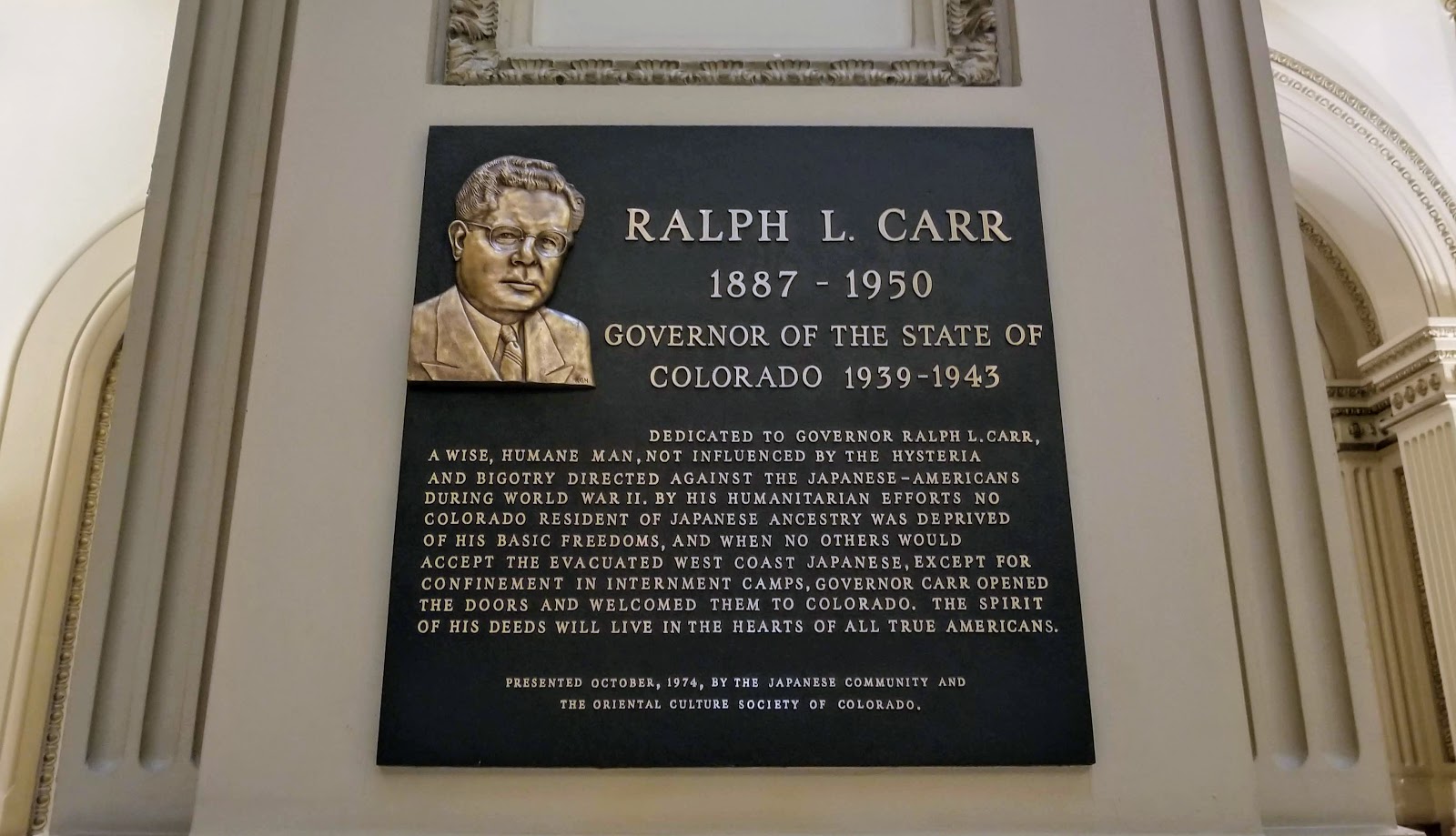
One governor, Ralph L. Carr, is also honored by this plaque for his courageous stand during WWII. The plaque reads: "Dedicated to Governor Ralph Carr as a wise, humane man, not influenced by hysteria and bigotry directed against the Japanese Americans during World War II. By his humanitarian efforts, no Colorado resident of Japanese ancestry was deprived of his basic freedoms, and when no others would accept the evacuated West Coast Japanese, except for confinement in internment camps, Governor Carr opened the doors and welcomed them to Colorado. The spirit of his deeds will live in the hearts of true Americans.” In the lobby of the Governor's office is a life-size fiberglass horse named "Scout." Scout was a resident of Governor John Hickenlooper’s office when he was mayor, and now welcomes visitors in his state capitol office.
This beautiful brass oval has an open floor that looks down to the basement. The capitol was coal-heated in the late 1800s and early 1900s. Wagons used 14th Street to bring coal in and take the coal ash out. However, some thought that was unsightly, so tunnels were dug underground to move the coal ore carts. Today the tunnels are used for utilities. The capitol has a geothermal power plant in its sub-basement. This is the first state capitol to use a geothermal system to both heat and cool the building. The water comes from an aquifer below the capitol and after being used, the water is returned to the aquifer so there is no loss of water.

Two beautiful quilts are hanging on the wall of the first floor of the capitol. The Centennial State Quilt is the one with the red border in the collage above. Twenty-five Capitol volunteers spent 250 hours completing this quilt, depicting Colorado's symbols and emblems. The 38 stars on the quilt represent that Colorado was the 38th state admitted to the Union.
The white quilt and hand-embroidered wall hanging is called "Women's Gold," and is a tribute to the historical achievements of Colorado's women in its first 100 years of statehood. It is entitled "Women's Gold" because of the yellow roses found in mining camps by gold seekers. 3,500 people put at least one stitch in the tapestry.
There are eight murals painted on the walls of the rotunda in honor of Charles Boettcher. The murals were painted in 1940 by Colorado artist Allen True. Each mural is accompanied by an excerpt of a poem written by Thomas Hornsby Ferril, who was later named Colorado's poet laureate.
The magnificent Grand Staircase leads to the second floor. The marble staircase is adorned with oak leaves and acorns cast in brass.
A section of the ornate second floor. Many stained glass panels are located here that depict famous Coloradans.
Views from the second floor. A portrait of Henry Cordes Brown hangs here. In 1859, Brown journeyed to Colorado by ox team with his wife, son, and all of their belongings. He arrived in Denver on July 10, 1860, and resumed his trade as an architect, carpenter, and builder. In 1863, he claimed 160 acres, known as “Brown’s Addition” in Denver. Brown donated 10 acres to the state, part of which is the current site of the State Capitol building. Brown also built the Brown Palace Hotel in Denver --you can see my post about that magnificent hotel here.
Looking up at the spectacular capitol dome! The circular "Colorado Hall of Fame" stained glass windows are portraits of 16 individuals who contributed to the initial growth and development of the state. These windows were placed in the dome in 1900.
Looking from the gallery to the Colorado House of Representatives chamber. 65 members are elected to serve two-year terms.
The chambers of both the House and Senate were recently refurbished and retiled and skylights that had been covered were reopened.
The Colorado Senate Chamber. 35 Senators are elected to serve four-year terms.
The beautiful refurbishment is also evident here.
The third floor of the capitol building contains the "Hall of Presidents."
In November of 1978, Mr. and Mrs. Harry Sullivan notified the Colorado Department of Education of their intent to donate a collection of original oil paintings by portrait artist Lawrence Williams. Entitled "Gallery of Presidents," the collection included 38 portraits of Presidents of the United States. Since then private donations paid for subsequent portraits.
We were excited to be able to go up into the dome on this tour!
First, we read some very interesting placards about the history of Colorado the building of the capitol, and the recent dome refurbishing, in a museum area that is sentimentally referred to as "Mr. Brown's Attic," after the man who donated the land on which the capitol stands. Mr. Brown's Attic, a 2,000-square-foot public gallery located between the third floor and the dome, is dedicated to the history and significance of the Capitol building. It features photographs, displays, and artifacts that tell the story of the Capitol from its beginnings to the present day.
We then walked up a narrow staircase up to a platform inside the dome. What a view looking down! The circular windows were all easier to see. The writing is backward as they are meant to be read from the exterior. This was Chief Ouray's window.
Walking outside, the views we saw were amazing! This view is looking west towards the Rocky Mountains in the distance. Some brass markers pointed to significant mountains and told their elevation. Lookout Mountain is close to where I live.
This photo shows a small view of the walkway around the outside of the dome.
Some more views and markers. The sky looks stormy but we had no rain that day.
Pike's Peak is 65 miles away and not too easy to see that day because of cloud cover.
The views of downtown Denver were wonderful!
If you ever have the chance to visit Denver, Colorado I highly suggest you take a tour of our Colorado State Capitol building--there was so much to see and my post just showed a fraction of all its beauty and historical significance.




 Posts