Showing posts with label NYC Museums. Show all posts

Sunday, September 6, 2015

The National 9-11 Memorial Museum


When I visited New York City this summer to attend some family functions, a few of the places I wanted to see that were not yet open when I lived there was the One World Trade Center Observatory (click here to see that post), and the 9-11 Memorial Museum. I have written a 9-11 blog post every year since my blog began in 2007, as it was a day I will always remember and an anniversary I feel should remain as a solemn tribute to those lost. The museum commemorates the September 11 terrorist attacks of 2001, in which 2,507 civilians, 343 firefighters, 72 law enforcement officers, 55 military personnel were killed, and also the World Trade Center bombing of 1993, which killed six civilians. (All photos and photo collages in this post will enlarge for easier viewing if clicked on.)


The 9-11 Memorial Museum is located at the World Trade Center site, the former location of the Twin Towers, which were destroyed by the terrorist attacks. There are Memorial Waterfalls in the approximate footprints of the destroyed towers, and the names of those that perished in the towers are inscribed around the waterfalls (click here to see a post about the Memorial Waterfalls).  The Museum opened on May 21, 2014, and has been visited by millions of people so far. My husband and I spent six hours in the museum, as we wanted to read every placard, listen to all the recordings, watch all of the videos, and spend time looking at all the artifacts.  I would suggest if you want to visit the museum someday that you purchase your admission ticket(s) online,  and visit early in the day.

All photos in this collage taken of photos inside the 9-11 museum

The Twin Towers were a large part of the New York City skyline, and over 50,000 people came to work in their 12 million square feet of office space, including my husband who worked in 7 World Trade Center. Many New Yorkers watched the towers being built in the late 1960s and early 1970s, never dreaming they would see them destroyed that fateful day in 2001.  I know there are still people who cannot bear to return to Lower Manhattan because of the traumatic memories of that day, and I respect their feelings.  I also know there were many, many controversies about the museum during the years of its construction and opening. The tragic events of 9-11, and its aftermath, left heartaches and turmoil for the families involved and many of them could not agree on how the tragedy should be displayed and memorialized.
Although I spent much of my visit to the 9-11 Museum in tears, I was very grateful I visited it.  There will soon be a generation of adults who were not yet born when these events happened, and I believe the museum will be a future reminder of what was, and what was lost, and the innocent victims who went to work one day and never returned home.  We must never forget!


Most of the 9-11 Museum is 70 feet below ground, and the first objects one sees as you ride down the escalators are two tridents that remained standing from the Twin Towers.


The story and timeline of the events of 9-11 are explained in placards and the sights of bent and shredded steel that once comprised the towers shows the impact of their destruction.


There are many exhibits to see, videos to watch, and voices to hear of people involved in the events. A portion of the museum does not allow photography, which I did not realize at first until a young visitor told me so.


Some of the building artifacts recovered--the brass World Trade Center buildings signs, a portion of the antenna that was on tower two, an elevator motor, one of the fire engines destroyed as the building fell.


The large slurry wall that holds back the Hudson River and the last standing column.


The Vesey Street stairs, which are now called the "Survivor Stairs."   They were located in the northernmost section of the World Trade Center Plaza. To reach these stairs to get away from the towers on 9-11, many survivors had to run across the plaza, dodging falling debris from the North Tower.  When my husband worked in Tower 7,  I often waited for him at the bottom of these steps so that we could go home together, so it was poignant for me to see them again in the museum.


Another poignant sight for me was this wall, that contains a quote from Virgil.


The blue squares make up a mosaic of different shades blue. They represent the beautiful blue sky that most New Yorkers remember that made up the sky on the morning of September 11, before the terrorist attacks began.  Upon closer examination, this wall, on the lower right, was a plaque that states: "Reposed behind this wall lies the remains of many who perished on the World Trade Center site on September 11, 2001."  These are the remains of those that could not be identified by today's methods.  It is a very solemn sight to see and I stopped to say a prayer.


 In this area, there are also walls filled with the photos of all the people who were lost on 9-11, and touch screens to read the story of each person.  There is a darkened room in which you can sit and hear a recording of the names of each person and memories about them from family members. My husband and I spent a lot of time here looking up the people we knew who perished that day and said a prayer for each of them.


The 9-11 Memorial Museum also contains uplifting stories about how New York City and our nation came together in unity to remember and honor those lost, and to revitalize patriotism.   Click on to enlarge the photos mosaic above to read two of them.


I was happy to see that the entire World Trade Center area was thriving again.  It was full of visitors and new construction that was in progress and already completed.  Life and progress go on, but it is also good to look back and remember. I felt that the National 9-11 Memorial Museum allowed me to do just that. It was a very powerful experience.  

The world today is full of tragic events--famine, wars, persecution, prejudice, poverty, and abuse. If only we could all work together, each and every day in our best way to make the world a better place to conquer hate and evil.  A dream perhaps, but as Mahatma Gandhi once said: "Be the change you wish to see in the world."  It is up to each and every one of us!


Bookmark and Share

Sunday, March 8, 2015

Vanderbilt--Mansion, Museum, Planeterium


On my last visit to New York, a friend Rosemary and I decided to take a drive out to the north shore of Long Island to the town of Centerport, in Suffolk County, where through these elegant iron gates stands "The Eagle's Nest," an estate of William K. Vanderbilt II, the heir to one of America's greatest fortunes.  Upon Vanderbilt's death in 1944 the property became the Vanderbilt Mansion, Museum, and Planetarium. (All photos and photo collages in this post will enlarge for easier viewing by clicking on them)


The estate property includes 43 rolling acres and a panoramic view of Northport Bay and the Long Island Sound that delighted Vanderbilt when he had the estate constructed in three stages during the years 1910 through 1936.


The first phase of construction was the building of a 24 room Spanish revival mansion, designed by the famed New York architecture firm of Warren and Wetmore, the same architects responsible for designing and constructing New York's Grand Central Terminal.


Gorgeous architectural details could be seen everywhere, and it was evident no expense had been spared when the complex of buildings was constructed.


As my friend and I walked into the central courtyard and glanced around at all the structures, I was transported back to the era of F. Scott Fitzgerald's novel, The Great Gatsby...


,,,. where once rich and privileged socialites gathered in summer mansions along what was called the Gold Coast of Long Island. They held glittering parties, listened to jazz, and filled their homes with expensive art, furnishings, and priceless possessions.


The grand splendor of the Vanderbilt Mansion was still visible, but, sadly, there was also a sense of an era long past its elegant glory and in faded decay. Just as the enigmatic flapper Daisy Buchanan, from the Great Gatsby novel, would have aged by now to have become a wrinkled old crone, the Vanderbilt Mansion showed the ravages of age, weather and neglect on its body.


The mansion and grounds are now operated by Suffolk County, and this Wikipedia article states that "..there has been a tumultuous relationship between the parties who own and the parties who oversee and run the museum. Currently, Suffolk County officials are experiencing difficulty receiving and allocating funds to keep the museum running. The museum's endowment from previews occupant, William Vanderbilt, was tied up in stock and bonds, which as a result of the economy proved to be a less than desirable financial safety net...."


It would be a shame to let this enchanting time capsule, and one of the last remaining Gold Coast Mansions, to fall into ruin, and we did see some efforts being made to maintain the property during our visit.  I wish I could show you the rooms and artifacts inside the mansion, especially Mrs. Vanderbilt's elegant dressing room and closet, filled with hat boxes and rotating hangers, which my friend and I found very interesting, but unfortunately, no photography was allowed inside the mansion,


I managed to take this photo inside the museum portion of the property before I was told no photography was allowed inside the museum either. If you are not impressed by touring the rooms of the mansion, then the museum of Vanderbilt's personal collections would be a reason enough to visit! William K Vanderbilt II, during his oceanic expeditions on his various yachts, sailed around the globe and collected thousands of specimens of birds, invertebrates, and marine life for his museum, They are all on display in different exhibitions. He also worked with artisans from the American Museum of Natural History to create a room of marine and animal taxidermy dioramas, including a 32-foot whale shark and a 3,000-year-old Egyptian mummy! It was really fascinating to see his well-curated collections.


The Vanderbilt property also includes the Charles and Helen Reichert Planetarium.  It recently underwent a 4 million dollar renovation, with cutting edge technological updates, and it is now considered one of the finest and most advanced in the United States.  Seasonal shows and special features for children, families, and school audiences are produced and conducted by trained astronomy educators.


The Vanderbilt Mansion, Museum, and Planetarium has one of the most impressive views of the Long Island Sound, although as time marched on in the area it now sadly came to include a view of the ugly Northport Power Station in the distance.


F. Scott Fitzgerald was influenced by his visits to various opulent Long Island Gold Coast homes during the roaring, 20's and perhaps the Vanderbilt Mansion was one of them?


Once over 500 Gold Coast Mansions existed on Long Island's north shore in both Nassau and Suffolk Counties, and today less than 200 survive. The remaining mansions are used as hotels, event venues for tours and parks and some remain privately owned mansions and a few are for sale.

If you want to take a step back into the past, the Gold Coast Mansions open to the public are the place to begin. My friend and I enjoyed our visit to the Vanderbilt Mansion, Museum Planetarium, and we both hope to visit a few more of these beautiful mansions in the future.


Bookmark and Share

Sunday, February 15, 2015

The Morgan Library and Museum, New York City


The Morgan Library and Museum, located at 225 Madison Avenue, New York, New York is a treasure trove of manuscripts, and printed books as well as prints and drawings that are in the once private and personal collection of the American financier and philanthropist John Pierpont Morgan. I felt fortunate to be able to visit the Morgan on a trip to New York City, and I'd love to show you some of its magnificence.  (All photos and photo collages in this post will enlarge  for easier viewing when clicked on)


Mr. Morgan's library was built between 1902 and 1906 adjacent to his New York residence at Madison Avenue and 36th Street.  It was designed by Charles McKim of the architectural firm McKim, Mead, and White in an Italian Renaissance style.  The two lionesses in front were sculpted by Edward Clark Potter, who would later create the two lions that guard the New York Public Library's main building.


Today the library is a complex of buildings that serve as a museum and a scholarly research center. The most recent addition, designed by Italian architect Renzo Piano and Beyer Binder Belle, and was completed in 2006, is a modernist entrance building that joins the interior spaces of the complex.


In 1924, eleven years after Pierpont Morgan's death, his son J.P. Morgan Jr, fulfilled his father's dream of making the library and its treasures available to scholars and the public alike by transforming it into a public institution. The rotunda portion of the library is opulent in detail.


Monumental bronze doors lead to variegated marble columns, an ornately patterned floor, and fine mosaic panels that line the curved walls. Highlights of Morgan's collection of rare printed and manuscript Americana are on display here, such as letters of George Washington and Abraham Lincoln as well as the journal of Henry David Thoreau and Nathaniel Hawthorne and works by Edgar Allen Poe and Ralph Waldo Emerson.


I was particularly fascinated by this life mask of the first President of the United States, George Washington, made in 1785 by the French Sculptor Jean-Antione Houdon at the President's Mount Vernon residence.  To make the mold of Washington's face Houdon had Washington lay down, and he placed a protective layer of grease on his face and then applied plaster over that, covering his entire face. When the plaster hardened, he removed the mold and poured plaster into it, thereby making this positive "life mask."  Houdon returned to France with the mask and used it to sculpt a marble portrait of the president which was presented to the rotunda of Virginia State Capital building in 1796.


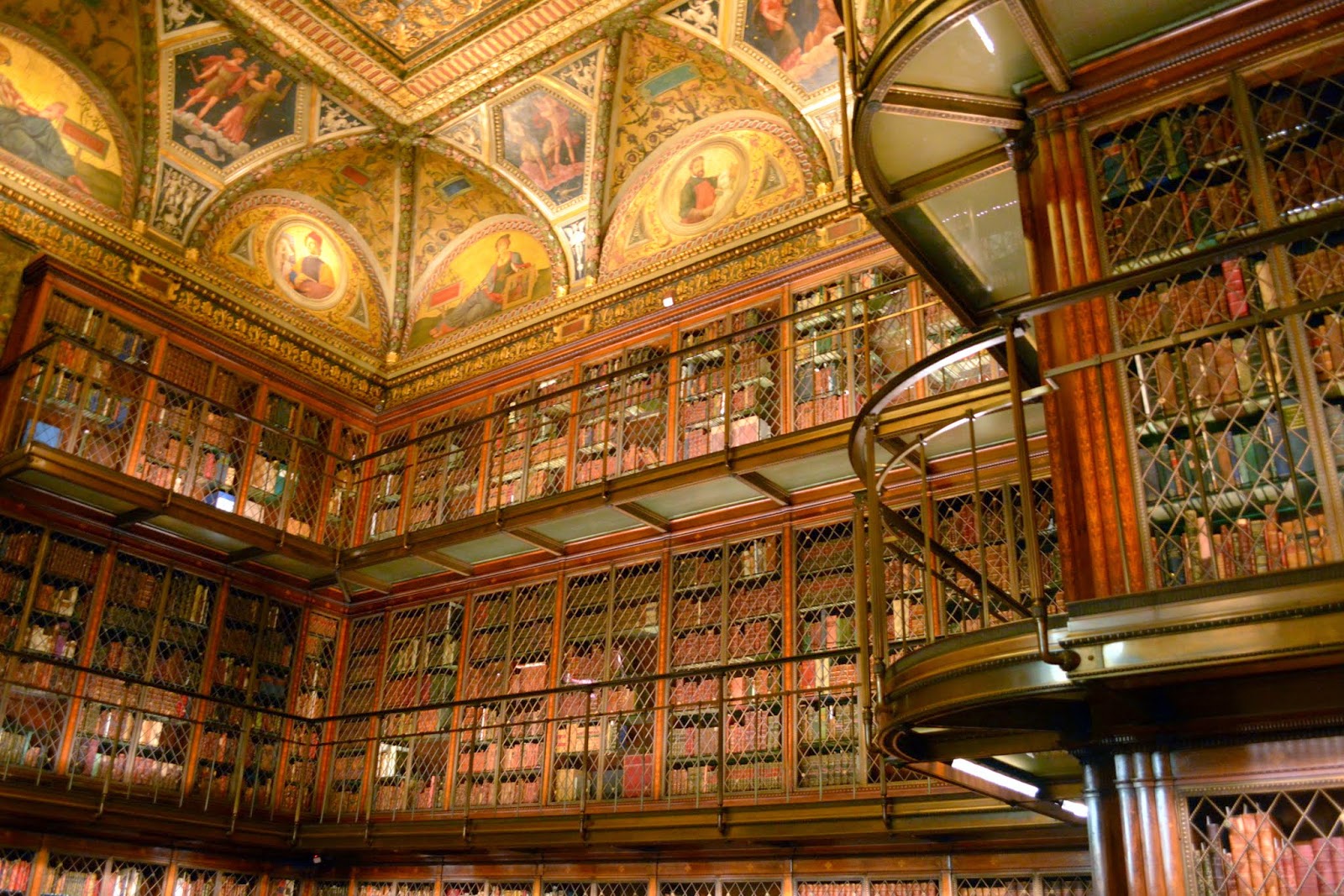
The grandeur of the East Room Library takes one's breath away!


The library, with three-story inlaid walnut bookshelves and magnificent ceilings, was designed as a treasury for Pierpont Morgan's collection of rare printed books.


The sixteenth-century tapestry over the mantelpiece depicts avarice; one of the seven deadly sins personified by the mythological King Midas.


One view in the East Room are examples from The Morgan Library and Museum's extraordinary collection of medieval illuminated manuscripts, rare printed books, and bindings, and handwritten manuscripts of great writers, artists, and composers from the Renaissance to the present day.


Some articles in the collection have been acquired since Pierpont Morgan's death.


There were volumes upon volumes of books on the shelves...


...and beautiful murals painted on the ceiling.


Two staircases, concealed behind bookcases, provide access to the balconies.


Display cases held a variety of rare books in the library.


The North Room is lined with two tiers of bookshelves and adorned with ceiling paintings from the studio of American artist James Well Finn. This was the first librarian's office. In 1905 Pierpont hired Belle de Costa Greene to manage and augment his collection of rare books, and she later served as Morgan's first director.


Selection on display are changed regularly in the library, but one work always-on display is one of Morgan's three copies of a Bible printed by Johannes Gutenberg in 1455. With Gutenberg's Bible, the painstaking process of copying books by hand gave way to an innovative new technology--movable type--that facilitated the exchange of art and ideas for the greater masses of people.


Pierpont Morgan's study, called the West Room, was a lush but intimate room where Morgan relaxed and met with art dealers and business associates.


To the left of the massive fireplace, Morgan's impressive manuscript collection was once secured in a vault lined with solid steel.


The Morgan Library and Museum offers the Thaw Conservation Center,  Research Services, as well as Online Exhibitions.  Information on Current and  Upcoming Exhibitions can also be accessed on their website. It truly is one of the exceptional library and museum gems of New York City!

Do you remember the TV show called The Adventures of Superman?  Next post I'll show you a building that has a fascinating bit of scenery that was used in the show!


Bookmark and Share