Showing posts with label Historic Homes In Brooklyn. Show all posts

Sunday, July 31, 2016

The New Brooklyn Navy Yard


Whenever my husband and I visit New York City we spend most of our time in our favorite borough - Brooklyn, where I was born, raised and lived for most of my life, and where my husband immigrated from Italy as a child.  We have family and friends that still live there and it's always so wonderful to see everyone again. Brooklyn has always been the borough of immigrants--the beginning of many people who came to the USA from all around the world.  Both of my parents were born and raised in coal country in Pennsylvania, and both of my grandfathers were coal miners, but my parents met in Brooklyn during the years around WWII, when my mother and father lived and worked in Brooklyn, as jobs were more plentiful in New York City at that time. Brooklyn has now also become a beacon for many young professionals from across the country who want to live and work in New York City, but found Manhattan too expensive. They have actually made the prices for rent in Brooklyn become almost as high as those in Manhattan in many neighborhoods, but the renaissance of Brooklyn becoming a very desirable place to live and work has brought many new opportunities to the borough.

One example of a changing Brooklyn is the Brooklyn Navy Yard. In all the years I lived in Brooklyn, I had never visited the Brooklyn Navy Yard or area, and I was curious to see how it has changed with the times, as I had heard it has reinvented itself.

(All photos in this post will enlarge for easier viewing if clicked on) 


The Brooklyn Navy Yard opened in 1806. The area produced merchant ships from the time of the American Revolution, but the land was purchased by the federal government in 1901 and became a US Navy shipyard five years later.  By the American Civil War the yard has expanded to employ about 6,000 men, and at its peak, during World War II the yard employed 70,000 people, 24 hours a day.  Ships such as the first ironclad ship, the Monitor, was built. Maine was built in 1890, the battleship North Carolina in 1937, the 1942 battleship Iowa and Missouri, were also built here. America's first angled-deck aircraft carrier the Antietam was built in 1952.  The Navy decommissioned the yard in 1966, after the completion of the USS Duluth, and the yard was eventually sold to the City of New York. 
In 1967, Seatrain Shipbuilding, owned by Seatrain Lines, signed a lease as a nonprofit body to run the yard for the city but closed its production in 1979. By 1987 the Brooklyn Navy Yard Development Corporation failed in all attempts to lease any of the six dry docks and buildings to any shipbuilding or ship repair company.  Without a future in shipbuilding, the Brooklyn Navy Yard now focused on using its space to become an area of private manufacturing and commercial industry.  

As my friends and I entered through the security at the gatehouses of the Yard we began by walking around to see how redevelopment was slowly taking place.  $700 million in new development is underway, and employment in the Yard is planned to more than double in the next few years, from 7,000 to 20,000 jobs by 2020.  As you can see by my photos in the collage above, the Yard is now a mix of old and new buildings with many more new uses in development planned/


My friend suggested that we visit the 117-year-old former Brooklyn Navy Yard Paymaster building, where now the Kings County Distillery has been located since 2012.   They produce moonshine, bourbon and other whiskeys,  using New York State grain and traditional distilling equipment to make their distinctive spirits. Their whiskeys have won numerous awards from the American Distilling Institute, the Craft Spirits Association, and the San Francisco World Spirits Competition.


They are proud to be located just steps away from where the legendary 1860 Brooklyn Whiskey Wars took place and the former distillery district of the waterfront. Their walls had interesting information about that era. The Smithsonian Magazine has an interesting article about the Whiskey Wars on this link (click through the advertisement on the arrow upper right on the Smithsonian link)


Information on how the laws changed to allow for the distilling of whiskey again in New York--click on the photo to enlarge it to read.  We enjoyed sampling some of the different whiskeys that the Kings County Distillery produced, and we also enjoyed speaking with the friendly staff on our tour.

The Kings County Distillery conducts tours Tuesday through Sunday at 3:00 PM and 5:00 PM and on Saturday every half hour from 1:00 PM to 4:00 PM with the last tour ending at 4:00 PM.  For more information about the tours and admission price click here.


Next, we visited Rooftop Reds, in the Yard, wherein the spring of 2015, they introduced the world's first commercially viable urban rooftop vineyard in New York City.  With the help of the upstate New York  Finger Lakes industry and Cornell University, they developed a planter system to grow grapevines that fill their 14,800 square foot rooftop, to one day produce a sustainable and completely Brooklyn vintage of wine. As they wait for their vines to mature they offer events such as rooftop happy hours, pop up dining, and educational viticulture tours and rental opportunities. Until the first rooftop harvest, they are serving wines produced in the Finger Lake region in their bar area.

Since we indulged in samples of whiskey earlier, we did not imbibe any of the wine at Rooftop Red, but we enjoyed their views and the exercise we had walking up the four flights of stairs to visit this rooftop dream in the making.


In fact, one of the views we had from this part of the Navy Yard was a juxtaposition of the old Civil War era "Admirals Row" buildings being torn down in the Brooklyn Navy Yard with the backdrop of expensive new condominium buildings in downtown Brooklyn that have been popping up in the skyline.


Happily, one of the vintage handmade brick buildings that have been preserved is Building 92--the former United States Marine Commandants' Residence, and built-in 1858 by Thomas Ustick Walter, who is considered one of America's most important 19th-century architects.  Building 92 is now a museum that tells the story of  the "Brooklyn Navy Yard: Past, Present, and Future." It introduces the generations of people who worked or were stationed at the Yard and those who lived in the communities surrounding it. They shaped the Yard over time, and are now are creating its future.
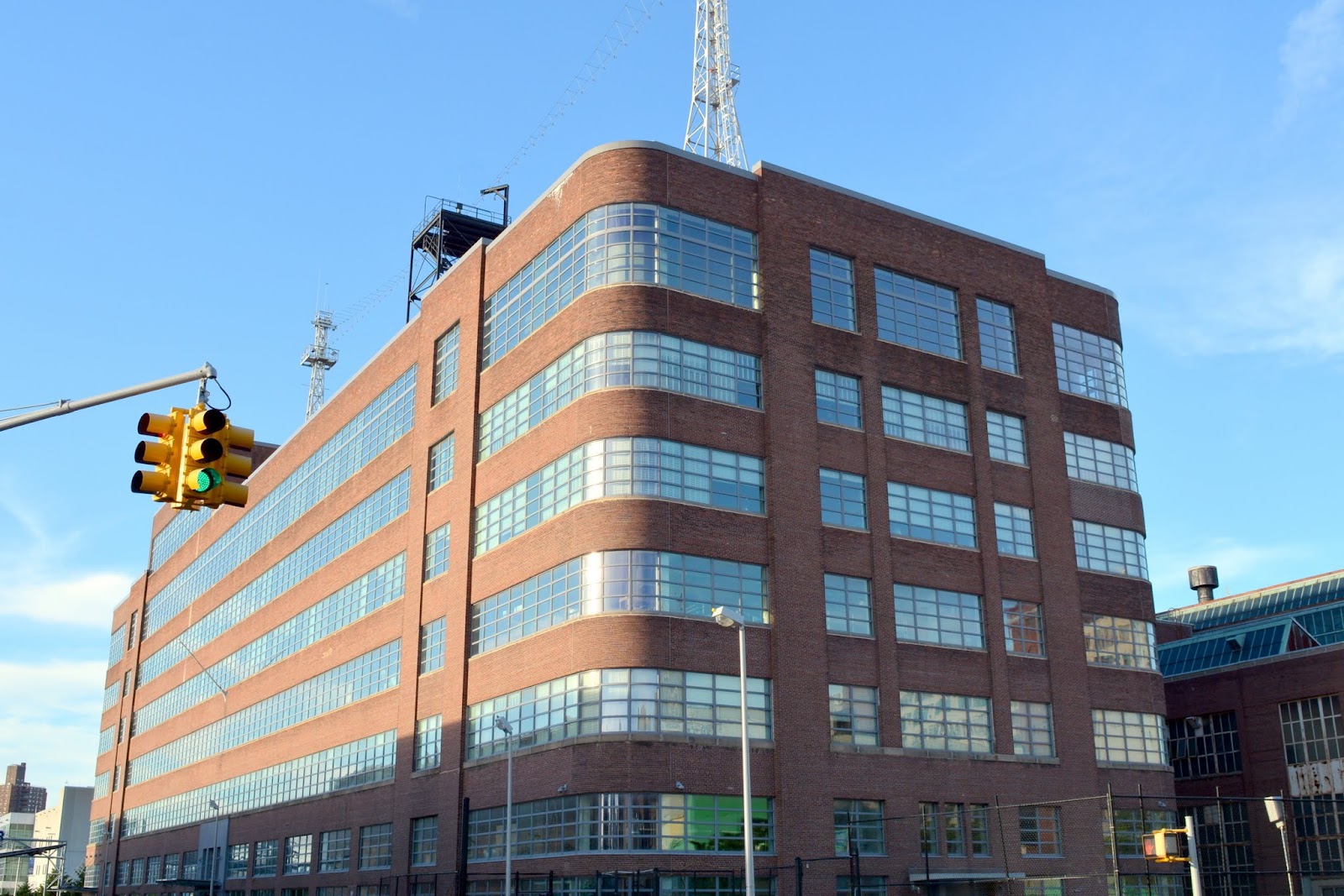

We also saw a part of Steiner Studio in the Brooklyn Navy Yard. It is the largest film and TV studio outside of Hollywood. Opened in 2004 on a 15-acre site containing 580,000 square feet of studio space.


Besides assorted movies and television shows being filmed there, commercials, photos shoots, music videos, Broadway rehearsals, and other events use the studios. 


You may recognize this building in the Brooklyn Navy Yard as the place where one of the 2016 Democratic debates between Hilary Clinton and Bernie Sanders took place at the Duggal Greenhouse.  It has the capacity to hold 3,000 people in its 35,000 square foot venue space.


The location of the Brooklyn Navy Yard, along the coastline of the East River, gives it a wonderful view of midtown Manhattan and the Williamsburg Bridge.


As we walked around we came upon a placard for an event happening that evening called "Fly By Night" by Duke Riley and hosted by Creativetime in the Yard.  My friends heard about this event, especially through a Wall Street Journal article, and thought that perhaps we could see if we could get a standby pass to see it.


At dusk, in a union of public art and nature, over 2,000 pigeons would be encouraged to fly overhead, wearing tiny LED lights instead of the small leg bands that were historically used to carry messages in the past. Duke Riley wanted to pay homage to the role pigeon keeping had in New York and other areas, as domesticated pets and revered for their companionship, sport, and service. When we were children, my friends and I remember seeing rooftop pigeon coops in Brooklyn and watching their owners let them fly in beautiful formations overhead, so this concept was not unusual for us, although we did hear that it was somewhat of a controversial demonstration for this event. 


Fortunately, we were able to get standby tickets to the free event.  As we waited, "crowd watching" was almost as entertaining as the event itself, as we saw some famous people in attendance.


As soon as the blue hour arrived, after sunset, Duke Riley and his assistants whistled and gently swirled flags overhead, while the pigeons took flight and swooped and fluttered in the air like glittering, twirling diamonds.  It was a peaceful and magical sight to see. If you would like to see a short video I took of the pigeon flying overheard go to this link on my Mille Fiori Favoriti facebook  page.  I'd be pleased if you follow my facebook page as well as following me on Instagram, and on Pinterest.


We did not have the opportunity to visit the Brooklyn Grange Farms in the Brooklyn Navy Yard, that operates a 65,000 square foot commercial space on top of building 3, as well as the many other hundreds of tenants in the Yard that allowed visitors. We did enjoy the new developments we did tour and look forward to seeing more in the future, such as the Mast Brothers large chocolate factory and headquarters that will soon be located in the Yard. The coffee company Brooklyn Roasting and Russ and Daughters, who are a century-old purveyor of pickles, bagels, smoked fish and babka, and the first Wegmans Grocery Store in New York, will also be opening in the next year or so.  It is all good news for Brooklyn and I'm happy to see my old hometown thriving so well!

 If you want to visit the Brooklyn Navy Yard click here for further information. 


You can also find me on 


Bookmark and Share

Wednesday, October 12, 2011

The Schenck Houses in the Brooklyn Museum

There are many historical homes still standing in Brooklyn, New York, that date back to early days when it was a Dutch settlement. I've shown the Pieter Claesen Wyckoff House, the Wyckoff Bennett House, the Hendrick I Lott House, and the Lefferts Historic House Museum before on my blog, which all remain on, or near, their original foundations. Now I'd like to show two homes that were dismantled and then reconstructed for display in the Brooklyn Museum to preserve them for all time.


The Jan Martense Schenck House is one of the oldest houses in the United States. It was built around 1675 in what is now known as the Mill Basin/Mill Island neighborhood of Brooklyn, part of the town of Flatlands. Flatlands was one of five towns--Bushwick, Flatbush, Flatlands, Gravesend, and New Utrecht---to become the borough of Brooklyn. Jan Martense Schenck, the man who built this house, arrived in New Netherland in 1650. On December 29, 1675, he purchased the land on which he built the house, along with a half interest in a nearby gristmill.


The house survived through the first half of the 20th century in its original location, but in 1952 the house was at risk of demolition because of development in the area. The Brooklyn Museum arranged to have it dismantled and stored for a decade until preparations for the installation of the house could be made. On April 26, 1964, the house was opened to the public inside the Decorative Arts Gallery.

My photo enlargement  from an informational placard in the museum

If you remember my blog post about the Beautiful Houses in Mill Basin, Brooklyn, you can see how this neighborhood now looks. All of the marshland has been filled in and the land where the Schenk house stood on is now a schoolyard.  I grew up in this area of Brooklyn, and while I don't remember the Jan Martense Schenk house being here my older brother and sister do!  They said it was in ruins and covered with vines.

My photo enlargement from an informational placard at the museum

During the 275 years that the house stood in its original location, it underwent many changes to accommodate the needs of new generations. In the museum photo above, the Jan Martense Schenck House is shown with the porch and dormers which were added by about 1825. When reconstructed in the museum it was returned to the original two-room structure.


Part of the exterior clapboard siding has been removed in one section to show a reconstruction of the brick nogging originally used to insulate the house. The museum web site states:  "For many years the house was painted gray. A recent analysis of the exterior paint layers on the original clapboard surviving in the corner at the short end of the building revealed that the house was originally white and then red. Since the interior of the house is interpreted to the first decades of the eighteenth century, we decided that the house might have received its second coat of paint, the red layer, by that time."


None of the original Dutch colonial furniture owned by the Schencks is known to have survived. The curators have assembled the interior-decorations and furniture using objects that would be typical in an interior of a prosperous family of Dutch descent living in colonial English Flatlands. The rooms are viewable behind glass, so, unfortunately, there is some glare on the glass in my photos.


A linen press.


This informational placard by the second entrance to the house describes the more formal room of the house. (please double click on the photo to enlarge it)


Notice the built-in bed boxes with heavy drapes on the fireplace wall on the left side of the room. Staying warm in winter was a challenge, and this was a way to block drafts and utilize radiant heat.


A beautiful wardrobe from the 1600s would be the type that would have been in a house such as this.
The Schenck family owned the house for three generations, finally selling it in 1784. It was abandoned and in disrepair when rescued by the museum.  How fortunate that the Brooklyn Museum had the foresight to preserve for all time such a treasure from Brooklyn's past.  It tells the almost forgotten story of the people who were among the first settlers in the United States.

The next house in the exhibit is the house of Nicholas Schenck (1732–1810), the grandson of Jan Martense Schenck,  in what is now the Canarsie section of Brooklyn. It was built about 1775 and installed in the museum in 1929.


The house was heavily remodeled in the early nineteenth century and is therefore installed here as it might have looked about 1830 when Nicholas Schenck, Jr. (1765–1836) lived in it with his family.


A model of what the house looked like when it was on its original location.


Let's go through the Dutch door and enter the house.


The color of the woodwork is based on fragments of paint found under the fireplace mantel and accurately reproduces the original color.


The dining room.

The furnishings of the house, like its architecture, are a mixture of both eighteenth and nineteenth-century styles and traditions.


Parlor/living room

Large fireplaces, considered inefficient by 1830, have been closed up and replaced as sources of heat by cast-iron stoves.


The Master bedroom


A child's bedroom.

Although small and rustic, both houses revealed that life was not that much different in the 17th, 18th and 19th centuries than modern-day life. The kitchen was the heart of the home, and adequate dining accommodations and comfortable bedrooms were important assets to have. 

In addition to the Schenck houses, the museum also had other period rooms to view and many decorative items on display.


17th and early 18th century China and silver pieces

17th-century glassware

The Brooklyn Museum's collection of decorative arts is considered one of the most important in the country.  It is a fascinating way to look at how life was lived over 300 years ago.

For anyone interested in antiques, American architecture and interior design the Decorative Arts galleries, the American Identities: A New Look gallery and the Luce Visible Storage Study Center in the Brooklyn Museum are not to be missed!


Bookmark and Share

Wednesday, August 19, 2009

The Wyckoff Bennett House -- The Last Privately Owned1700's Dutch Colonial house in New York City


The Wyckoff-Bennett Homestead, located at 1669 E. 22nd Street in Brooklyn, New York was declared a National Historic Landmark in 1976. It is believed to have been built before 1766 because that date was carved into a beam in the barn.


A beautiful farmhouse example in the Dutch Colonial style, it has been continuously occupied since its construction. The house was built by Hendrik and Abraham Wyckoff, descendants of Peiter Wyckoff who immigrated to this country in 1637. The house was bought by Cornelius W. Bennett in 1832, and the Bennett family held possession through four generations until 1983 when it was sold to the Mont family.


Please click on photo to enlarge

During the American Revolutionary War, during the British invasion during the Battle Of Brooklyn--which I have blogged about on this link--this home was occupied by Hessian officers, and two of the soldiers etched their names and ranks into the window panes. Two of these panes have been carefully preserved. One is inscribed with the name "Toepfer Capt. of Regt. de Ditfurth" and the other "M. Bach Lieutenant Hessen Hanau Artillerie."


An enlargement of a photo of one of the soldier's signatures that is etched on the windowpane.


I am so grateful that this original Dutch farmhouse has been so well cared for throughout the years by its owners, and now through historic preservation and landmark status it will continue to be treasured as a part of our young nation's history.


Bookmark and Share

Tuesday, August 18, 2009

The Hendrick I Lott House, A 1700's Dutch Colonial Farmhouse in Brooklyn, NY


The Hendrick I Lott House, located at 1840 East 36th Street, Brooklyn, NY, is a New York City and New York State Landmark and is listed on the National Register of Historic Places. Purchased by the Lott family in 1719, the house and property were sold by the Lott family to the City of New York in 2002, marking the end of the longest continual ownership of a property by a single family within the City.

(Click on any photo to enlarge it for easier viewing.)


Presently, the house is surrounded by a chain-link fence, as you can see in the photo above, and is closed for restoration. The Friends of the Lott House organization is raising money to complete interior and landscape restoration. Click here to make a donation

Some historical information about the house from the preservation web site:
"The Lott House, as it is presently configured, was constructed in 1800 by Hendrick I. Lott in the then town of Flatlands in Kings County New York. The house incorporates the circa 1720 house of Hendrick's grandfather Colonel Johannes H. Lott. The Lott House was the center of a large and active farm in Flatlands. In fact the Lott farm continued to produce goods for market until circa 1925. At one time Flatlands was the second largest agricultural producer in the region, second only to Queens County.

In 1989 the last Lott to live in the house, Miss Ella Suydam, passed away. Soon after the City awarded the Lott House landmark status and protection. In 2002 Miss Suydam's estate sold the Lott House and property to the City of New York."


On this link is a photo slide show of the extensive restoration that has begun to return it to its original 1700's condition.  The Friends of the Lott House have some wonderful videos on their home page describing the home and its history.


A New York Parks Department sign describing the history of the Lott family and the house. It can be clicked on to enlarge.

Like most of the large farmers in southern Brooklyn, the Lotts relied on the labor of slaves, indentured servants, and hired hands to help grow the crops that they sold in the markets of Brooklyn and Manhattan. The Lotts, however, freed their slaves by 1805, many years before the abolition of slavery in New York State in 1827. During archaeological excavations of the home, conducted by members of the Brooklyn College Archaeological Research Center, a secret room in the house was discovered which was believed to be part of the Underground Railroad in the 1840s. You can read about this discovery on the May/June 2001 issue of the Archaeology magazine website.


This is the American Revolutionary War "Battle Of Brooklyn" information placard at the house's site. It describes how in August of 1776, 20,000 British and Hessian soldiers came onshore from ships in Gravesend Bay to prepare to battle the Continental Army under General George Washington's command. They marched along the Kings Highway which was the northernmost border of the Lott property at the time and set their tents up in the fields surrounding the Lott house. A Lott family legend tells how a member of the family made a daring raid one evening on one of the enemy camps and made off with the cast iron fireback that belonged to the British General Charles Cornwallis. It remains in the family until this day. Click on the above photo to see the fireback and a photo of how the house farm and barns looked in the 18th century.


The photo above shows what those fields look like now. The last farmer, John Bennett Lott, died in 1923. and since he had no sons to take over the farm, most of the Lott house's 200 acres were sold to developers. Middle-class track houses were constructed on the former property as part of the ever-growing suburbia of New York City. This neighborhood became known as Marine Park. The houses seen in the photo above are on the west side of the Lott house, and similar houses surround it on all four sides.


Next blog post I'll show you one more Dutch farmhouse that still stands in Brooklyn -- one that was occupied by Hessian soldiers who left their mark behind 233 years ago!  It is the Wyckoff Bennett House.

To see the oldest Dutch House in Brooklyn --The Pieter Claesen Wyckoff  House, click here.

Read my blog posts about the Revolutionary War of the Battle of Brooklyn, click here.


Bookmark and Share