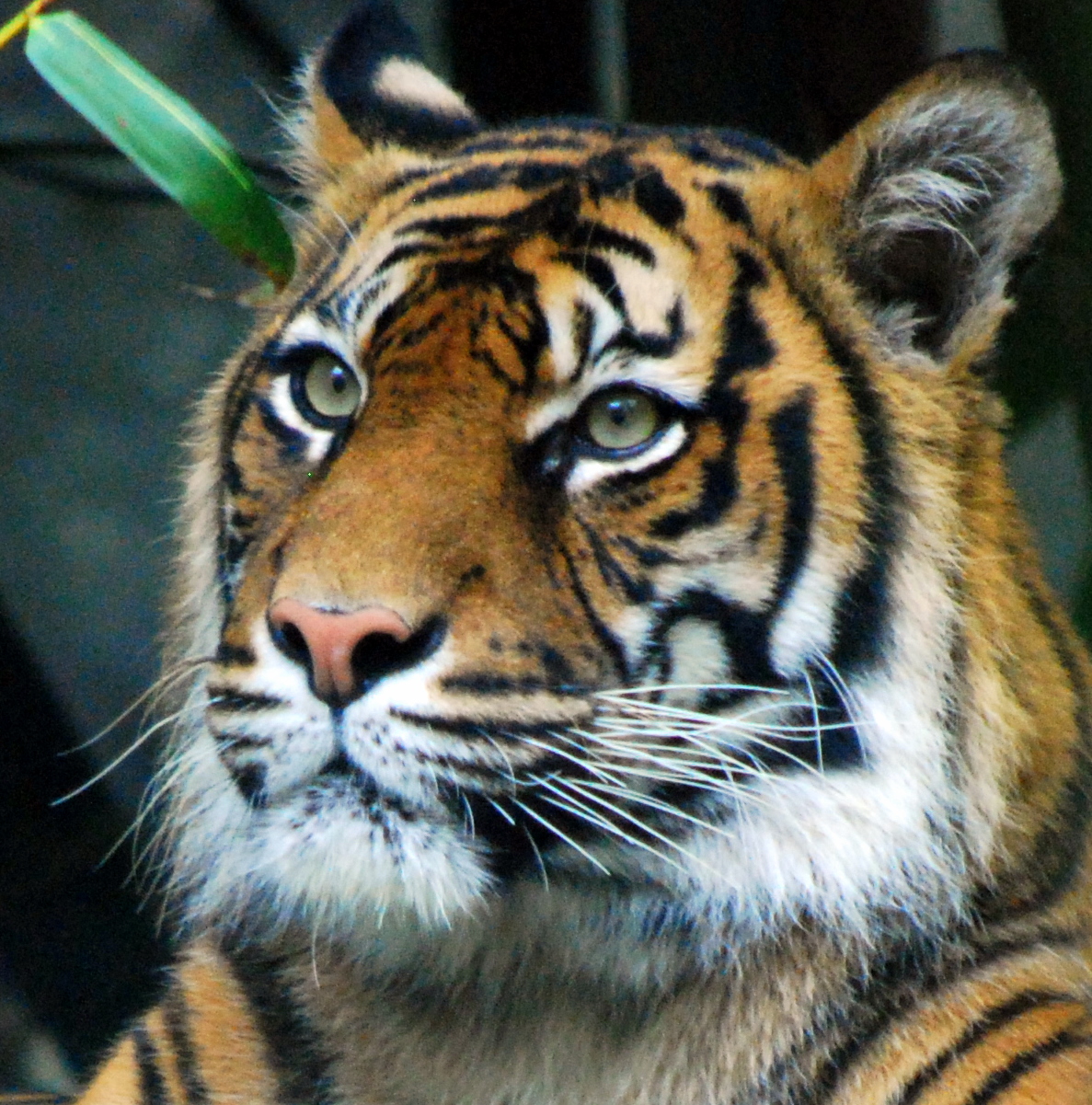
It is time for Vee's monthly note card party, where bloggers chose four photographs that they previously used in a blog post that they feel would be nice to turn into note cards. I decided to share some majestic animal portraits I made in Taronga Zoo, Mosman NSW, Australia in 2011. You can see that post and many more animal photos from that magnificent zoo on this link.
Lioness
Koala Bear
Giraffe
Taronga Zoo is home to over 2,600 animals on 52 acres (21 hectares), making it one of the largest of its kind. The zoo places emphasis on the promotion of world wildlife conservation. Since 2008 the Taronga Foundation has spent over $200,000 helping protect endangered species in the wild, helping save and regenerate natural habitats and working with local communities to reduce conflict with wildlife. 2010 was earmarked as the International Year of Biodiversity where the Taronga Conservation Society supported nine projects focusing on education, anti-poaching, population management, wildlife health, and habitat restoration. These projects are taking place in Australia, India, Sri Lanka, Indonesia, Fiji, Nepal, Tanzania and Zambia and will help protect the habitat, health, and safety of a variety of animals. You can see a full list of all the animals living at the zoo at this link.
I really enjoyed visiting this zoo and I think a wonderfully expressive animal face note card would be a fun card to receive. What do you think? You can check out Vee's and see links to all the other note card selections over at A Haven For Vee blog beginning at 8:30 PM EST Tuesday evening. Why not post your own card selections, link up, and join in all the fun?
I took a twelve-minute ferry trip across Sydney harbor during my recent trip to Sydney, Australia to visit Taronga Zoo, located across the harbor on Bradleys Head Road in Mosman, NSW, Australia. (All photos will enlarge if clicked on once and then again when they re-open)
.
Taronga Zoo is home to over 2,600 animals on 52 acres (21 hectares), making it one of the largest of its kind. The zoo places emphasis on the promotion of world wildlife conservation. Since 2008 the Taronga Foundation has spent over $200,000 helping protect endangered species in the wild, helping save and regenerate natural habitats and working with local communities to reduce conflict with wildlife. 2010 was earmarked as the International Year of Biodiversity where the Taronga Conservation Society supported nine projects focusing on education, anti-poaching, population management, wildlife health, and habitat restoration. These projects are taking place in Australia, India, Sri Lanka, Indonesia, Fiji, Nepal, Tanzania and Zambia and will help protect the habitat, health, and safety of a variety of animals. You can see a full list of all the animals living at the zoo at this link.
The zoo is located on a high hill so I took the "Sky Safari" ride to the top to be able to walk my way downhill through the grounds of the zoo.
My first sight was a koala bear hanging in a eucalyptus tree! Taronga is currently home to 21 koalas.
The next was an exciting exhibit in which you do a "walkabout" with the kangaroos. They literally hopped all around me! The male Red Kangaroo is pale red to brick red in color while the female is usually blue-grey in color. The Western Grey Kangaroo is brown in color while the Eastern Grey Kangaroo is grey.
I was enthralled by the many birds in exhibits. Most of the aviaries were walk-through exhibits where I could see the birds close up as they flew around and rested on tree branches.
This group was playing in a waterfall.
There were many entertaining shows during the day -- a wonderful free-flight bird show with some breathtaking views of the city of Sydney in the background across the bay, and also .....
...... a sea lion show.
I was by the lion area to listen to a zoo keeper's talk and this beauty lioness, perhaps anticipating the feeding hour, came right up to the Plexiglas window and looked right into my eyes for almost a minute! I have to say as a person who likes cats it was one of the most amazing and intense encounters with a wild feline that I've ever had.
I think I watched the lions for over an hour -- they were so majestic!
A lion yawning.
The giraffe exhibit also was situated to allow for wonderful close-ups. I felt as if they were smiling at me!
Of course, there were many other wonderfully cared for animals.......
...and reptiles, to see at the zoo.
You can see a full alphabetical list of all the animals that are part of the zoo at this link.
The Floral Clock at the Taronga Zoo. The Floral Clock was donated to Taronga by the late Sir Arthur Rickard, KBE, of Sydney. The clock was officially started on 19th December 1928. The clock 'cuckoos' once at the quarter-hour, twice at the half-hour, three times at three-quarters of an hour, and the full number of hours at each hour. The clock keeps the time accurately and is wound once a day
The beautiful Taronga Zoo was really one of the highlights of my trip! I highly recommend including a visit to this beautiful zoo if you visit Sydney, Australia. You won't be disappointed, as there are many opportunities to learn more about the magnificent animals that are there.
As an aside, my heart and prayers go out to the people of Japan. The earthquake and tsunami were such horrible disasters. As always after a world disaster we will be making a contribution to the Red Cross to help support aide to Japan. Using your cell phone, you can text-message donations of $10 to the Red Cross. Text the letters REDCROSS to 90999 to make the $10 donation, or visit the organization's website.
I have been showing photos from a trip that my husband and I took to Sydney, Australia last week. I already showed the beautiful and iconicSydney Opera House, and my full day of traveling all over the city of Sydney on the "hop on and hop off" sightseeing bus while my husband was at work, as this was a business trip for him. One of the most magnificent sights I saw in the beautiful city of Sydney was a portion of The Royal Botanical Gardens. A portion was located right across the street from the hotel where we were staying, and I liked to sit out on the balcony to watch the sun come up and listen to the birds chirping in the morning. (All photos will enlarge if clicked on once and then clicked on again when they re-open)
The photo above is The Palace Garden Gate located at Macquarie Street, between Bridge Street and Bent Street. This ornamental gate was built in 1889 to commemorate the International Exhibition.
The seventy-five acre Royal Botanical Gardens is managed by the same trust as The Domain adjoining it is free to access and open every day of the year. It is in close proximity to the downtown business center as you can see from the photo above. PDF maps of the garden's large grounds can be viewed on this link. The gardens were established in 1816 by Governor Macquarie on the site of the first farm in the colony.
The fountain in the photo above is dedicated to Captain Arthur Philip, RN, (1738-1814), First Governor of New South Wales. Fountain and statue are by the Italian sculptor Achille Simonetti, erected in 1897.
One of the two mini gardens I saw at this location was the Rose Garden and Pavilion and the Pioneer Garden. The Palace Rose Garden contains around 1800 roses. Even though we were in Sydney during the last days of the Southern Hemisphere summer, there was quite a bit of verdant green and flowering shrubs and plants still visible.
The gardens contain over 7,500 species of trees, flowers, and shrubs.
Some of the flowers I saw while visiting the gardens
They were also full of many different kinds of birds, many of which were exotic to me!
The cockatoo playing in the water fountain (middle left )was such an enjoyable sight to see, and someday I'll show the entire series of photos I took of him. The baby ducklings making their way to a pond (top left) were also delightful!
Memorial Garden to Pioneers was part of the 150th-anniversary celebrations of Australia in 1938, this garden was built on the site of the central dome of the Garden Palace. The massive Palace, opened in 1879, was completely destroyed by fire in 1882.
A close up of the fountain
The Herb Garden and Garden Terrace
Meandering paths lead to so many wonderful sections of the gardens.
The Tropical Center
The Main Pond
The Oriental garden is a serene location by the pond's edge with an Oriental-inspired landscaped setting. It contained wild and cultivated plants from warm-temperate and sub-tropical areas of China, Japan, Vietnam, Korea, Taiwan, and Bhutan.
The Succulent Garden displays desert landscapes and is a mosaic of colors, shapes, and textures...
A glimpse of the nearby Sydney harbor can be seen in this photo.
.
The Woolloomooloo Gate
The main southern entrance to the Domain was used by Governors and their suites as they strolled from St James Church to the Botanic Garden in the 1840s. An elaborate sandstone gate was erected in 1873, at the junction of Fig Tree Avenue and Central Avenue in the Domain. This entrance gate was moved during the construction of the Cahill Expressway to its present position on Mrs. Macquaries Road.
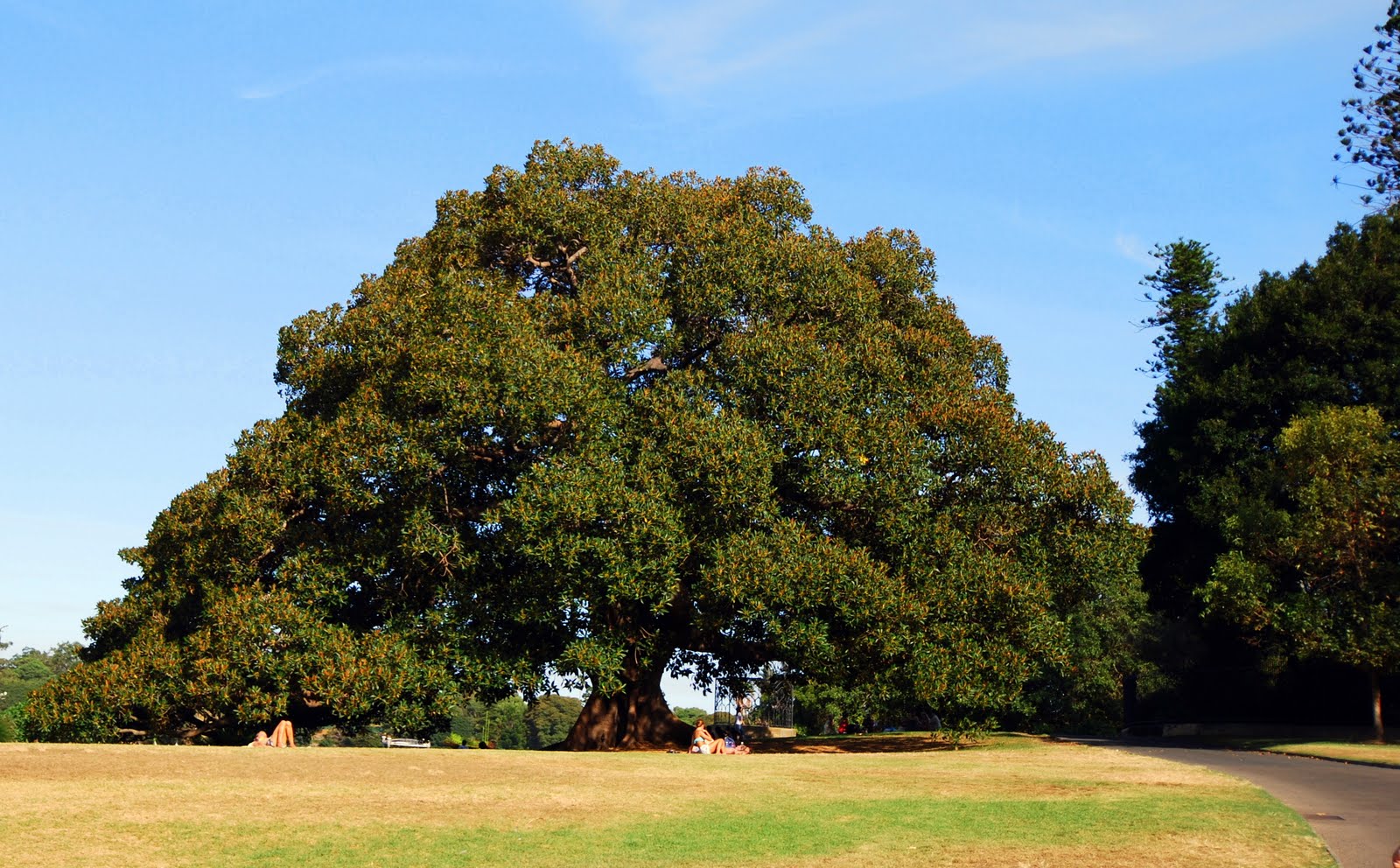
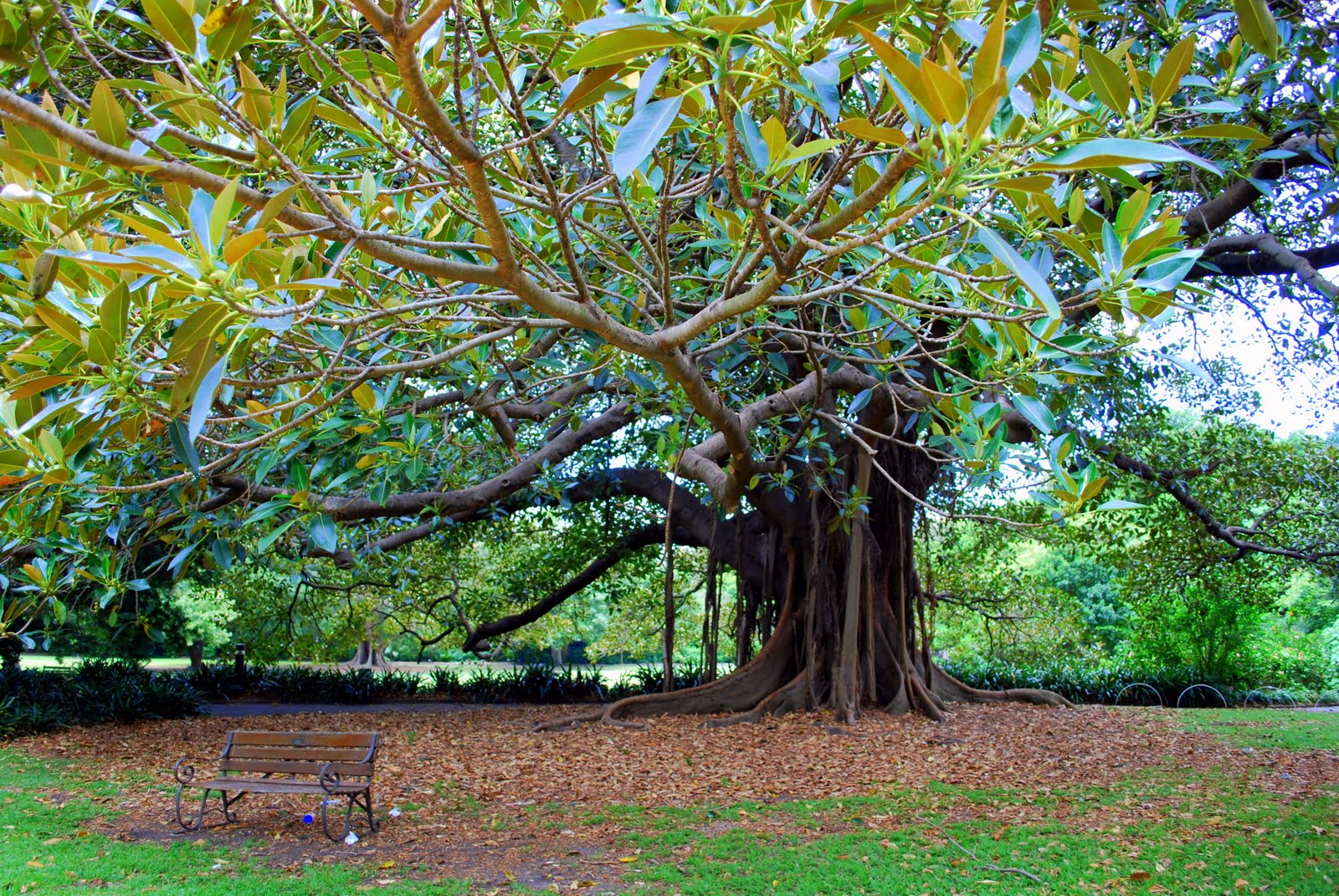
One aspect of the garden that astounded me was the abundance of large, mature, and magnificent trees!
One tree was more spectacular than the other!
The fragrance of the Eucalyptus trees floated through the air.
There were many benches throughout the gardens to sit and pause and enjoy their beauty.
One thing we were told not to miss seeing was evident in this tree! Can you what they were? (double click to enlarge the photo)
Bats!
Close up of a Grey-Headed Flying Fox Bat!
TheGrey-Headed Flying Fox Bats are completely harmless as they eat only fruit and portions of plants such as pollen and nectar. The Grey-headed Flying-fox is a native species that is endemic to Australia.
Flying-foxes are essential in maintaining many ecosystems because they are able to move pollen and seeds over long distances and across the cleared ground, thus linking patches of native vegetation. It has the longest wingspan of any bat with a maximum wingspan of about three feet (one meter). Its body length is normally between 8.5 to 10.5 inches (22 and 27 centimeters.)
I sent my husband over to the garden one evening to do a short Flip film of the bats hanging from the trees so you could hear them and see them move:
They look and sound pretty gross, don't they? I tried not to walk under the trees where they were roosting for obvious reasons.
We were enthralled by the bats and had a good time in the evening sitting on our balcony watching them fly over the hotel in search of food, as you can see in this short video:
The Royal Botanical Gardens are truly one of the gems of Sydney and an incredible place to visit!
Hello and welcome!
I'm Pat, a lifelong New Yorker who has recently moved to a suburb of Denver in the beautiful state of Colorado, so that I can live close to my children and grandchildren. I look forward to learning many new things about my new "mile high" city and I will share them on my blog.
New York City will always be my second home, and I will also continue to share many posts about it.
My blog's name in Italian means a "Thousand Favorite Flowers." I chose this unusual blog name because researching and writing for my blog, and taking photogrpahs for it, is like another "memory flower" that I am collecting in my bouquet of life.
I hope you will enjoy your visit to my blog and that you will leave a comment so that I know you've been here.
Thanks!
Copyright:2007 through 2026, MilleFioriFavoriti:LLC all rights reserved
Unless indicated, all photos and writings are my personal property and can not be used or reproduced without my written permission. My e-mail address is available in my profile. Thank you very much!
My Blog Followers -- Thank you for your interest and friendship!
We write to taste life twice. Once in the moment, And once in retrospection. ~ Anais Nin
Why I blog:
"I write to discover what I know" ~ Flannery O'Connor
Pay Attention, Be astonished, Tell about it. - Mary Oliver
Rocky Mountain National Park
“Climb the mountains and get their good tidings. Nature's peace will flow into you as sunshine flows into trees. The winds will blow their own freshness into you, and the storms their energy, while cares will drop away from you like the leaves of Autumn.” ― John Muir, Our National Parks
Colorado
You can fall in love at first sight with a place as with a person ~ Alec Waugh
Mt Evans
I was uplifted above a world of love, hate, and storms of passion, for I was calm amidst the eternal silences, bathing in the living blue. For peace rested that one bright day on the mountaintop. ~ Isabella Bird "A Lady's Life in the Rocky Mountains"
RMNP
"Life is your art. An open, aware heart is your camera. A oneness with your world is your film." ~Ansel Adams
Rocky Mountain National Park
“And above all, watch with glittering eyes the whole world around you because the greatest secrets are always hidden in the most unlikely places. Those who don't believe in magic will never find it.” ~Roald Dahl
Rocky Mountain National Park
And our first pure mountain day, warm, calm, cloudless, - how immeasurable it seems, how serenely wild! I can scarcely remember its beginning. Along the river, over the hills, in the ground, in the sky, spring work is going on with joyful enthusiasm, new life, new beauty, unfolding, unrolling in glorious exuberant extravagance, - new birds in their nests, new winged creatures in the air, and new leaves, new flowers, spreading, shining, rejoicing everywhere. - John Muir
Colorado Beauty
“Still round the corner there may wait a new road or a secret gate, and though I oft have passed them by, a day will come at last when I shall take the hidden paths that run West of the Moon, East of the Sun.” - J.R.R. Tolkien,
Bethesda Fountain in Central Park, NY
Look at everything as though you were seeing it either for the first or last time. ~Betty Smith, A Tree Grows in Brooklyn
My hometown: Brooklyn, NY
"Every day I walk out into the world to be dazzled, then to be reflective." ~ Mary Oliver
My buddy Bo
1998 - 2013 I still miss those I loved who are no longer with me, but I find I am grateful for having loved them. The gratitude has finally conquered the loss.
Grand Dog Lucy
“In times of joy, all of us wished we possessed a tail we could wag.” ― W.H. Auden
Pepper
1991 - 2008 Until one has loved an animal, a part of one's soul remains unawakened. ~Anatole France





 Posts
Posts