Showing posts with label Canon City. Show all posts

Sunday, November 7, 2021

The Royal Gorge Route Railroad in Canon City, Colorado


The last week in October a group of friends and my husband and I decided to take a trip on the Royal Gorge Route Railroad. Most of us drove down to Colorado Springs the day before so we could get an early start the next day to drive further south toward Canon City, where the train is located.  It was the second time my husband and I rode the train--click here--to read a prior post I wrote then in 2017. That trip we took in summer, so this time we were looking forward to seeing autumn colors on our drive and along the train route.


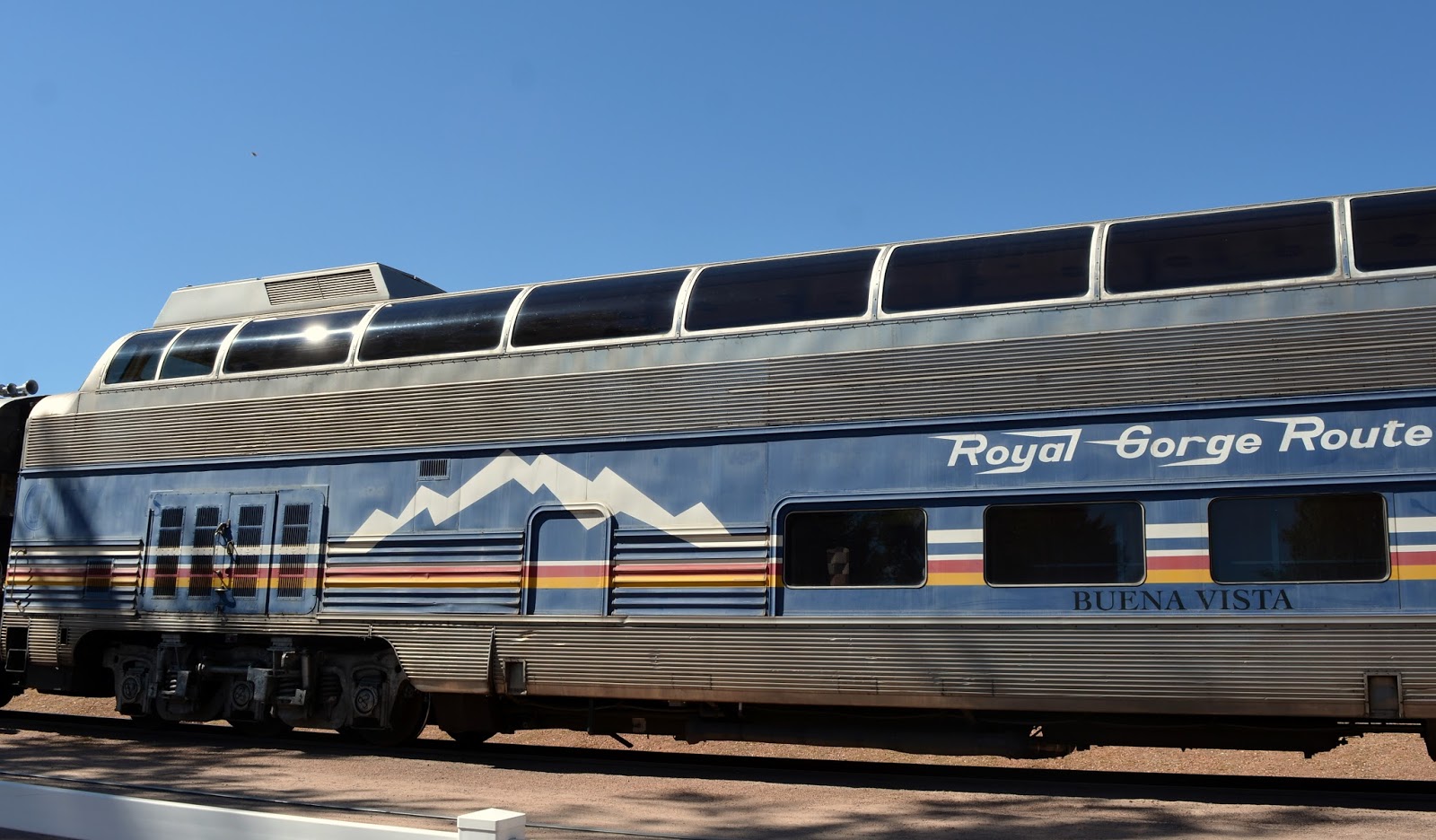
All aboard!  We had seats in the "vista dome" and some of us ordered food and drinks to enjoy while the train was loading.

The Royal Gorge Route Railroad offers daily departures with several classes of service and dining to choose from, and first-class lunch, dinner, and murder mystery train rides. The interesting history of the original Royal Gorge Route Railroad, which began back in 1879, can be read on their website at this link.


The Royal Gorge is a 1,200-foot (365.76 m) high canyon on the Arkansas River, forming a 10-mile-long gorge.  The river was running lower than when we saw it in the summer of 2017, and there were no rafters on it this time of the year, although the weather was very pleasant.  The autumn sunlight gave a beautiful glow and deep shadows to portions of the gorge walls.


We saw workers setting up the life-size "North Pole" winter wonderland village on the north side of the canyon in preparation for the special "Santa Express Trains" that runs during the holiday season.


As we ride west through the gorge, we see the Royal Gorge Bridge suspended 1,053 feet above the river! The bridge was constructed in 1929 and only took 7 months to build at $350,000.  It was the highest suspension bridge in the world for 70 years. Now it is the highest in North America.


We were outside at this time on the observation deck car to enjoy the open-air experience and 360-degree views. Notice how close to the canyon walls the train travels at times.


This is the deepest point of the gorge and it is a thrilling sight to see the bridge above! On our last trip, my husband and I walked across the bridge--click here--to read that post. It was a thrilling experience! 


Do you see the aerial gondolas high above?   They glide 2,200 feet across the Gorge, 1,200 feet high above the Arkansas River, and bring visitors from one side of the gorge to the other side. We rode on the gondolas when we visited the Royal Gorge Bridge and Park in 2017.


A short video above that I took of the train passing near the Royal Gorge Bridge which is 1,053 feet above! You can also watch this on YouTube at this link I also have this and another video on my Mille Fiori Favoriti Facebook page at this link.  The train ride is fully narrated live the entire ride, with interesting facts and places of interest pointed out along the way.


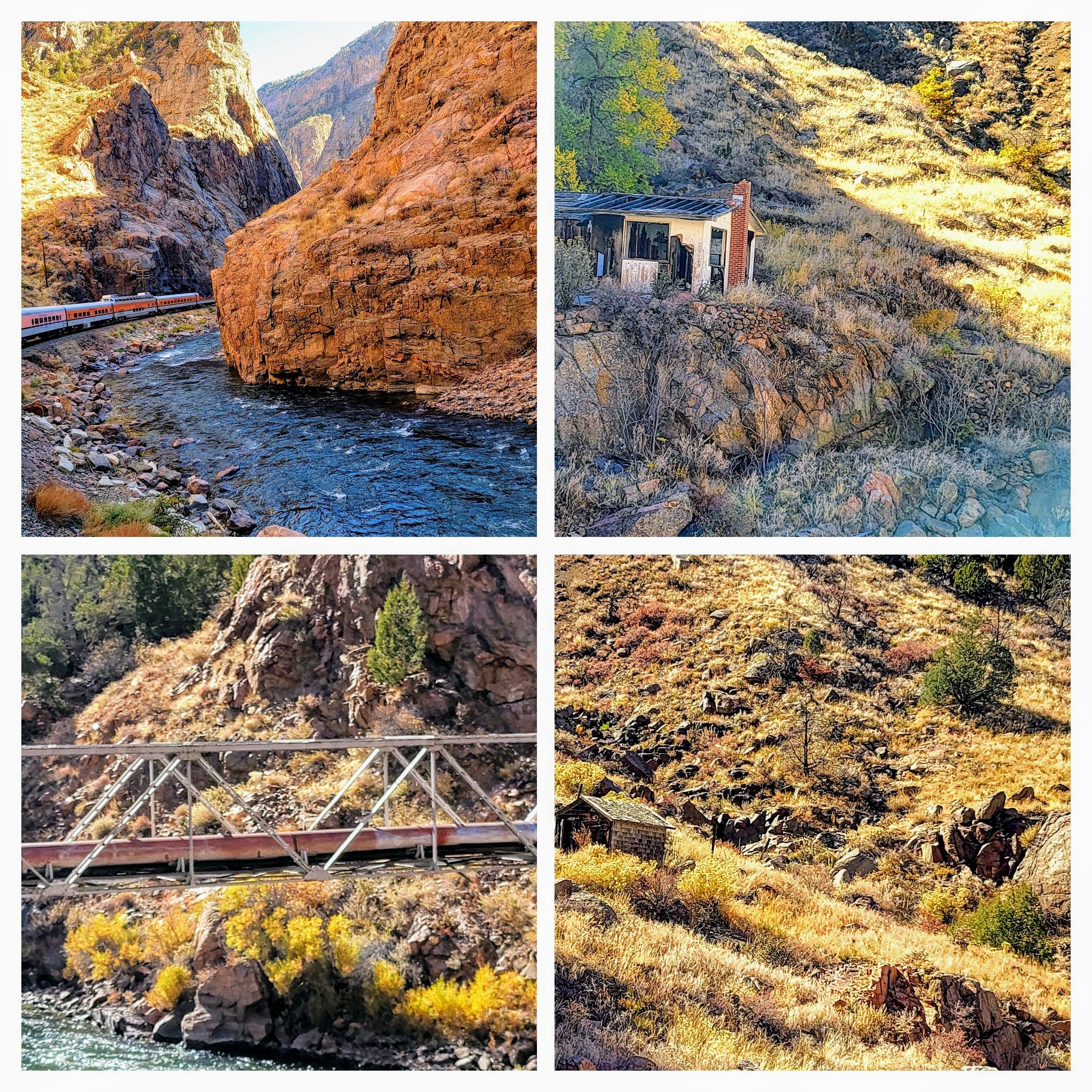
A collage of the colorful rock walls of the Royal Gorge. The gorge's sheer walls are made of Precambrian gneiss and granite. The Arkansas River has cut into this hard rock for the past three million years, making it more steep and narrow than other canyons of the American West. 


One fascinating point of interest is this hanging bridge structure built at the narrowest portion of the gorge, literally located above the Arkansas River.  It was an engineering marvel when it was built in 1878.  When the Denver and Rio Grande Railroad was building this rail line they found one portion of the gorge narrowed to 30 feet wide. The railroad would have to travel over the river at this point and a 175 ft plate girder suspended on one side by "A" frame girders spanning the river and anchored to the rock walls.



In the early years of the rail passenger service, trains would stop to allow tourists to get off and marvel at the “world-famous engineering feat.” Passengers posed for their picture standing around the train while the engine was on the bridge. President Theodore Roosevelt made history when he stopped and picnicked at the Hanging Bridge on May 8, 1905. Archives say the president was on an excursion train to Canon City, Florence, and the Royal Gorge a day after a speaking engagement in Pueblo.  The Royal Gorge Route Railroad train narrator had a photo of this event on his phone and I took the photo above of it. President Roosevelt is in the middle of his entourage and is wearing a top hat.


Another interesting sight along the way was the now unused water pipes that once brought water into Canon City. In the early 1900s, Canon City installed a dam and pipeline in the Royal Gorge for the town’s water supply. Prisoners from a territorial prison were used to help build the pipeline, which was mostly constructed of redwood. The system was abandoned in 1973, but much of it still exists today.  An abandoned caretaker's house from that era could also be seen.


Some of the beautiful autumn foliage we saw as the train traveled back east at the end of its two-hour journey.


There are several giant old cottonwood trees located along the railroad boarding and exit site.  I am always fascinated by these beautiful trees that are also known by their nickname of "Pioneers of the Prairie." You can read a blog post I wrote about these western trees on this link.


I asked my husband to take another photo of me standing next to one of the trees as I did in 2017which can also be seen at the end of that blog post. It's now a new tradition established for the next time we visit the Royal Gorge Route Railroad!

You can also find me on

Sunday, April 2, 2017

The Royal Gorge Bridge in Colorado


Would you take a walk across the highest suspension bridge in the United States, that crosses a gorge 955 feet high above the Arkansas River in Colorado? A bridge that is only 18 feet wide, composed of wooden planks, and spans 1,270 feet from one edge of the gorge to the other edge?   


(All photos will enlarge for easier viewing if clicked on)


If so, then welcome to the Royal Gorge Bridge and Park located in Canon City, Colorado!  The bridge was built in 1929, by Texan Lon P Piper, as a tourist attraction to give visitors a view of the Royal Gorge.


In my last blog post--click here to read--I showed you our visit to nearby Canon City and our ride on the Royal Gorge Railroad that travels below in the gorge alongside the Arkansas River.  After the train ride, we drove to the Royal Gorge Bridge and Park to visit this attraction. There is so much we want to see and do in our new state, and visiting the railroad and the bridge was high on our list, so we were happy to have a beautiful day to visit both attractions.

 Please click on to enlarge

If you visited this area before June 2013, you might notice from my photos that many of the attractions that are part of the park look different. That is because there was a devastating wildfire in this area on June 11th, 2013, that destroyed 48 of the park's 52 buildings, plus the aerial tram and the funicular. Fortunately, there was no loss of life and the bridge sustained only slight damage to its wooden deck. The park was rebuilt for a cost of 30 million dollars and had a grand re-opening in May 2015. It now has a brand new Visitor's Center, Aerial Gondolas, Water Clock, and a new Cloudscraper Zip Line, which crosses the gorge on the east side of the bridge, the Royal Rush Skycoaster, a new Tommy Knocker Children's Playground, and a new Plaza Theater and Historical Expo


After we paid our general admission fee --some attractions have an extra fee--at the Royal Gorge Bridge and Park's Visitor Center, we took the included gondola ride, that traverses 2,200 feet across the gorge. We planned to walk back to the visitors' center by walking across the bridge.  The views looking down the gorge from the aerial gondola were astounding!


If you take the gondola ride to the south side of the gorge, you will find the walk to the bridge an easy downhill trek with some beautiful views of the Sangre de Cristo Mountain Range in the distance.  You also get more views of the deep 1,200-foot gorge.


The bridge and the incline railway were listed in the National Register of Historic Places in 1983 and underwent extensive renovations between 1980-84 where new cable anchors and suspension rods were installed to stabilize it.


Usually, there are no cars allowed to cross the bridge, except for an occasional car club that prearranges a scheduled ride.


My husband and I began our walk across the bridge feeling very safe.  It was somewhat windy, but the bridge felt steady and secure.


 Please click on to enlarge

There were interesting informational placards along the walls of the bridge to read--click on to enlarge.


We were visiting late in the afternoon, so there were not many people on the bridge, and we were able to take our time to look at all the sights.


We noticed there were small gaps between the wooden planks that line the bridge, and if you looked carefully you could see all the way down to the river below!


We could see the 100 or so new plank boards that had to be replaced after the wildfire. It was miraculous that the bridge survived when 90% of the surroundings burned!


The Royal Gorge Bridge is lined with all the 50 state flags of the United States, and my husband and I took photos of both New York, our original hometown state, and Colorado, our new one!


Our favorite thing to do on the bridge, of course, was looking down at the amazing views!   Click on the photos to see them enlarged to see the Arkansas River which begins near Leadville, Colorado, and flows eastward all the way to the state of Arkansas and into the Mississippi River.


The river is estimated to cut the gorge lower one foot every 2,500 years.


If you click on this photo collage to enlarge it, you can see an engineering feat for the Royal Gorge Railroad below, called the hanging bridge.  In 1878 when the Denver and Rio Grande Railroad was building this line they found one portion of the gorge narrows to 30 feet width. The railroad would have to travel over the river at this point and a 175 ft plate girder suspended on one side by "A" frame girders spanning the river and anchored to the rock walls.


There were also other signs to see along the bridge walls. Bungee jumping is no longer allowed


Towards the end of our walk, on the north side of the bridge, we could see the new cables that now anchor the bridge, plus wind cables underneath. 


Visitors who traveled across the bridge before this work was completed in 1983 said the bridge would sway in high winds.  Now it feels very secure.


A placard explaining how the Gorge earned its "royal" name.


The ruins of the funicular--the incline railroad-- that once brought visitors to a platform at the bottom of the gorge.  It was damaged in the 2013 fire and as of now, there are no plans to rebuild it.


We really enjoyed our visit to the Royal Gorge Bridge and Park and all the sights we saw there. Now we are part of the many millions that can say they walked across the high suspension bridge in the United States!


Before I finish this post, I have to show my youngest grandson's recent 6th birthday party! He wanted to have a "cooking party" and so a young chef came to his house to teach my grandson and his friends how to make ricotta pancakes and a fruit salad, and also how to decorate their cupcakes. The boys really enjoyed eating their creations, and we had one very happy birthday boy!

You can also find me on


Bookmark and Share

Sunday, March 26, 2017

Royal Gorge Route Railroad--Canon City, Colorado


Canon City (pronounced Canyon City) is located two miles south of Denver, and 45 minutes west of Colorado Springs. It is known as the "Corrections Capital of the World," as it is the location of nine state and four federal prisons and penitentiaries, which employ thousands of residents of the area. Canon's City was laid out in 1858 during the Pikes Peak Gold Rush, and the first building was built in 1860.  The American Civil War interrupted the development of the town for a few years, but afterward, both Confederate and Union soldiers began settling here due to the Homestead Act of 1862.  


Please click to enlarge

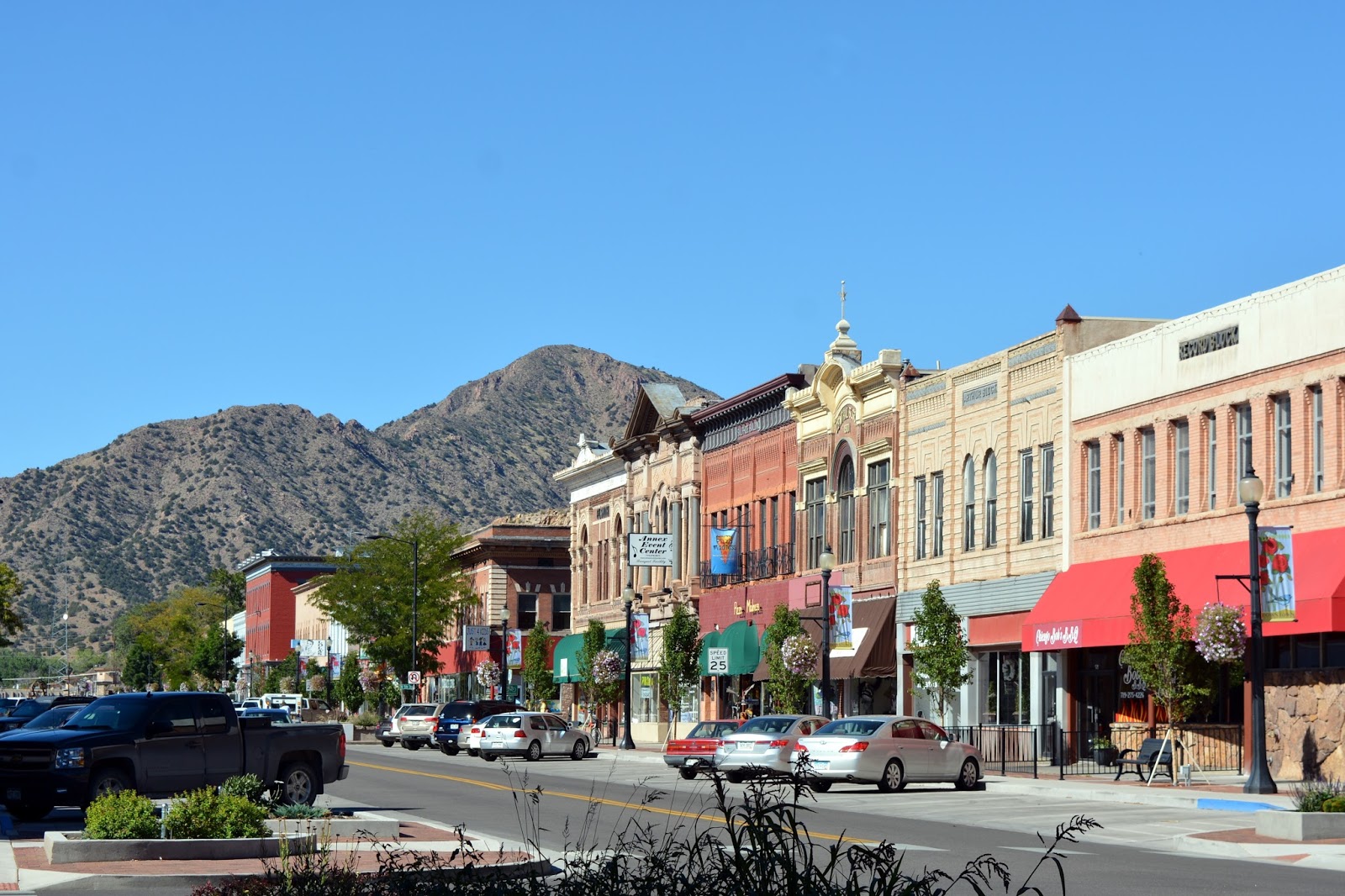
By the 1870s, Canon City became well know regional trade center. Today, Main Street is full of interesting shops, restaurants, and museums.


The Canon City Downtown Historic District was placed on the National Register of Historic Places in 1983.  It consists of 80 historic buildings, built mainly between 1870 and 1920.


I loved looking at the architecture of the well-maintained brick buildings and imagining what the town looked like during its early days.

Please click on this photo to enlarge

A placard along Main Street tells of some of the histories of the town and region.


Please click on this photo to enlarge

Another placard along Main Street describes how Canon City is also known as the "Banana Belt of Colorado" due to its geography. It has a mild climate compared to other regions in Colorado. This enabled early settlers to farm, have orchards, and raise livestock.


I liked the architecture of the 1899 First United Methodist Church, with its red brick walls and copper tower pinnaclesYou can read the church's history on its website at this link. The church was not open on my visit, but the church's website has many photos of the inside and of its stained glass windows, as well as its Kimball pipe organ on the church website under its "history" tab.


One of my favorite sights was this charming home, that was built in 1888, in the middle of Canon City's Main Street.  I believe there is a business located in it now, but I liked how they kept its cozy home appearance. 

 All in all, I loved our visit to Canon City and would like to return one day for a longer visit to spend more time in the area.


The main reason for our visit to Canon City, however, was to take a ride on the Royal Gorge Route Railroad!  The railroad transits the Royal Gorge on a two-hour scenic and historic train ride, along the most famed portion of the former Denver and Rio Grande Western Railroad. The train departs the Santa Fe Depot in Canon City daily.

The Royal Gorge is considered the "Grand Canyon of the Arkansas River.  Approximately six miles long (9.7 km), and one of the deepest canyons in Colorado, the Royal Gorge has a depth of 1,250 feet (380 m).  It is also very narrow at points, measuring from 50 feet (15 m) wide at its base, to 300 feet (91 m) at its top. The Arkansas River carves through the granite formations of Fremont Peak and YMCA Mountain, which rise above the north and south trims, to form the canyon


My husband and I purchased tickets for a glass-domed Vista car. The Royal Gorge Route Railroad offers daily departures with several classes of service and dining to choose from, and first-class lunch, dinner, and murder mystery train rides.  The interesting history of the original Royal Gorge Route Railroad, which began back in 1879, can be read on their website at this link.


We had lunch while we traveled west, and enjoyed the views from the domed windows.


We planned on going outside to the observation deck car after lunch to enjoy the open-air experience and 360-degree views. Notice how close to the canyon walls the train travels at times!


The train ride is fully narrated.  We were told that the wires we saw across the canyon are there to signal the train engineer if there were any rock falls from the top of the canyon. If so, the train would stop so they could be removed from the tracks.


As we dined we enjoyed looking at the views out the doomed windows at the passing scenery.


Our first glimpses of the Royal Gorge Bridge, which traverses the canyon from above was exciting! We knew we would be driving to the Royal Gorge Bridge and walking across the bridge later in the day.


The bridge is 955 feet above the Arkansas River that runs beside the railroad--the highest suspension bridge in the United States, and one of the highest in the world!  Built-in 1929, the main span of the bridge between the towers is 880 feet (268 m), and the total length is 1,260 feet (384 m). The width is 18 feet, and the towers are 150 feet (46 m) high. The steel base structure is covered with 1292 wooden planks.


During our ride west. we were also excited to see the whitewater river rafters traveling along the  Arkansas River alongside the train! 


We continued traveling west until we were out of the canyon to its terminus in Parkdale, Colorado. The train then stopped for a short while...


...and then the train reversed to travel back east towards Canon City.


We went to the open-air car to stand for the trip back so we could enjoy the views.


As the canyon walls grew higher we saw the Royal Gorge Bridge again above us in the distance.


You can get an idea of how narrow the canyon becomes at the bridge point. 


If you click on the photo above you can see people looking down at us from the bridge! The train stops for a few minutes at this point on the return trip to allow people to take photos.


My husband and I really enjoyed being outside on the train to see all the views and to take photos of the bridge above.


I was able to take this photo above of what was once an attraction of the Royal Gorge Bridge Park. It was a funicular, that was built in 1931, and brought people down from the Royal Gorge Bridge Park to the bottom of the gorge, where they could stand on the platform to watch the train pass by. The funicular is sadly no longer functioning, due to a fire that occurred in 2013, that damaged the tracks.


I was able to capture a photo of both the bridge above and the train below, traveling through the Royal Gorge Canyon.


We saw the whitewater rafters again at the end of their trip.


I was also excited to get a photo of the "North Pole" of the Royal Gorge.  Every Christmas season the Royal Gorge Route Railroad has special "Santa Express Trains" that are very popular events. The area is decorated with lights and a Santa Workshop. As the children on the train eat cookies and sip hot chocolate, "elves" read stories to them. As the train passes the North Pole they can see Santa waving to them. Santa then comes on board to greet all the children and give each child a bell from his reindeer's harness. You can watch a video about the Santa Express Train at this link.


We passed remains of old water pipes that once brought water from the river, but are no longer in use.


We were approaching Canon City again, and the end of a wonderful train ride.


Before we left the train station I asked my husband to take this photo of me standing under a nearby very old cottonwood tree. Look how wide it is!  It must be hundreds of years old.

We were now on our way to visit the Royal Gorge Bridge and Park--see my next blog post to see more!


You can also find me on


Bookmark and Share