

Wild bee populations in North America have collapsed by up to 96% in two decades, according to the Xerces Society, an international nonprofit organization that protects the natural world through the conservation of invertebrates and their habitats. Unfortunately, in many places, the essential service of pollination is at risk from habitat loss, pesticide use, and introduced diseases.

My husband and I were invited to attend a Denver Metro South Rotary Club meeting held in the conservatory of the Colorado Governor's Residence at Boettcher Mansion in Denver, Colorado, because one of our friends was receiving a citizenship award from the club that day.
One of the topics discussed that day was the upcoming "Operation Pollination," an Epic Day of Service at Denver Audubon Kingery Nature Center, held this past weekend, where volunteers planted native plants, assisted with garden maintenance, and helped with invasive plant removal.
You can watch a YouTube video of this event at this link.


Butterflies I photographed at past visits to the Butterfly Pavilion.
The Butterfly Pavilion is the first stand-alone, Association of Zoos and Aquariums-accredited non-profit invertebrate zoo in the world and a leader in invertebrate knowledge, inspiration, and connection.
We have visited it many times with our grandchildren--you can see a couple of past blog posts about it at this link.

Yarger told us that pollinators are not just bees--they are anything that helps move pollen from one part of a flower to another. This movement fertilizes a plant, helping make seeds, fruits, and new plants. Some plants can pollinate themselves, and others use wind or water to move their pollen. But many plants need help from insects and animals like bees, butterflies, birds, bats, and even some small mammals.

We learned there are at least five ways to save pollinators by focusing on habitat:
1. Replace one patch of lawn with native plants. Residential yards have enormous potential as pollinator habitat, and converting even a portion of turf grass to native pollinator plantings makes a measurable difference.
2. Plant for the full season, not just summer. Use plants that bloom from early spring into late fall, and plant in clumps rather than single specimens so pollinators can find and use them efficiently. In Colorado, goldenrod and native asters carry pollinators through fall when almost nothing else is blooming, including migrating monarchs.
3. Stop fall cleanup. Seriously. Pollinators overwinter in hollow stems, attached to plants, and in leaf litter. Cutting down perennial gardens in the fall destroys these overwintering sites. Leave stems standing until early April. What looks messy to you is a nursery to them.
4. Leave bare dirt. This one surprises people. More than 75% of native bees are ground-nesters and require patches of unmulched, bare soil. A small, sunny, unplanted corner of your yard, left intentionally bare, is more valuable to native bees than most garden features.
5. Cut pesticides, especially neonicotinoids. Choose plants that have not been treated with pesticides, insecticides, or neonicotinoids. If you must use a pesticide, use the least-toxic option and apply it at night when bees and other pollinators are not active. Many nursery plants, including ones marketed as "bee-friendly," are pre-treated. Ask before you buy.
You can see charts for beneficial pollinator plants to grow in different areas in the US on this link on Xerces.

One of the speakers at the Operation Pollination event was a woman who lives in my community who has totally replaced her typical suburban "all grass" landscape--see top photo in the collage above--with an amazing flower and vegetable garden--seen in the bottom photo! She was also instrumental in forming a "Makers Market" at our neighborhood community center, where locally grown vegetables and flowers, as well as handcrafted products, could be sold on selected weekends. It was truly inspirational to see what one person could do!

Finally, this was our friend Stephanie, along with her son, after she received her good citizenship award for her volunteer work in our community. We were happy to be there to congratulate her!

As a bonus, after the Denver Metro South Rotary Club event, we were all invited to take a tour of the Colorado Governor's Residence at Boettcher Mansion.
I took many photos there -- please come back next week to see that post.
.jpg)
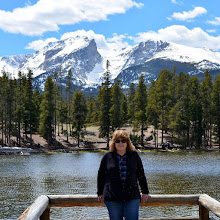
As you can see in the photo above, the snow we received a few weeks ago is still evident on the high Rocky Mountains. We may get some more snowfall tomorrow when another cold front arrives after we had a very warm week. It is never dull weather-wise in Colorado!
Blogs I link with:
Nature Notes, Home Matters Linky Party, Happiness is Homemade, Monday Morning Blog Club, Senior Salon Pit Stop, Talk About It Tuesday, The Happy Now Tuesday, Happy Tuesday, Wordless Wednesday 2, Wordless Wednesday on Comedy Plus, Wonderful Wednesday, Thankful Thursday, Weekend Traffic Jam Report, Thursday Favorite Things, Skywatch Friday, Fantastic Friday, Farmhouse Friday, Crazy Little Lovebirds Friday Link Up, Dare to Share, Saturday Sparks, Saturday Critters,


 Posts
Posts




34 comments:
It is so sad that the number of bees are dropping and it is so important we look after them. What a wonderful event and photos!
This was interesting to read and such an important topic. I hand pollinate as much as I can in the garden to give our hard working bees a break (and also plant A LOT of flowers to tempt them our way :-)
Amalia
xo
Hello Pat,
Great post and information on the pollinators.
They must be protected and saved, we need pollinators.
The photos are beautiful. I love the flowers and butterflies.
Take care, enjoy your day and the new week ahead.
I, too, am concerned about our pollinators. Many people do not realize that chemicals are everywhere and can kill our helpful insect friends. Taking care to not use pesticides and buy plants from garden clubs and gardeners who practice green gardening is vital. Many plants in large box stores are already pre-treated with pesticides.
It's quite amazing the impact these pollinators have on our daily lives! Thanks for sharing these important reminders with us all!
Well those tips make me feel better about our messy planters and wild areas. That mansion is very cool looking. I'm sure it was a fun visit.
What a staggering statistic. We don't see many bees but we have more than our fair share of wasps living so close to the water. It's a constant battle between not wanting to kill them off but not wanting to get stung while sitting on our deck/patio. I'd much rather plant things that attract butterflies, hummingbirds, and even honey bees into our yard.
Wonderful event. I am trying to plant a pollinator friendly garden. I have been keeping the dandelions a bit longer too in our lawn for the bees.
-Soma
We all need to help the bees....good suggestions...Michelle
Some lovely photographs and collages.
We need more pollinators!
Everything we can do to help them should be encouraged.
Congratulations to your friend Stephanie on her award.
All the best Jan
...our diets would be mighty boring without pollinators.
It is heartbreaking to hear how much pollinator numbers have dropped. 🐝🌸
Protecting them is so important for our future.
Your photos of the flowers and butterflies are absolutely beautiful and uplifting!
We have tons of wonderful plants for the bees and the butterflies to enjoy. We made sure we did when the landscaper started working. It makes us smile to see them working. A most wonderful post.
Thank you for joining the Happy Tuesday Blog Hop.
Have a fabulous Happy Tuesday, Pat. ♥
That 96% collapse statistic is absolutely heartbreaking, but it is so empowering to learn these concrete steps we can take to help, like leaving bare dirt and skipping the fall cleanup. Your friend Stephanie's total yard transformation is incredibly inspiring and proves that we really can make a massive difference right in our own neighborhoods! Huge congratulations to her on that well-deserved citizenship award, too.
Beautiful shots! So glad there are people who care about our world, it is so very precious. Doing the good work. Thank you for sharing!
A wonderful event for more reasons than one! Your friend's award was special but oh, hearing about the pollinators -- that's something you can hold onto and live with. day to day, for many moons to come. Your photos are terrific and I liked the recommendatons. What a gorgeous building, too!
Looks like a great place to see things and learn stuff about pollinators. Non standard yards incorporating native plants are becoming more and more common.
It's sad to read about the population of the bees. I agree, we should helpdesk the nature. And yes ! Each of us can do a small Part. I made artwork many year's ago. You can see in my Header...
...thank you very much, dear Blogfriend, for sharing at MosaicMonday
Greetings by Heidrun ❤️
Bees bring us life.
Thank you for joining the Wordless Wednesday Blog Hop.
Have a fabulous Wordless Wednesday. ♥
Some excellent recommendations. I cringe every time I see the exterminator driving through my neighborhood and spraying everyone's property.
Pat, very nice! One of my features for WTJR, thanks so much for sharing with us.
We all have a role to play to ensure the bee population is safe and growing.
Worth a Thousand Words
Good scenery.
This was so informative. Thank you for putting this together for us. Your photos are gorgeous.
Visiting today from SSPS
This is an excellent post. The bee population is vital to our existence. I continue to keep a large hive here on our farm. They are very interesting creatures. Thank you for linking up!
It is a worry that the bee population is declining. It is so good that people are making an effort to slow the problem. Lovely photo of the latest snowfall.
Hello pat,
I enjoyed this post, you included good information to help save the pollinators. Your photos of the flowers, bees and butterflies are so pretty and colorful. Thank you for linking up and sharing your post. Take care, have a great day and a happy weekend!
I'm with you on the wasps, Joanne. Horrid things!
This was so interesting. I love having bees visit our garden, and do all I can to keep them happy.
Congrats to Stephanie too! #MMBC
It is so important to encourage the bees and pollinators to our gardens.
How much we depend on pollinators. The bee photos and flowers are beautiful, and I enjoyed learning more about Operation Pollination!
Down the road from my home is a farming supply company (Fertilizer, Agricultural Herbicides, Agronomy, Precision Farming). I know when they schedule spraying herbicides and fertilizer, they will call known beekeeping or apiculture owners. It allows the owners to keep the bees in the hives until the application is over. Also it depends on how the wind is blowing. However, owners must call the farm supply and get on the notification list. I did a real quick Google search and this is what popped up. "The primary public, nationwide lists are the voluntary mapping registries operated by the non-profit organization FieldWatch. These tools allow beekeepers, flower growers, and specialty crop producers to map the exact locations of their hives and sensitive crops so commercial applicators can check them before spraying"
Pat, wonderful post. I learned so much. Pollinators are so important. I have seen quite a few in my flower garden, and I am loving it. They work so hard and are very appreciated.
Hi Pat, great tour picks! I forgot Gov. Polis lives in Boulder!
THe bees! Great info! Enjoy the sunshine!
Post a Comment