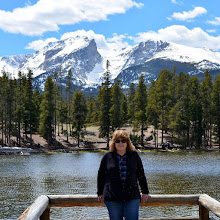
If you read my post about the beginning of our drive to Independence Pass--click here to read that post-- you will remember that when we left Leadville, the highest incorporated town in the United States, we took a wrong turn, and instead of driving on CO 24 east, we went west.


It turned out to be a fortuitous mistake, as we soon discovered we were driving on the Top of the Rockies Scenic and Historic Byway, and we were seeing beautiful vistas all over 9,000 feet high.


The next stop we made was in the very scenic Pando Valley.

Please click on it to enlarge the photo
Here I found some very weathered informational placards that told the story of the Pando Valley and the interesting story about the 10th Mountain Division from World War II and Camp Hale which was located here.

When the War Department decided in 1942 to establish a unit of mountain troops trained in skiing and winter warfare, they chose Pando Valley, a stop along the Denver and Rio Grande Railroad as the ideal location. This area had consistent and heavy snowfall throughout the winter, due to its elevation at 9,200 feet (2800 m), as well as the topography was conducive to ski training. There was also accessibility due to the railroad and Highway 24, which enabled building materials to be brought in easily and quickly. There was also a water supply from the Eagle River and Homestake Creek and regional coal supplies to heat the camp.

Camp Hale was constructed with around 1,000 buildings and housed approximately 16,000 soldiers and 3,900 animals. Approximately 14,000 military personnel stationed there were members of the Tenth Mountain Division. After two years of rigorous training, the Tenth Mountain Division was ordered to Italy in 1945 to prepare for an advance of the U.S. Army. They breached the supposedly impregnable Gothic Line in the Apennines and secured the Po River Valley to play a vital role in the liberation of northern Italy. By the time the Germans surrendered in May 1945, 992 ski troopers had lost their lives and 4,000 were wounded. This was the highest casualty rate of any U.S. division in the Mediterranean.

In 1965, Camp Hale was dismantled and the land was deeded to the US Forest Service. Except for a few foundations, signs, and some concrete ruins, there is not much left of the camp except for memories. Yet, the Tenth Mountain Division had a large impact on the state of Colorado, because after the war many of the returning members returned to Colorado and were pivotal in creating the recreational ski industry in the state. They designed ski lifts, became ski coaches, racers, instructors, ski patrollers, shop owners, and ski school operators, improved ski equipment, and developed ski resorts. In fact, one of the founders of Vail Ski Resort, Pete Seibert, was a member of the Tenth Mountain Division.


Please click on this to enlarge
A close-up of the plaque on the memorial.

We continued driving west on 24 West until we reconnected with I-70 again, where we drove to Aspen and then turned back east to drive over Independence Pass as we originally planned.

Map of Highway 24 West--the Top of the Rockies Scenic and Historic Byway
We may have taken the wrong turn, and driven an unplanned byway, but seeing the Camp Hale area and learning about the Tenth Mountain Division turned out to be a real bonus! The fact that we took this trip on Memorial Day added extra poignancy to the Tenth Mountain Division's story and the ultimate sacrifice that was made by many.

Someone had left roses on one of the placards at Camp Hale, and I added a prayer as I stood there. May we never forget and honor them always.

Colorado is home to 26 scenic and historic byways, and eleven of them are designated by the U.S. Secretary of Transportation as America's Byways, which gives Colorado more national designations than any other state! To learn more about these byways go to this Colorado Department of Transportation Scenic Byway link.
You can also find me on


 Posts
Posts