On our October bus tour of Ireland and Scotland, we stopped at the pretty village of Adare. Adare is a village in County Limerick, Ireland, located south-west of the city of Limerick, It was founded in the 13th century and is designated as a heritage town by the Irish government.

Adare is widely known as a major Irish tourist attraction and is regarded as one of the prettiest and most picturesque towns in Ireland. as it retains many thatched cottages, historical buildings, and churches.

A thatched roof is a roof made from dry vegetation, such as straw, heather, rushes, water reeds, palm branches, or sedges. The vegetation is layered so that water runs away from the inner roof. The vegetation is also densely packed, trapping air and functioning as insulation. They can last as long as a regular roof. Our tour guide said they are now very expensive to replace.





The ruins seen in the upper right of the photo collage above are that of Desmond Castle, which also lies on the bank of the River Maigue. The castle was erected with an ancient ring fort around the early part of the 13th century. It became a strategic fortress during the following turbulent years. It was the property of the Earls of Kildare for nearly 300 years until the rebellion in 1536 when it was forfeited and granted to the Earls of Desmond who gave the castle its present name. The castle has tours available in the summer months.

A close-up view of the thatch that makes up the roof

Many of the houses were semi-attached to their neighbor's home.

They were so charming!

I loved looking at all their details.

Quite a few were now businesses.

I was surprised to see the Dunraven Arms Hotel as the Fourth Earl of Dunraven had a connection to Colorado. In 1872 he visited Estes Park to go hunting and enjoyed it so much that he acquired much property there. You can read more about this on this link on Rocky Mountain National Park
I learned that the present village of Adare was mostly developed in the 19th century by the Dunraven family. In the early 19th century, the Earl of Dunraven developed plans for townhouses and streets, which are present to this day. It was in these plotted lands that the famous Adare cottages were constructed.

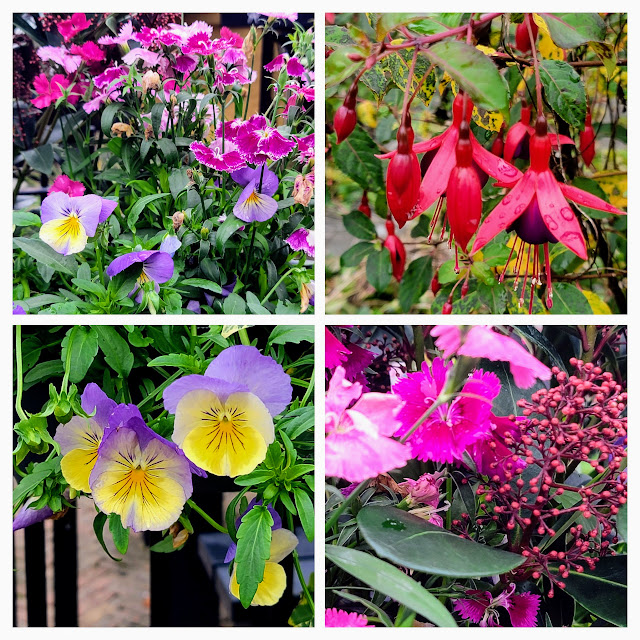
Although we were visiting in late October the house gardens were full of beautiful flowers!

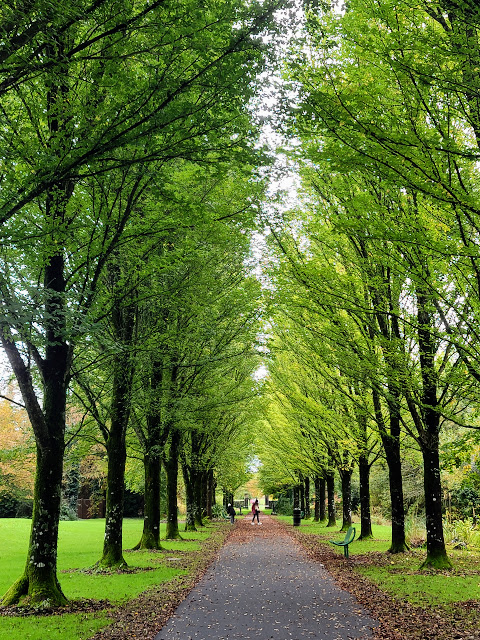
We also came upon the picturesque Adare Town Park, which still had roses blooming!

We enjoyed walking around the entire park.

We headed toward the shops in town to window shop.

Please click on the photo above to enlarge it to read the poem "O Sweet Adare," written by the poet Gerald Griffen. It is located on the side of a local pub.

Holy Trinity Abby Church in Adare has a long and fascinating history! Although there is no record of the precise date of the foundation, the only Trinitarian Abbey in Ireland, sources suggest that it was established between 1230 and 1240. Dissolved in the 1560s, the Abbey eventually became a ruin. In 1809 the 2nd Earl of Dunraven restored the ruins of the Trinitarian Abbey and gave it to the Catholic Church in Adare. No major structural changes have taken place since 1884 though several modifications and much development have happened during that time.

Please click on the photos above to see a placard that shows how the church developed over time. You can read an online booklet on the church's website that goes into great detail about the church's history and features on this link.
..

Some views of the inside of the church.

As our bus drove away towards Limerick, I snapped the photos above. In the collage above on the upper portion is the gate that leads to the magnificent Adare Manor, which is located on the banks of the River Maigue, and was the former seat of the Earl of Dunraven. The present house was built in the early 19th century, though retaining some of the walls of the 17th-century structure. It is now the Adare Manor Hotel & Golf Resort, a luxury hotel, and contains the Michelin-starred Oak Room restaurant. The Adare Manor Golf Club will be hosting the Ryder Cup in 2027.

I could have spent much more time in Adare--perhaps a future visit?
You can also find me on:
I'm linking with:
Mosaic Monday, Hello Monday, Through My Lens Monday, Hearth, and Soul Link Party, Anything Goes Monday, You Are the Star Blog Hop, Inspire Me Monday, Nature Notes, Home Matters Linky Party, Senior Salon Pit Stop, Good Random Fun, Happiness Is Homemade, Tuesdays With A Twist, Talk About It Tuesday, The Happy Now Tuesday, Wordless Wednesday on a Tuesday, Wordless Wednesday, Wordless Wednesday 2, Wednesday My Corner of the World, Wonderful Wednesday, Little Things Thursday, Thursday Favorite Things, Skywatch Friday, Fantastic Friday, Saturday Sparks, Saturday Critters, Sunday on Silverado


 Posts
Posts