Showing posts with label Arizona. Show all posts

Sunday, November 12, 2017

A Long Weekend in Arizona


I was away last week, on a short trip to the beautiful state of Arizona. My husband and I enjoyed visiting our family members that live there, and we were especially excited to meet our niece and nephew-in-law's twin babies for the first time.  (All photo collages will increase in size for easier viewing if clicked on)


We also enjoyed a day visiting the very scenic Superstition Mountains and the Goldfield Ghost Town, which is a replica of an 1890's gold mining town.


We also attended a beautiful moonlit, outdoor wedding and reception. Everything was so perfect! We were happy to share this happy occasion, and we wish the new couple much love and happiness.


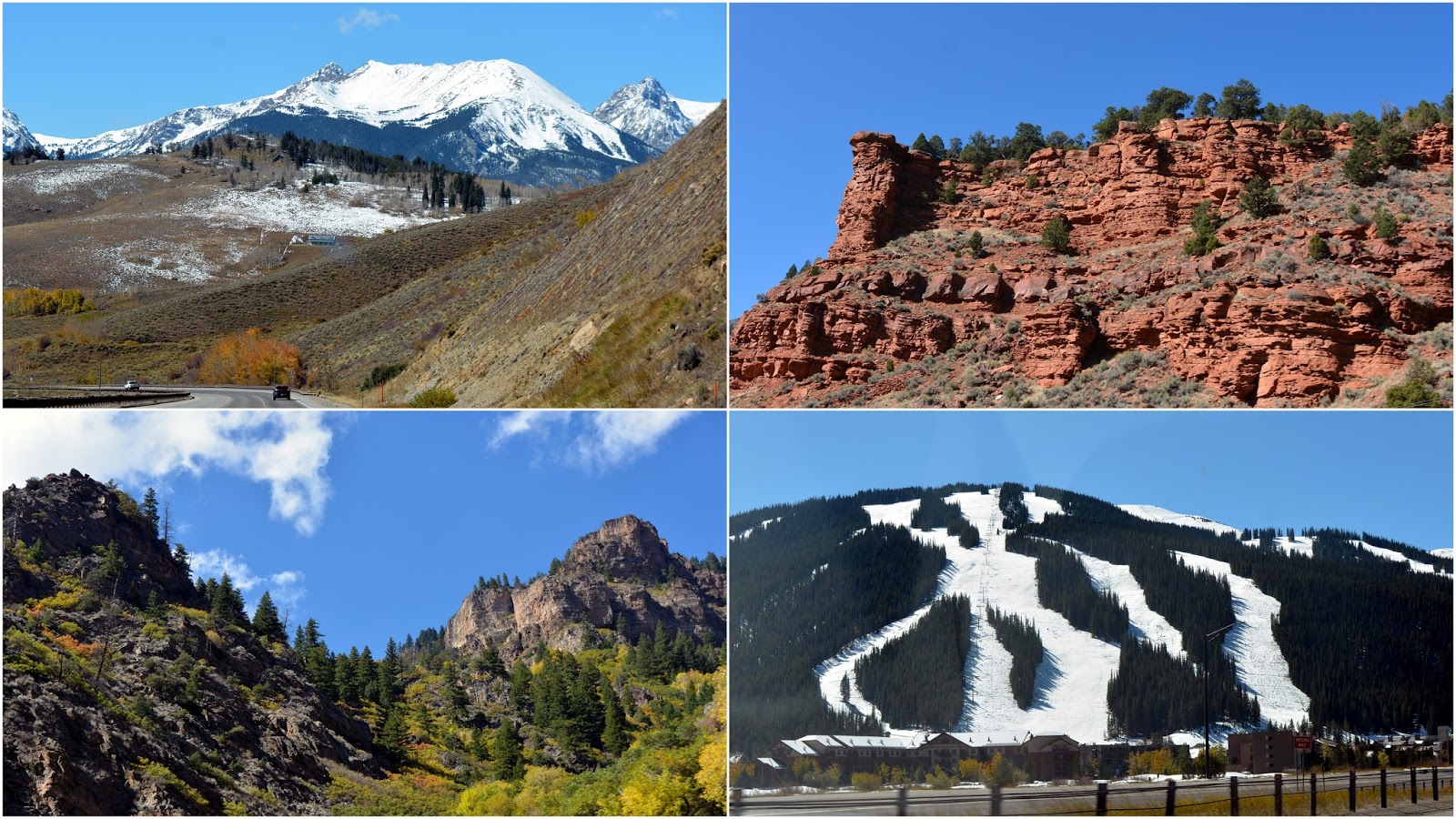
We are back in Colorado, where autumn colors have faded and the mountains await their mantles of heavy snow. Ski resorts have opened for the season with the aid of man-made snow, but on the Front Range, the weather has remained mild during the day and frosty at night.  

I've already begun shopping and preparing for the Thanksgiving holiday--how about you?  I host every year and make all the usual favorites.  Busy times are ahead--the best times of the year!


I'm linking this post to the following blog events:

Thank you blog hosts!

Bookmark and Share

Sunday, April 3, 2016

Petrified Forest National Park and the Painted Desert


On the way back home driving from a family wedding in Arizona, my husband and I decided to re-visit the Petrified Forest National Park and the Painted Desert. We had visited the park many years before when our children were pre-teens, on a trip we took to the Grand Canyon and the Meteor Crater near Flagstaff. The Petrified National Forest is located in northwestern Arizona, 28 miles east of the Navajo Nation town of Holbrook, along I-40 and old Route 66.  The park is a surprising land of scenic wonders, featuring one of the world's largest and most colorful concentrations of petrified wood.   It also contains the multi-hued badlands of the Chinle Formation known as the Painted Desert. Within the Petrified Forest National Park are historic structures, archaeological sites, and displays of 225 million-year-old fossils. (All photos will enlarge if clicked on)


Imagine a time 225 million years ago when the earth's climate and the continental land masses were very different. This was a time when lush green forests filled the landscape with 200-foot trees. many of the type that is now extinct in the northern hemisphere. Volcanic mountains erupted, toppling those trees, which were then swept away by waterways and covered with volcanic ash and sediment. Those trees became entombed and over millions of years of time, they became petrified.


Through gradual erosion, the gigantic logs and remnants of the petrified trees became exposed. They are now fascinating glimpses back in time for the over 600,000 annual visitors to the park to see.


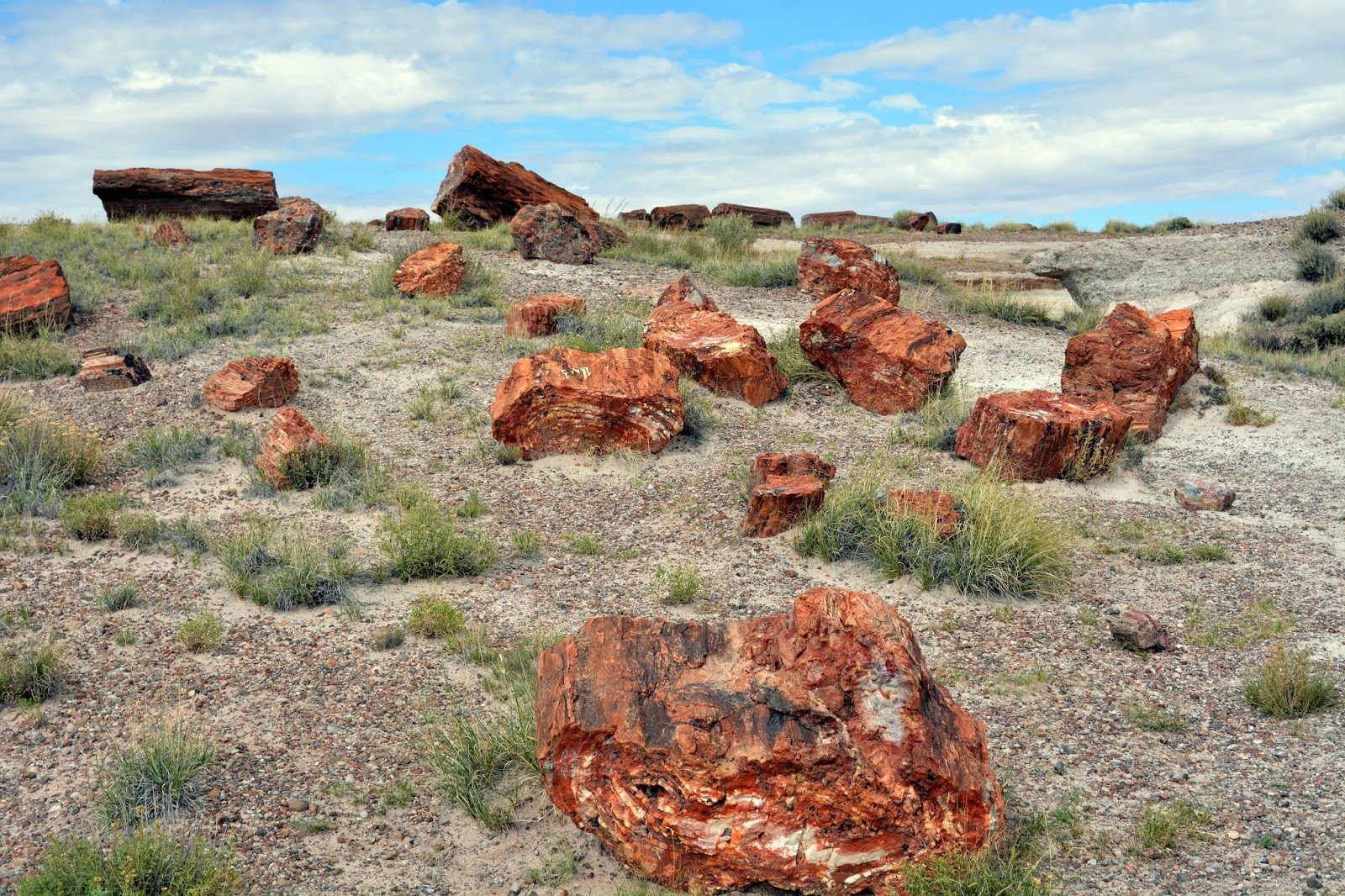
The Petrified National Park consists of two main sections, and recent legislation has authorized doubling the land area to 217,533 acres. The southern part of the park has the major concentrations of the famous colorful petrified wood.  Most of the pieces have been broken by the elements into giant logs, and are scattered over the land as far as the eye can see.


Some of the formations are more tree-like in shape.


We stopped into one of the visitor's centers called the Rainbow Forest Museum.  Here we watched an interesting 20 minute orientation movie about the park and looked at the paleontological exhibits complete with skeleton displays of the prehistoric vertebrates found in the park--including the giant crocodile-like reptile called the phytosaurs,and the large salamander-like amphibians called Buettneria, plus early dinosaurs such as the pterosaurs, and invertebrates including freshwater snails and clams


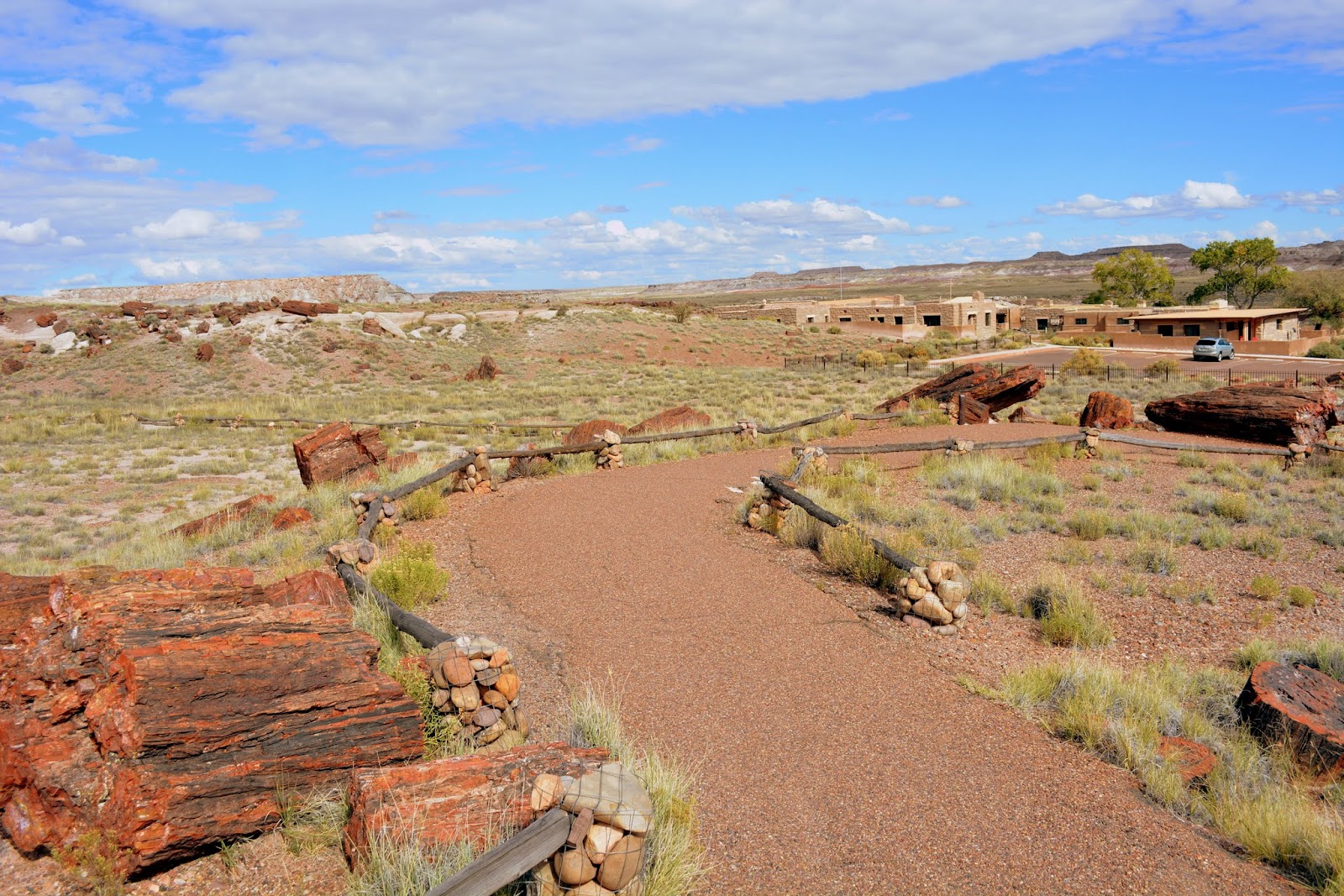
Outside the Rainbow Forest Museum are trails where you can see the beautiful pieces of petrified wood up close.  It is now against the law to remove any of the wood from the park, with strict fines imposed for any type of vandalism. Unfortunately, for many years before the area was protected by the government, large pieces of the petrified wood were removed by visitors for their own use or sold. There are still places that are outside the park in Navajo Nation that has petrified wood for sale, and since those pieces came from private land, they can be bought without penalty.


You can see the beautiful rainbow hues of the stone like wood in these photos.


There are many trails within the park. One of the most interesting formations is found on the Giant Logs Trail, a giant petrified tree called "Old Faithful."  As you can see in the photo collage above it was truly massive, with a base over 10 feet tall!


There were many different areas to see petrified wood.....


...and this region is called the Crystal Forest.


The Crystal Forest Trail allows you to see the silica quartz in the petrified wood, that sparkles in the sun. During the 1800's people actually dynamited some of these logs in order to extract the quartz. Now visitors are required by law to protect these samples for future visitors by not taking pieces of them.


As we drove north in the park, the topography kept changing, with many colorful buttes and mesas.


The Petrified Forest National Park area it is constantly changing, as weather and time continue to erode it.


An example of the changing scenery can be read about in the placard above (click on to enlarge)


This structure is called the Agate Bridge.  Centuries of flood waters washed out the area beneath this 110-foot long petrified log, and it formed a natural bridge. Conservationists over the years have tried to preserve this bridge, by first placing architectural support in 1911, and then a concrete span in 1917. Current National Park philosophy would be to allow nature to take its course, which would have left the Agate Bridge in its natural state, even if it means allowing it to fall.


As we continued to drive north we entered the Painted Desert section of the Petrified Forest National Park. The colorful mudstones and clay of the Painted desert badlands are composed of bentonite, a product of altered volcanic ash. The clay minerals in the bentonite absorb water and the expansion and contraction properties of the bentonite cause rapid erosion. This prevents vegetation from growing on the hills.


The painted desert is also composed of stratified layers of easily erodible siltstone, mudstone, and shale of the Triassic period Chinle Formation.  These fine-grained rock layers contain abundant iron and manganese compounds which provide the pigments for the various colors of the region.


The patterns visible in the eroded soft sedimentary rocks are due mainly to hematite (red), limonite (yellow) and gypsum (white).


Exposed to wind and water, the formations erode into badlands made up of cliffs, gullies, mesas, buttes, and rounded hills.


The Petrified Forest National Park has many viewing sites in which to look down to these fanciful formations.


The time of day makes the colors change with shadows and brightness. Sunset is said to be the most magical time to view them.


The entire Painted Desert encompasses over 93,500 acres and stretches over 160 miles. It begins about 30 miles north of Cameron, Arizona, near the southeastern rim of the Grand Canyon to the Petrified Forest, where it is protected wilderness.  There are a few authorized hiking trails within the park, check this link for their location.  There are no camping facilities within the park. Check this link for other camping info.


Some more beautiful views...


The Painted Desert Inn. This 100 old structure is now a museum, The original building was made of petrified wood, but today's adobe facade dates back to a 1930's renovation. Inside is an exhibit on the historic Route 66, and the Civilian Conservation Corps.

Please click on to enlarge

There is also a placard nearby about the historic story of he once heavily traveled road Route 66 which ran from Chicago to Los Angeles.  The Petrified Forest National Park is the only National Park that a portion of the road passed through. You can also read more about Route 66 on the National Park web site here.


We left the Petrified Forest National Park grounds, but the amazing scenery continued,


We were on our way towards New Mexico, and hoping to reach the reservation we made at a hotel in Las Vegas---yes, not the famous Las Vegas of Nevada, but the Las Vegas of New Mexico-- before nightfall.  New Mexico is called "The Land of Enchantment" for good reason.  My next blog post will show more about what we saw on our journey home through this beautiful state!

I'm linking this post to the following blog events:

Thank you to all the blog hosts!
Bookmark and Share

Monday, March 21, 2016

Saguaro National Park, Arizona


When we attended a family wedding in the Phoenix area of Arizona last autumn, my husband and I decided on a free day to take a two hour drive south to Tuscon, Arizona, where Saguaro National Park is located. We had visited this park once before, and wanted to see it again. Saguaro National Park has two districts--East and West-- that are separated by the City of Tucson.  It is a 30-45 minutes transit between the two districts depending on the route and traffic but visitors pay only one fee to see both sides. 

(All photos in this post will enlarge if clicked on)


Tucson, Arizona is home to the nation's largest cacti--the giant saguaro--the universal symbol of the American west. These majestic plants are only found in a small portion of the United States in southern Arizona, and few stray ones in southern California, to western Sonora, Mexico.


The giant saguaro cacti, which can reach a height of 50 feet, and live 150 to 200 years, are unique to the Sonoran Desert, which covers the valley floor and rises into the Rincon and West Tucson mountains. Since 1933 these extraordinary cacti has been protected within the Saguaro National Park


You can see the size of these ancient cacti by us standing next to them in the photo collage above. Saguaro cacti are very slow growing.  A ten year old cactus may only be 1.5 inches tall, but they can grow to be between 40--60 feet tall. When fully hydrated with rain water it can weigh between 3200 to 4800 pounds.  Most saguaro cacti grow "arms" as they age, that can number up over 25, and are covered with protective pointy spines.  They flower in late spring and produce fruit in summer. Bats, bird and mammals eat the fruit and distribute the saguaro seeds.


In a section of the park we parked our car and walked one of the trails.


 It was nice to see the cacti up close...


...and read the educational metal placards along the trail, some of which I show above. Click on to enlarge to read them.


In addition to the saguaro cacti there are many different types of cacti, trees and shrubs in the park.


We saw barrel, cholla and prickly pear cacti.


There were many beautiful cacti to look at and photograph.


 It was thrilling to see occasional hawks flying overhead.


 We stopped in the eastern Visitor Center in the Rincon Mountain District.


From its back porch there was a view of a deep "forest" of saguaros!


There is an interesting and well done exhibit just outside the center that walks around 15 major plants that live in the Sonoran Desert, with a plaque that contains the name and description of each plant.


We also saw examples of holes in some of the saguaro that contain holes that nesting birds or Sonoran desert mammals made, as well as the skeletons of dead saguaro.  The strong woody ribs of the dead cacti have been used to build roofs, fences, and furniture.


We were enjoying our visit very much until we unfortunately saw the skies begin to darken with heavy clouds.


Soon we heard the rumbles of thunder, so we headed back to the safety of our car in case there was lightning.


As we drove for the park exist the sky turned dark and ominous but the few rays of sunshine gave the landscape a deep jewel tone that was exquisite,


As we drove out towards the exit the weather improved somewhat, until....


...we entered the highway where we saw the wind causing a dust storm in the distance.


These dust storms, called "haboobs" after the Arabic word for "blasting/drafting," can be very intense and dangerous when they are large and black out the sun, with choking dirt and sand.


Fortunately, this dust storm was not too intense...


...and we were able to drive past it without incident.


We headed back to our families that live in suburbs of Phoenix and enjoyed the rest of our visit.  


In the next post I'll show you our drive through another Arizona National Park --the Petrified Forest.  It is an amazing sight you won't want to miss! 


I'm linking this post to the following blog events:

Thank you to all the blog hosts!

  Bookmark and Share Pin It