The Morgan Library and Museum, located at 225 Madison Avenue, New York, New York is a treasure trove of manuscripts, and printed books as well as prints and drawings that are in the once private and personal collection of the American financier and philanthropist John Pierpont Morgan. I felt fortunate to be able to visit the Morgan on a trip to New York City, and I'd love to show you some of its magnificence. (All photos and photo collages in this post will enlarge for easier viewing when clicked on)

Mr. Morgan's library was built between 1902 and 1906 adjacent to his New York residence at Madison Avenue and 36th Street. It was designed by Charles McKim of the architectural firm McKim, Mead, and White in an Italian Renaissance style. The two lionesses in front were sculpted by Edward Clark Potter, who would later create the two lions that guard the New York Public Library's main building.

Today the library is a complex of buildings that serve as a museum and a scholarly research center. The most recent addition, designed by Italian architect Renzo Piano and Beyer Binder Belle, and was completed in 2006, is a modernist entrance building that joins the interior spaces of the complex.

In 1924, eleven years after Pierpont Morgan's death, his son J.P. Morgan Jr, fulfilled his father's dream of making the library and its treasures available to scholars and the public alike by transforming it into a public institution. The rotunda portion of the library is opulent in detail.

Monumental bronze doors lead to variegated marble columns, an ornately patterned floor, and fine mosaic panels that line the curved walls. Highlights of Morgan's collection of rare printed and manuscript Americana are on display here, such as letters of George Washington and Abraham Lincoln as well as the journal of Henry David Thoreau and Nathaniel Hawthorne and works by Edgar Allen Poe and Ralph Waldo Emerson.

I was particularly fascinated by this life mask of the first President of the United States, George Washington, made in 1785 by the French Sculptor Jean-Antione Houdon at the President's Mount Vernon residence. To make the mold of Washington's face Houdon had Washington lay down, and he placed a protective layer of grease on his face and then applied plaster over that, covering his entire face. When the plaster hardened, he removed the mold and poured plaster into it, thereby making this positive "life mask." Houdon returned to France with the mask and used it to sculpt a marble portrait of the president which was presented to the rotunda of Virginia State Capital building in 1796.
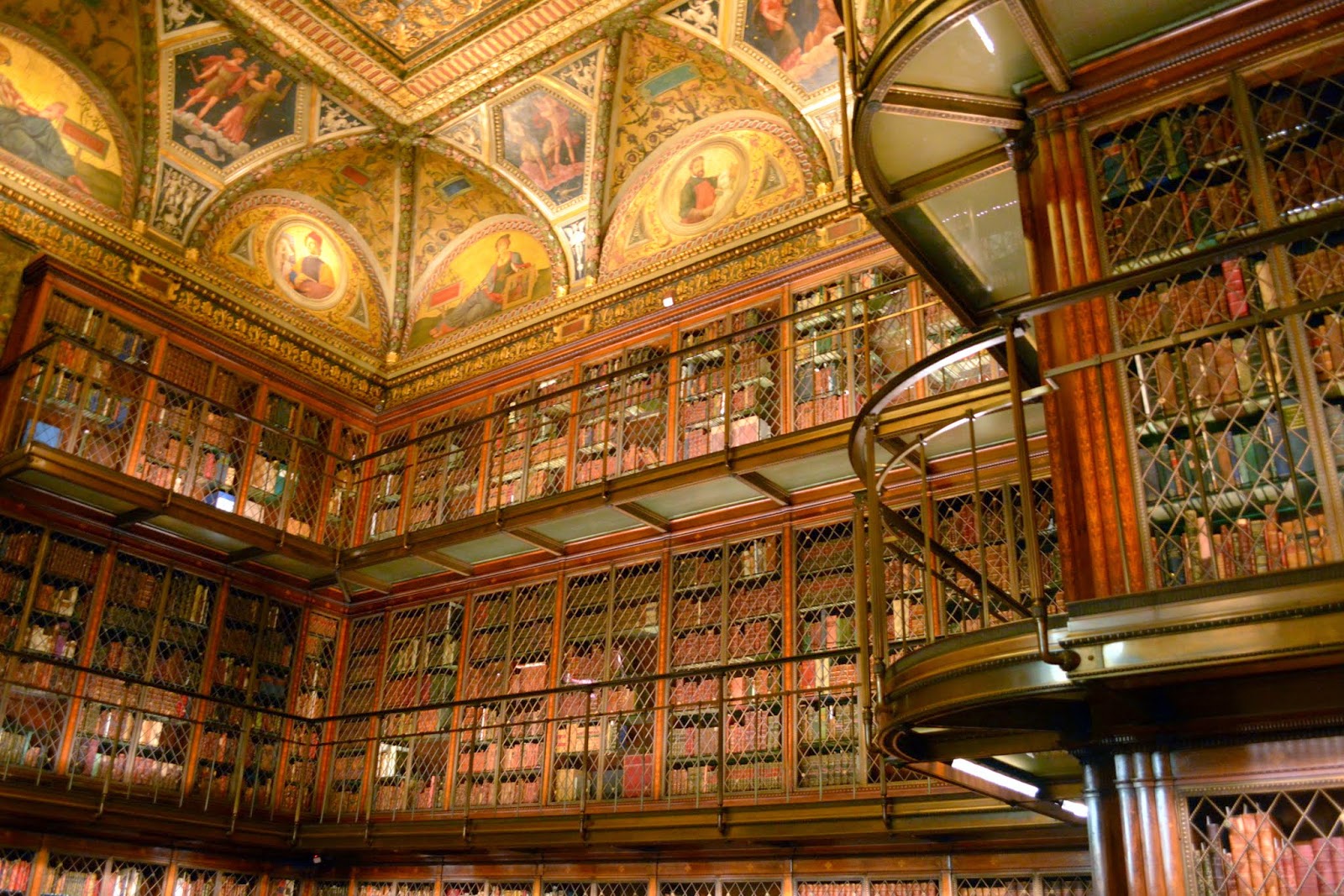

The library, with three-story inlaid walnut bookshelves and magnificent ceilings, was designed as a treasury for Pierpont Morgan's collection of rare printed books.

The sixteenth-century tapestry over the mantelpiece depicts avarice; one of the seven deadly sins personified by the mythological King Midas.

One view in the East Room are examples from The Morgan Library and Museum's extraordinary collection of medieval illuminated manuscripts, rare printed books, and bindings, and handwritten manuscripts of great writers, artists, and composers from the Renaissance to the present day.

Some articles in the collection have been acquired since Pierpont Morgan's death.

There were volumes upon volumes of books on the shelves...

...and beautiful murals painted on the ceiling.

Two staircases, concealed behind bookcases, provide access to the balconies.

Display cases held a variety of rare books in the library.

The North Room is lined with two tiers of bookshelves and adorned with ceiling paintings from the studio of American artist James Well Finn. This was the first librarian's office. In 1905 Pierpont hired Belle de Costa Greene to manage and augment his collection of rare books, and she later served as Morgan's first director.


Pierpont Morgan's study, called the West Room, was a lush but intimate room where Morgan relaxed and met with art dealers and business associates.

To the left of the massive fireplace, Morgan's impressive manuscript collection was once secured in a vault lined with solid steel.

The Morgan Library and Museum offers the Thaw Conservation Center, Research Services, as well as Online Exhibitions. Information on Current and Upcoming Exhibitions can also be accessed on their website. It truly is one of the exceptional library and museum gems of New York City!
Do you remember the TV show called The Adventures of Superman? Next post I'll show you a building that has a fascinating bit of scenery that was used in the show!

Do you remember the TV show called The Adventures of Superman? Next post I'll show you a building that has a fascinating bit of scenery that was used in the show!


 Posts
Posts