Showing posts with label Historical Buildings in Colorado. Show all posts

Sunday, July 12, 2026

Four Mile House Historic Park

Four Mile House is the oldest standing structure in the city of Denver, Colorado!

The oldest portion of the house was built in 1859, and the location served as the last stagecoach stop before entering what was then the "Colorado Gold Rush" city of Denver, on the Wells Fargo Butterfield Stagecoach route between El Paso and Denver.


Routes from the plains towards the Front Range of the Rocky Mountains.
 
The Colorado Gold Rush, originally known as the Pikes Peak Gold Rush, started in 1858 and was the second largest mining excitement in United States history after the great California Gold Rush a decade earlier. Over 100,000 people participated in this rush and were known as “Fifty-Niners”, a reference to 1859, the year the rush to Colorado peaked.

“Pikes Peak or Bust” was the motto of many emigrants, a reference to the mountain in the Front Range that guided many early prospectors westward over the Great Plains.

Gold Rush Prospectors

Gold prospectors were the first major non-native population to enter the region, leading to the creation of many early towns, including Denver, Boulder, Golden, and numerous smaller mining towns, some of which are still active communities today.

As prospectors flooded the region in search of quick riches, the rapid population growth led to the creation of the Colorado Territory in 1861 and to the U.S. State of Colorado in 1876.

The rear of Four Mile House

Four Mile House was built in late summer or fall 1859 by the brothers Samuel and Jonas Brantner. In 1858, Jonas had come to Colorado from Ohio to look for gold. After prospecting unsuccessfully on Cherry Creek and the South Platte River, he gave up and staked a farming claim along Cherry Creek.

In August 1859, Jonas’s brother Samuel arrived in Colorado, and they soon built a two-story log house on Jonas’s land. Samuel, his wife, and their infant daughter occupied the house in October 1859.

 The house might have acquired the name “Four Mile House” in 1859 or 1860, when part of the Cherokee Trail began to be used by mail carriers traveling between Colorado City (now part of Colorado Springs) and Denver as well as by immigrants following the Smoky Hill Trail from Kansas to Denver. It was four miles from the house to Broadway in the city of Denver.


In 1860, the Brantners sold Four Mile House to Mary Cawker. A widow from Wisconsin, Cawker moved into the house with her two children that September. She operated it as a stage station with a bar downstairs and a tavern, and held dances on the second floor.


 Over the next decade, stages regularly stopped at the house to change horses and to allow passengers to change clothes and freshen up before they arrived in Denver after their 700-mile, 12-week journey across the midwestern and high desert plains.

Mary Cawker sold the house to Levi Booth for $800. An attorney originally from Wisconsin, Booth moved into the house with his family in August 1864. He continued to operate the house as a stage stop and tavern for the rest of the decade.


Over the years, the current U-shaped plan evolved as three buildings were butted together to accommodate changing needs. Together, the 1859 squared log construction, the circa 1860s woodframe construction, and the 1883 brick portions reflect the evolution of rural housing during the Denver area’s early settlement period.

Glendale neighborhood of Denver in the distance of the Four Mile House grounds.


In 1946, the Booth family sold Four Mile House to Glen Boulton, who stayed there for nearly thirty years. During those years, the house, previously on the edge of the city, was surrounded by development as Denver spread southeast and Glendale became an enclave of businesses and bars. In response to encroaching development, preservationists worked to ensure Four Mile House’s survival. In 1968, the house became a Denver landmark, and in 1969, it was listed on the National Register of Historic Places.


In 1977, the nonprofit Four Mile Historic Park Inc. was formed to care for the property, which was opened to the public the next year as a living history museum.

One of the members of our friends group had volunteered as a tour guide for many years at Four Mile Park, and she decided to plan an outing for us to take a self-guided tour of the park and house, and then have lunch afterwards at a local restaurant.

Click on the collage to enlarge it.

We enjoyed looking at all the interesting history exhibits about Four Mile House in its Visitor Center...


...and then strolling the grounds to see how the land had been developed as a farm in the late 1800s, which included a school house...


... and a blacksmith shop, a summer kitchen, and a barn housing 1800s era transportation vehicles.


We had a guided tour of the inside of Four Mile House with a volunteer who told us more of its history.

Four Mile Historic Park is a great resource for educators and students to learn about Colorado’s early history and hosts many events for all ages during the year.


If you are a history enthusiast, and would like to learn more about Four Mile House there is an interesting PBS Experience show about it on YouTube with fascinating vintage photos of the covered wagons and stagecoach rides--see video above.

We we all so glad to see that Four Mile House was preserved and is now a wonderful view back into the pioneer days of our nation's history.


Monday, May 25, 2026

The Colorado Governor's Residence at Boettcher Mansion


After attending the Rotary Club of Denver Metro South's meeting in April for "Operation Pollination" -- last week's blog post on this link--we were able to take a tour of the Colorado Governor's Residence at Boettcher Mansion in Denver, Colorado.

Designed and built for the Cheeseman family in 1908, and later purchased by the Boettcher family, this mansion was deeded to the state in 1959. The Georgian Revival residence became the Governor's Mansion in 1960.

More about the home's history can be read on this link.


This was not the first time I visited the Governor's Residence. Twice before, my husband and I visited during open houses when the residence was professionally decorated for the Christmas season. You can see those posts here and here.


On this visit, I was looking forward to seeing the home without decorations and with fewer visitors. There were multiple docent tour guides from History Colorado to break up our group into smaller groups to take us on a guided tour.


The entrance door and hall.


The three-story staircase leads to the private quarters. The upstairs portion is 7,000 square feet with six bedrooms and seven bathrooms.

The present Governor of Colorado is Jared Polis, and he and his partner do not live in the residence, as they decided to remain in their home in Boulder, Colorado, because their young children attend school there.


The Library

The library shelves contain the complete works of Thomas Jefferson, a signed copy of A King’s Story: The Memoirs of the Duke of Windsor, and several first editions.


The Library features a rare French Louis XIV-style tulip wood cylinder desk.


The Library carpet depicts Colorado wildflowers, and window shelves looking into the Palm Room display Boettcher era collectibles.


The Drawing Room


 The Waterford cut crystal chandelier, which graces the Governor’s Residence drawing room, hung in the White House ballroom in 1876, when President Grant presided over America’s centennial celebration—the same year Colorado became a state.


More views of the Drawing Room.

After its completion in 1908, the first big event held inside this room was the wedding of John Evans II and Gladys Cheesman, the daughter of Walter and Alice Cheesman. Our Docent told us that the childhood sweethearts wed in front of the fireplace, with Gladys walking down the staircase to meet her groom instead of walking down an aisle.


The Drawing Room features a 1914 Steinway grand piano played by notables such as Liberace and John Denver.


Claude Boettcher and his wife Edna expanded the residence with the addition of the glass and marble Palm Room and furnished the home with the art and treasures they found on their travels throughout Europe and Asia. The room looks out to the SouthTerrace Garden.

On our visit, a portion of the room was filled with a table and chairs set up for a meeting.

The Dining Rooms and Kitchen


Colorado State China on display. The smallest dish had an imprint of the Rocky Mountain Columbine, our state flower.


The Bar Room

The last room we visited was the Bar Room, as our tour of the first floor of the mansion came to an end.
Mr. Boettcher's model ship, the “Cutty Sark,” is on display on the bar.


One wall had portraits of all the past and present Colorado Governors.

More views of the Bar Room.

Situated atop Logan Hill, the magnificent Governor’s Residence at the Boettcher Mansion, and its one-acre grounds, has entered its second century of helping to create Colorado history. 
Known as "Colorado's Home," the Residence has played host to national and world heads of state and dignitaries.

It was a pleasure to revisit it, and I hope you also enjoyed my photo tour.

I can also be found on


Sunday, April 19, 2026

The Higlands Ranch Mansion in Highland Ranch, Colorado


The Highlands Ranch Mansion is located in the Highlands Ranch Community, part of Douglas County, Colorado Highlands Ranch has a long and interesting history, which my husband and I learned about on a lecture and tour we attended at the mansion. 


At one time, most of the Front Range land west of the city of Denver became farm and ranchland, as settlers from the East came West.


Please click on to enlarge. 

The first to settle in this area was Samuel Allen Long, who came from Pennsylvania in 1884 and filed a 40-acre Homestead claim. He expanded his claim to 2,000 acres a few years later and, in 1991, built a barn and farmhouse which he called Rotherwood Ranch.


Please click on to enlarge.

John W. Springer, a wealthy man with ties to politics, banking, and law, became the new owner from 1897 to 1913, and he renamed it to Springer Cross Country Horse and Cattle Ranch. He expanded the home to include a turret and gave it a castle-like appearance.  Springer became the first president of what was then called the National Livestock Association. 
He became the area's largest landowner. He bought the property through a series of purchases while he was married to his first wife, Eliza Hughes Springer. The ranch grew to 12,000 acres, and Springer pursued his interest in show horses, raising rare German Oldenburg Coach StallionsAfter his first wife, Eliza, died, and his second wife was involved in a murder scandal, he sold the Colorado ranch to Eliza's father, Colonel William E. Hughes, in 1913.

Please click on to enlarge

In 1913, Hughes purchased John Springer’s Cross Country Horse and Cattle Ranch, changed the name to Sunland Ranch, and continued to operate it as a working ranch. At the time of his death in July 1918, it was estimated that Hughes was Colorado’s second-wealthiest man (the first being Lawrence Phipps, Sr.). Hughes bequeathed Sunland Ranch to his granddaughter Annie, who sold it two years later to oil tycoon Waite Phillips.


Please click on to enlarge

Waite Philips purchased Sunland Ranch in 1920 and used it as a breeding location for high-grade horses and cattle. He consolidated the ranch with other nearby land purchases to create a prodigious spread called Phillips Highland Ranch, named after the Highland Hereford cattle he raised here.

Please click on to enlarge

In 1926, Frank Kistler purchased Highland Ranch from Waite Phillips, renamed it the Diamond K Ranch, and began breeding operations that specialized in dairy and Angus cattle, sheep, chickens, and hogs. During his time living on the ranch, he did extensive renovations on the ranch, converting it from a castle to an English Tudor-style home.


Please click on to enlarge

The last ranch owner was Lawrence Phipps, Jr., who named it Highlands Ranch. As one of the largest ranches in Colorado, it hosted the Arapahoe Hunt Club for more than 40 years.  Upon Lawrence’s death in 1976, the ranch passed to his estate, which handled its sale to Marvin Davis, head of the Highlands Venturers Corporation. 


In 1978, Highland Venturers sold the property to Mission Viejo Company, and development began of the modern community called Highlands Ranch. Mission Viejo sold Highlands Ranch to Shea Homes in 1997. In 2010, Shea Homes gave the Mansion property and funds for renovation, as well as an endowment to the Highlands Ranch Metro District.
 The Highlands Ranch Metro District became the new owner of the Highlands Ranch Mansion in April.  On June 15, 2012, the Highlands Ranch Metro District hosted the grand opening of the renovated Mansion, inviting the community to enjoy this community treasure.

We toured the open rooms of the mansion...


Full descriptions and historical photos of each of the mansion's rooms can be seen on this link.


Much of the original furnishing remains. I loved the stained-glass lighting fixtures!


The extensive, long hallway is tiled in Italian Terrazzo tile and was used for formal dances by one of the owners.


The multiple dining areas have gorgeous tapestries.


The butler's pantry was filled with interesting period china and other artifacts.


Surrounded by 250 acres of ranchland and tucked away in a beautiful Highland Ranch neighborhood, at 9950 Gateway Dr, Highlands Ranch, CO 80126-3022, the Mansion is less than 20 miles south of downtown Denver, and is a 45-minute drive to Denver International Airport.

Go to the Highlands Ranch Mansion calendar or call 303.791.0177 for more information about free tours or special events held at the mansion. 
The Highlands Ranch Mansion website will also provide information about renting the mansion for special events, such as weddings or business conferences.

It is well worth a visit to learn more about the long ranching and development history of this part of Colorado.


Sunday, October 8, 2023

Durango and Silverton Railroad a Travel Adventure in Colorado!


Do you love taking a historic and scenic train ride?  Colorado has many, and my husband and I have made a point of taking a ride on them all. I have twelve train rides featured on my blog under the label Colorado Railroads, beginning with this post and continuing back to the first one we took ten years ago.  Each train ride offers wonderful views and experiences.  We typically enjoy these train rides during the fall season when the stunning colors of the Colorado aspen trees enhance the beauty of each journey. and the Durango Silverton Narrow Gage Railroad was no exception!  This time of the year is also around our anniversary and we celebrated number 49 this year!


We began our journey by driving from our area of the Colorado Front Range to Durango, Colorado which is located in South West Colorado in the San Juan Mountian region.  There is so much to see and do in Durango but our time was limited on this trip so we were there primarily to take the round-trip train ride that we scheduled ahead of time. The train fills up quickly this time of year so it is best to make advance reservations. We chose the 9-hour roundtrip journey (includes a 2-hour Silverton layover), but there are other shorter options if desired, and special train rides such as the upcoming Holiday Polar Express train ride that begins in November and ends at the end of December.


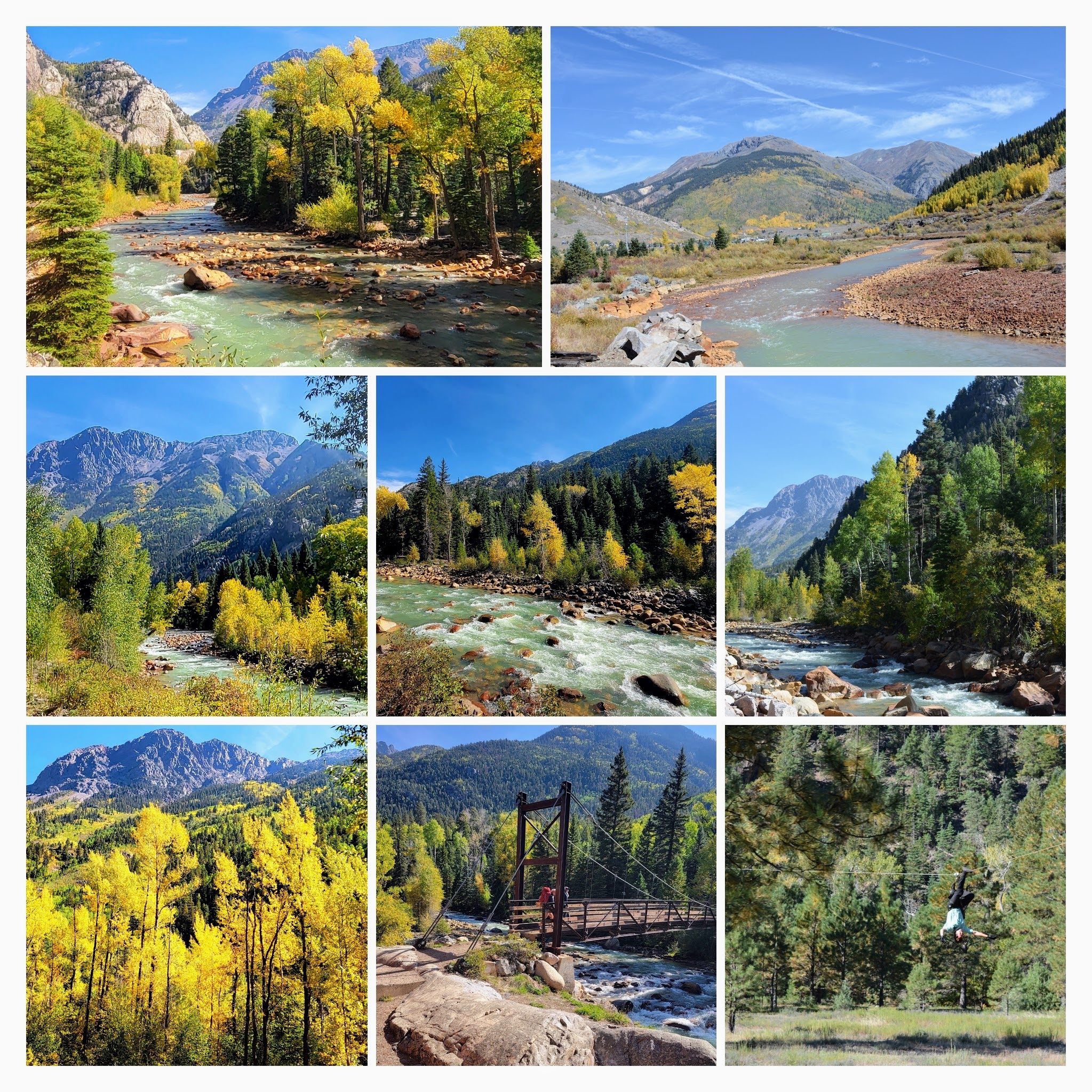
My husband and I reserved our seats on the open-air Gondola Car as we enjoyed seeing the sights from all sides of the train and having the flexibility to move around the car.   The Gondola Car had an outward-facing bench on both sides as assigned seats but there was a lot of flexibility to take photos and I took hundreds!  I made these photo collages to make sharing them much easier. to see more detail each collage can be clicked on and it will enlarge. As the Durango Silverton Train left Durango we passed, businesses, homes, farms, and ranches as well as the Durango Hot Springs area.


As the train rose higher and higher up into the San Juan Mountains we saw beautiful vistas and autumn color.  The train follows the Animas River route and crosses over and around the river five times during its journey.  You can watch a video short I took of the train climbing up into the mountains on this YouTube link or on my Mille Fiori Facebook page at this link.


The scenery was breathtaking!


The colorful fall foliage, the vast San Juan Mountain vistas, and the icy blue/green Animas River views were stunning!


At one point the train stopped at a mountain resort and some backpackers disembarked to hike. we also saw a man zip by on a zip line-- see the last photo in the lower right in the collage aboveIf you'd like to see a short video reel of more of the train ride on my Mille Fiori Facebook link Click Here--make sure to turn on the sound on the video to hear the sound of the steam train and the train whistle at the end of the video--it is very iconic and a bit romantic to me.


The terminus of the train ride is the historic gold mining town of Silverton. which is nestled in the San Juan Mountains at an elevation of 9,3018 feet (2,840.1264 meters)


During our round-trip train ride, we had a two-hour layover in Silverton where we enjoyed a nice lunch and took a walk around town to visit the shops.


Silverton Mountain is a thrilling year-round destination for skiing enthusiasts. The mountain boasts of over 400 inches (1016 centimeters) of hefty snowfall during winter, leaving the trails ungroomed. The current advertising campaign aptly describes the experience as "all thrills and no frills." However, the recent acquisition of the Silverton Mountain area by Aspen Travel Adventure Company may lead to changes beyond the current offerings.


Our train ride back to Durango was equally scenic.


We ended the day with a delicious dinner in the Diamond Belle Saloon at the historic Strater Hotel in Durango, where the diners were serenaded by a wonderful Ragtime Paino Player during dinner.  It was a wonderful way to begin our 49th anniversary! 

The next day we took a drive on the famous "Million Dollar Highway," US 550. from Durango to Ouray, Colorado. Photos will be in my next post, where you will see how it may have gotten its nickname.