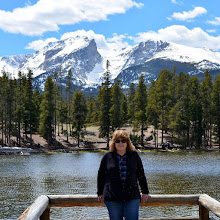
When my husband and I left the Great Sand Dune National Park (see part one blog post here, and part two blog post about these amazing sand dunes here) we traveled CO 150 South on our way towards the town of Alamosa, about 38 miles away from the park. (All photos in this post will enlarge if clicked on)
I love roadside "places of interest" or "historical markers" and often stop to see what they say. I was very glad to have stopped at this one which pointed out that the tall mountain peak in the distance was Mount Blanca.
Click on the photo to enlarge it to see what was written on the placard.
Mount Blanca is the fourth highest summit of the Rocky Mountains in Colorado. At 14,351 feet (4,374 m) it is the highest summit of the Sangre de Cristo Range.
The Navajo Native Americans called this mountain Sisnaajini (White Shell mountain). The Navajos believed it was one of the four sacred mountain peaks of the Navajo Land and a sacred mountain placed in the east, the doorway to Navajo Land because the sun rises in the east and the day begins there. They believed the First man and the First Woman, together with the Yei'i (Holy People) made the mountain with white shells, white lightning, and rain clouds and gave it positive thoughts. You can read more about the Navajo beliefs about Mt. Blanca on this link.
It was named Mount Blanca by the Spanish explorers in 1598. By then the Navajo tribes had moved further west and the predominant Native Americans living in the area were the Utes. They entered this region with their domesticated dogs pulling their belongings, and found the San Luis Valley rich hunting grounds for bison, elk mule deer, fish, and plants. When they first saw the Spaniards riding on horses they thought the horses were "magic dogs." When the Utes acquired horses their warriors became skilled riders and they fought off European conquest in the San Luis Valley of Colorado until the early 19th century.
Another historical placard at this road pull-off site told about the Southwestern expedition led by Lt. Zebulon Pike in 1806-7. He and his men were captured by the Spanish in this area and held captive in Chihuahua, Mexico for a while until they were released in 1807.
When I looked up at the high peak of Mt. Blanca I thought about the many eyes who marveled at this sight over the thousands of years before me, and the many who will gaze at it in the future. It sits as a silent and majestic sentinel of time.
One last look at the beautiful Sangre De Cristo Mountain range in southern Colorado. It is another area that has won my heart in this great state.
The Navajo, unlike most Native American tribes, continue to live on their ancestral lands. The Navajo Indian Reservation is 27,425 square miles large, and is located in parts of southwestern Colorado, northeaster Arizona, southwestern Utah and northwestern New Mexico. The 15 million acres of desert land ranges in altitude from 5,000 to 11,000 feet in altitude. Navajo Nation--Dine Bikeyah--is larger than 10 of the 50 states in America. It was established by treaty as a reservation with the United States in 1868. You can read more about the Navajo history on this link.(All photos, and photo collages in this post will eanlarge for easier viewing if clicked on)
When we left the Four Corners area in the Navajo Nation in Colorado --see last blog post-- we drove on US 160 southwest and entered the Arizona border of Navajo Nation. There is so much to see and do in the entire Navajo Nation --see their tourism site on this link--but we were going to drive straight through, on our way to the Phoenix area, to visit my husband's sister and brother-in-law's home, where we were gathering for a family wedding that would take place the next day. We knew we had many miles of driving before us, but we were excited to see the unique and beautiful scenery in this part of the country, and I kept taking photos as we drove to share with all of you.
We were driving parallel with the Monument Valley, area where I could see the most unusual and majestic looking sandstone masterpieces in the distance....
...and at times up close.
The colors of the desert and the shadows and light playing off the natural monuments gave them and other worldly appearance. We were tempted to take a rural road to get closer to the center of this valley, but knew we did not have the time on this trip to do so. In the future we want to take a guided tour of Monument Valley to see more of it up close.
In the Navajo creation story they believe they came to their land by emerging through four levels of worlds, to currently reside in the fourth level, the "glittering world." After seeing this spell blindingly beautiful area of Navajo Nation I feel as if I too, passed through a glittering world filled with the Navajo sacred colors.
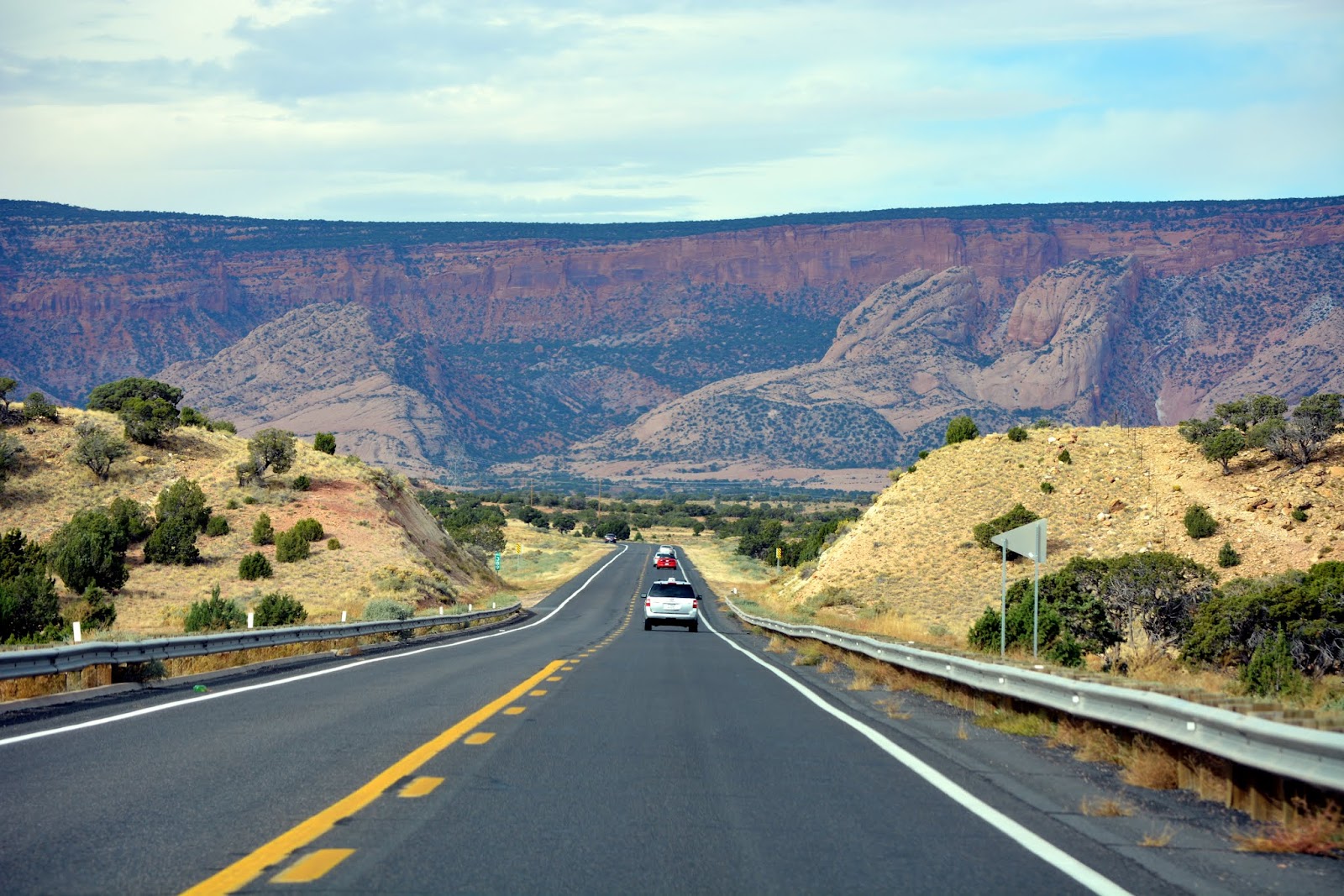
We kept driving and marveling at the changing scenery.
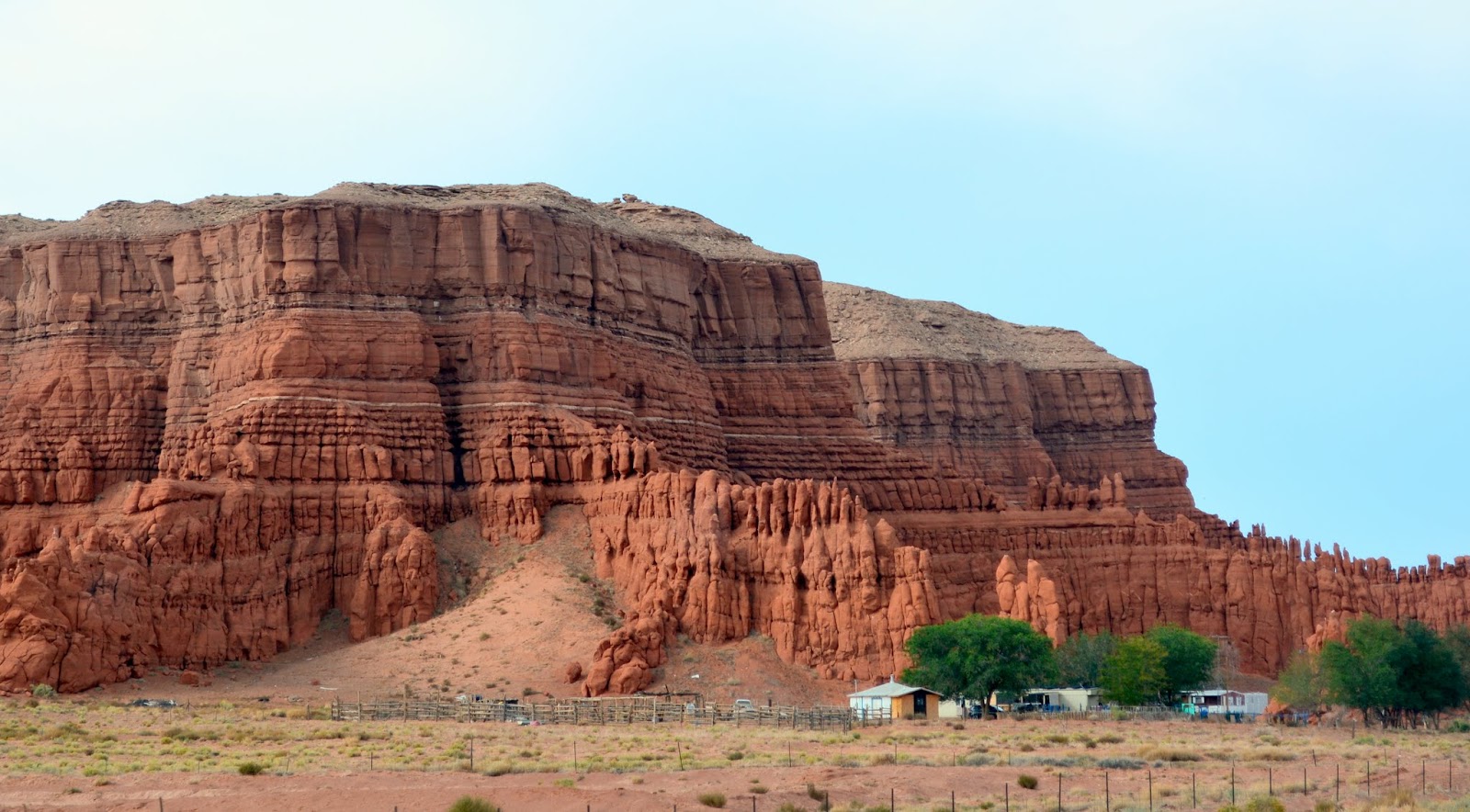
We again passed beautiful red rock formations...
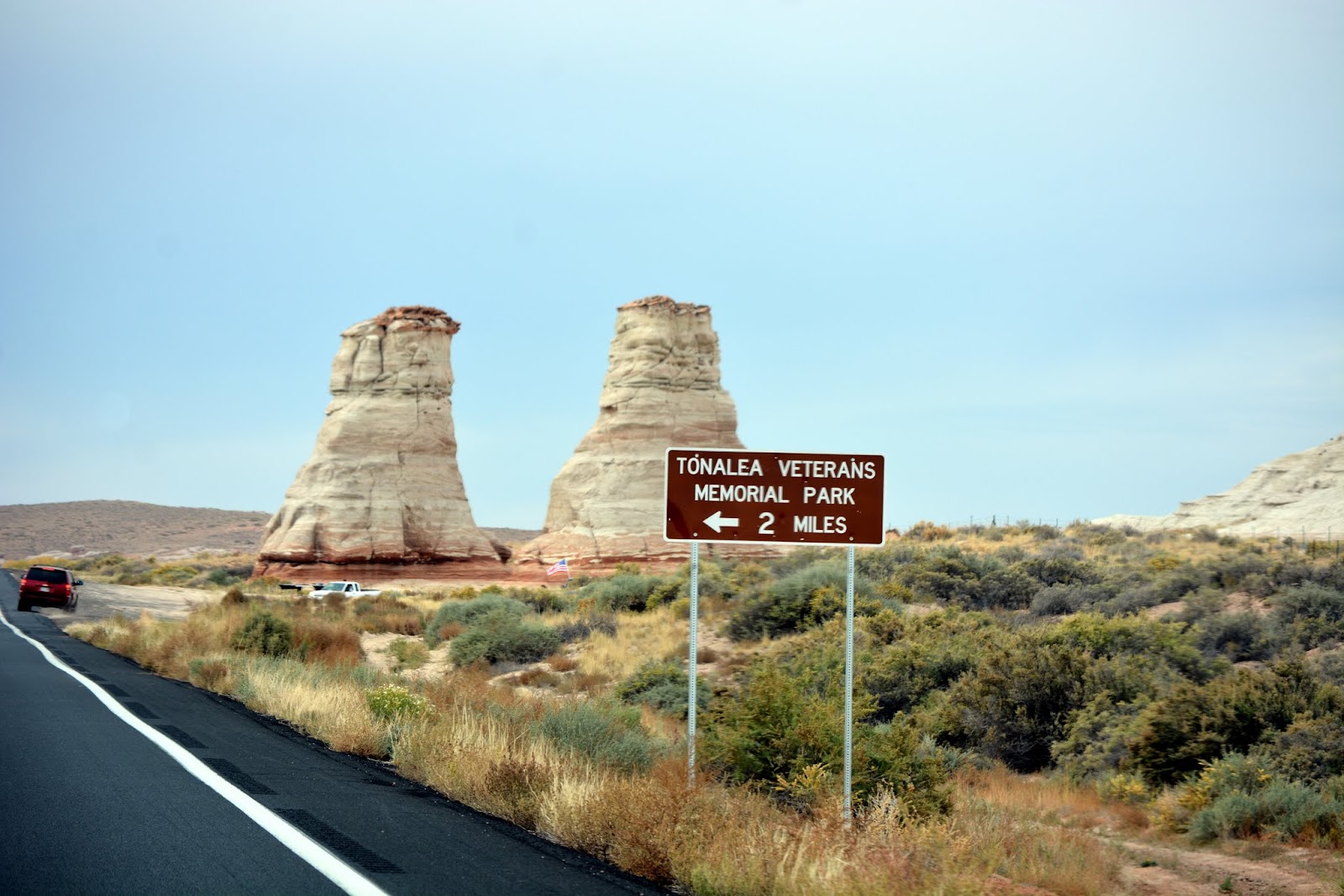
...until we saw two unusual sandstone formations in the distance near Tonalea, Arizona.
These formations are nicknamed "Elephant Feet." It is easy to see how they received that name!
We had driven a little more than two thirds of our route on US 160 through Navajo Nation, towards Tuba City, when I spotted men galloping by on horseback.
We passed many more horseback riders in this area
A good view from a high point on the road of the colorful dessert terrain.
We passed by exits that lead towards the Grand Canyon. Again, it was tempting to turn off for awhile to see some of the canyon, but we knew that would take too long and we did not want to drive at night. We had visited the Grand Canyon years ago on a trip to Arizona with our children, but I'd like to go back again one day and see the, less visited North Rim.
As we approached Tuba City, the largest community in Navajo Nation, we immediately recognized that we were now also in part of the Arizona Painted Desert
Again, the colors and formations of the land were other worldly in appearance. We would visit the Painted Desert as part of the Petrified Forest National Park before we return to Colorado on our way home, so I'll show you more of this natural wonder on a future blog post.
Another reminder that we were on Native American land was that some houses also had tepee structures next to them. They are most likely used for ceremonial or religious purposes. The Navajo. or Dine, as they call themselves, also used hogans, or mud style huts as shelter. They have been remarkably successful in preserving much of their unique culture, despite the modern day conveniences of an Anglo-American lifestyle. It is estimated that approximately 80% of the population speaks the Navajo language in addition to English. During World War II the Navajo language was used to create a secret code to battle the Japanese. Navajo men were selected to create codes and serve on the front lines in battlefield. These famous Navajo Code talkers exemplified the bravery and patriotism of the Navajo people. The following is a YouTube video documentary that tells the story about the Navajo Code Talkers
Passing the town of Cameron, we were approaching the end of Navajo Nation in Arizona turning onto US 89 south, headed towards Flagstaff.
This area began to show more greenery....
...and storm clouds began to gather.
Soon, we saw ominous mammatus cloudsforming overhead. It rained briefly, and then, happily, the sun began to shine again.
As we drove south in Arizona we began to see saguaro cacti. These cacti are only found in the Sonoran desert areas of Arizona, and in Sonora, Mexico. We knew we were getting closer to our destination, and happy times ahead visiting with family.
We had a wonderful time seeing my husband's sister and family, and my sister and her family, while in the Phoenix area. Young third cousins met for the first time and had a good time playing together. over our visit. The very best part of the get together was our niece's beautiful wedding! They have already celebrate their first anniversary--how time flies! While in Arizona we took the opportunity to visit the Saguaro National Park--come back next time to see that amazing place!
I'm linking this post to the following blog events:
Hello and welcome!
I'm Pat, a lifelong New Yorker who has recently moved to a suburb of Denver in the beautiful state of Colorado, so that I can live close to my children and grandchildren. I look forward to learning many new things about my new "mile high" city and I will share them on my blog.
New York City will always be my second home, and I will also continue to share many posts about it.
My blog's name in Italian means a "Thousand Favorite Flowers." I chose this unusual blog name because researching and writing for my blog, and taking photogrpahs for it, is like another "memory flower" that I am collecting in my bouquet of life.
I hope you will enjoy your visit to my blog and that you will leave a comment so that I know you've been here.
Thanks!
Copyright:2007 through 2026, MilleFioriFavoriti:LLC all rights reserved
Unless indicated, all photos and writings are my personal property and can not be used or reproduced without my written permission. My e-mail address is available in my profile. Thank you very much!
My Blog Followers -- Thank you for your interest and friendship!
We write to taste life twice. Once in the moment, And once in retrospection. ~ Anais Nin
Why I blog:
"I write to discover what I know" ~ Flannery O'Connor
Pay Attention, Be astonished, Tell about it. - Mary Oliver
Rocky Mountain National Park
“Climb the mountains and get their good tidings. Nature's peace will flow into you as sunshine flows into trees. The winds will blow their own freshness into you, and the storms their energy, while cares will drop away from you like the leaves of Autumn.” ― John Muir, Our National Parks
Colorado
You can fall in love at first sight with a place as with a person ~ Alec Waugh
Mt Evans
I was uplifted above a world of love, hate, and storms of passion, for I was calm amidst the eternal silences, bathing in the living blue. For peace rested that one bright day on the mountaintop. ~ Isabella Bird "A Lady's Life in the Rocky Mountains"
RMNP
"Life is your art. An open, aware heart is your camera. A oneness with your world is your film." ~Ansel Adams
Rocky Mountain National Park
“And above all, watch with glittering eyes the whole world around you because the greatest secrets are always hidden in the most unlikely places. Those who don't believe in magic will never find it.” ~Roald Dahl
Rocky Mountain National Park
And our first pure mountain day, warm, calm, cloudless, - how immeasurable it seems, how serenely wild! I can scarcely remember its beginning. Along the river, over the hills, in the ground, in the sky, spring work is going on with joyful enthusiasm, new life, new beauty, unfolding, unrolling in glorious exuberant extravagance, - new birds in their nests, new winged creatures in the air, and new leaves, new flowers, spreading, shining, rejoicing everywhere. - John Muir
Colorado Beauty
“Still round the corner there may wait a new road or a secret gate, and though I oft have passed them by, a day will come at last when I shall take the hidden paths that run West of the Moon, East of the Sun.” - J.R.R. Tolkien,
Bethesda Fountain in Central Park, NY
Look at everything as though you were seeing it either for the first or last time. ~Betty Smith, A Tree Grows in Brooklyn
My hometown: Brooklyn, NY
"Every day I walk out into the world to be dazzled, then to be reflective." ~ Mary Oliver
My buddy Bo
1998 - 2013 I still miss those I loved who are no longer with me, but I find I am grateful for having loved them. The gratitude has finally conquered the loss.
Grand Dog Lucy
“In times of joy, all of us wished we possessed a tail we could wag.” ― W.H. Auden
Pepper
1991 - 2008 Until one has loved an animal, a part of one's soul remains unawakened. ~Anatole France







 Posts
Posts