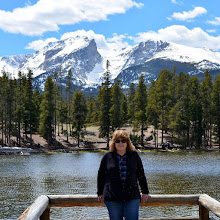
Culloden is a tract of moorland located in the county of Inverness, in the Scottish Highlands. As we drove towards the battlefield, our tour bus passed through charming towns and breathtaking scenery.

Crossing over the River Ness into Inverness

Our tour guide told us to quickly glance to see these bible passages engraved on the wall of a building in Inverness. Luckily, I could snap a few photos of them as our tour bus passed them. They are a series of thirteen verses carved on the first floor walls of a city center building on the High Street. The building dates back to 1815 and at one time was the Athenaeum Hotel. Our tour guide said they were placed there to remind local politicians of their Christian duties.

Please click on the photo collage above to enlarge it.
We arrived at the Culloden Battlefield and Visitor's Center
The Highlanders finally broke and fled, and some 1,000 more were killed in subsequent weeks of hounding by British troops. Hunted by troops and spies, Prince Charles wandered over Scotland for five months before escaping to France and final exile. The Battle of Culloden marked the end of any serious attempt by the Jacobites to restore the Stuart Dynasty to the British throne.

During the battle, a similar cottage stood on this spot and served as a field hospital for Government soldiers. Over time, the cottage has seen many changes.
After falling into disrepair, Leanach Cottage was rebuilt in the early 19th century. The cottage became a symbol for the battlefield, and the people who lived there became the site’s first tour guides. The cottage’s last resident, Mrs Annabelle Cameron (née Belle Macdonald) moved out in 1912 and the cottage stood empty. In 1944, Leanach Cottage was given to the National Trust for Scotland by Hector Forbes, the landowner. In the early 1960s, the cottage became the first ‘museum’ at Culloden Battlefield.


Today, Leanach Cottage houses temporary exhibitions relating to the battlefield. These exhibitions cover current research including new archaeological discoveries, people’s connection to the battlefield, and the threats to the battlefield in modern times.


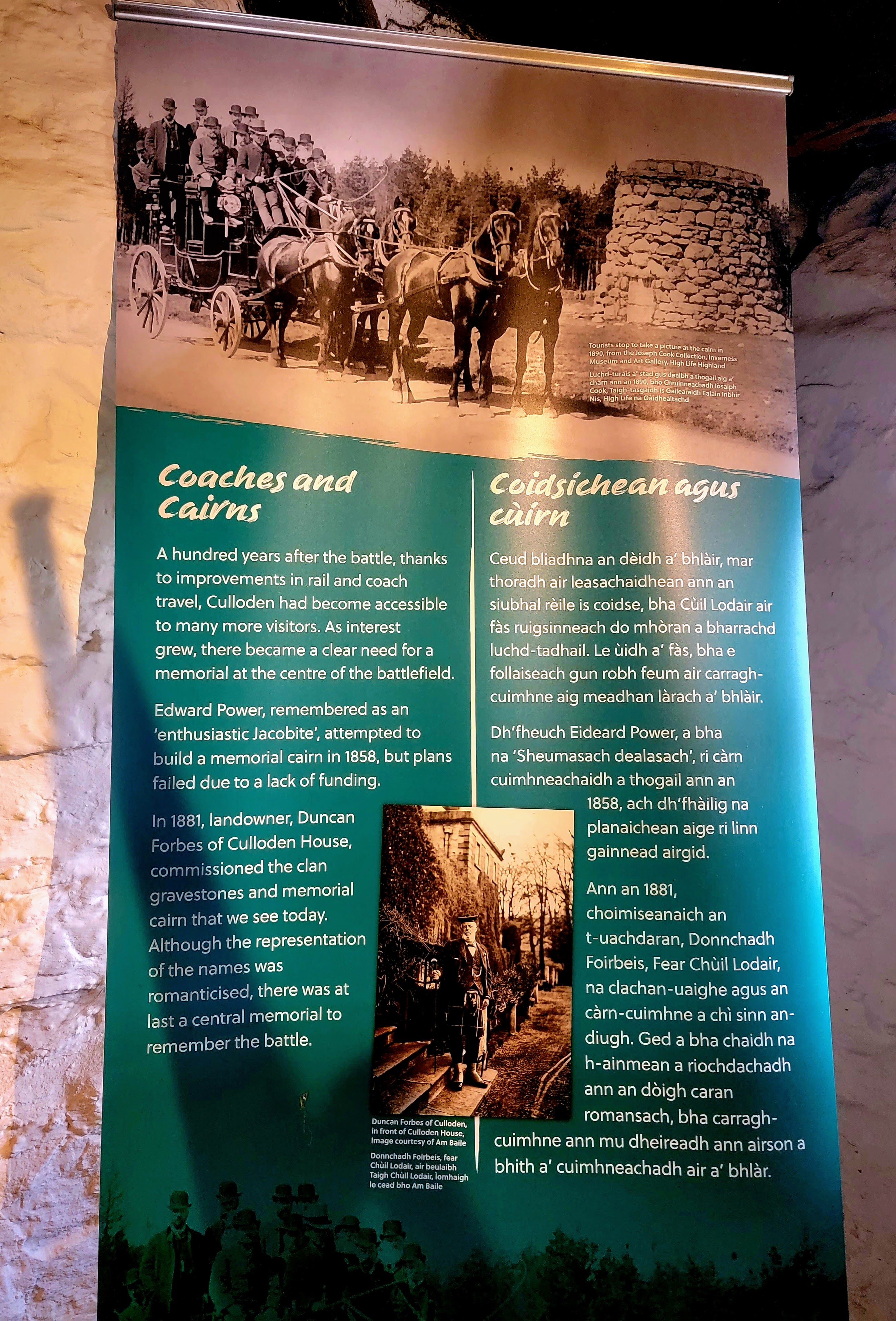
One of the most recognizable features of the battlefield today is the 20-foot (6 m)-tall memorial cairn erected by Duncan Forbes in 1881.


The Culloden viaduct consists of 29 arches and was designed by Chief Engineer Murdoch Paterson and constructed by the Highland Railway. It spans over the valley and River Nairn and is the longest masonry viaduct in Scotland, measuring 1800ft (549m) in length. The viaduct was opened in 1889 and remains in use today as the primary rail link into the Highlands.


Leanach Cottage
During the battle, a similar cottage stood on this spot and served as a field hospital for Government soldiers. Over time, the cottage has seen many changes.
After falling into disrepair, Leanach Cottage was rebuilt in the early 19th century. The cottage became a symbol for the battlefield, and the people who lived there became the site’s first tour guides. The cottage’s last resident, Mrs Annabelle Cameron (née Belle Macdonald) moved out in 1912 and the cottage stood empty. In 1944, Leanach Cottage was given to the National Trust for Scotland by Hector Forbes, the landowner. In the early 1960s, the cottage became the first ‘museum’ at Culloden Battlefield.

Please click on the photos above to enlarge it.

Thatching on the cottage is made from heather collected from the battlefield and then crafted together by local tradesmen, while the walls are a mixture of stone and turf.

Please click on the photo to enlarge
Please click on the photo to enlarge it.

Please click on the photo to enlarge it

Please click on the photo to enlarge it.

Please click on the photo to enlarge it.

The Culloden Battlefield was once wild fields of heather grazed upon by cattle. Since 1746, people from all around the world have visited the battlefield. The story of the Jacobite Risings has influenced works of art and literature across many generations, from "The Skye Boat Song" to the Outlander series..

In 1881, Duncan Forbes, the landowner of the moor, placed stone markers to show where most of the battlefield soldiers were buried.

As we walked along we saw stones for prominent Jacobite Scottish clans who fought and died on the battlefield.


Some stones were marked "mixed clans"


Inscription plaque on the cairn.

Another stone of note is for the Frazer clan, due to the popularity of the novels by Diana Gabaldon and the subsequent TV series "Outlander."

The novel features Jamie Fraser, a hero of historical fiction. It looked like a visiting fan left a bouquet of roses in front of the Fraser Clan stone.

Have you read the Outlander books or watched the TV series?

We spent a lot of time on the battlefield so we only had a few moments inside the Culloden Visitor Center.
A group of volunteers were there, entertaining visitors with music.

We were back on the bus passing beautiful fields full of sheep...

...and Highland cattle!

Another sight our tour guide pointed out to us was the Culloden Viaduct.

We were on our way towards the Victorian town of Pitlochry in the heart of Scotland-- more about that pretty town in my next blog post.
You can also find me on:
I'm linking with:
Mosaic Monday, Hello Monday, Through My Lens Monday, Hearth, and Soul Link Party, Anything Goes Monday, You Are the Star Blog Hop, Nature Notes, Home Matters Linky Party, Senior Salon Pit Stop, Good Random Fun, Happiness Is Homemade, Tuesdays With A Twist, Talk About It Tuesday, The Happy Now Tuesday, Wordless Wednesday on a Tuesday, Wordless Wednesday, Wordless Wednesday 2, Wednesday My Corner of the World, Wonderful Wednesday, Thankful Thursday, Little Things Thursday, Thursday Favorite Things, Skywatch Friday, Fantastic Friday, Saturday Sparks, Saturday Critters, Sunday on Silver


 Posts
Posts