Showing posts with label Colorado Museums. Show all posts

Sunday, May 3, 2026

A Littleton Museum Visit With Friends


The Littleton Museum, located at 6028 S. Gallup Street in Littleton, Colorado, is one of the region’s premier cultural destinations and one of the top ten history museums in the United States.. It features two authentic living history farm sites, one representing 1860, and the other 1890, located on the museum's 40 acres. Earlier this year, the Littleton Museum renewed its accreditation from the American Alliance of Museums, a prestigious designation held by only 3% of museums in the country, and was the first museum in Colorado to be recognized as an Affiliate of the Smithsonian.
The museum building includes a permanent exhibit focusing on Littleton's history, as well as two rotating galleries.


We went on an outing with friends to see the newest history exhibit at the museum, which presented a selection of objects from the museum’s collection of historic artifacts that celebrate both the 150th anniversary of Colorado’s statehood and the 250th anniversary of the founding of the United States.  This exhibit will run to the end of 2026.


Please click the photos above and below to enlarge them for easier viewing of the contents and writing.


As the nation commemorates the semiquincentennial – or 250th – anniversary of its founding throughout 2026, Colorado will be celebrating its 150th anniversary, called the “sesquicentennial.” Because Colorado is the only Centennial State, it is the only state that will observe dual anniversaries with commemorative events year-round.

Please click on the photo collage to enlarge it.


The Littleton Museum's History Gallery had multiple timeline displays in the exhibit that began with evidence of the area's prehistoric days, to the native tribes that lived here, and the Spanish and French explorations of the area, before the 1859 Colorado Gold Rush brought more European settlers west and to what would become Littleton.


According to the Museum website and displays:

"As the fledgling metropolis of Denver City began to grow, the need arose to construct a series of ditches to carry water to farms and businesses without ready access to rivers and creeks in this arid land. Among the engineers hired to lay out this system was young Richard Sullivan Little of New Hampshire.

Surveying in an area several miles south of Denver, Little fell in love with the site of present-day Littleton. Upon filing a home stake and other land claims, Richard brought his wife Angeline from the East in 1862, the dry climate all but curing her asthmatic condition, and began to farm. The Littles joined with several neighbors to build the Rough and Ready Flour Mill in 1867, providing a solid economic base in the community for years to come.

In 1872, the Littles filed a plat to subdivide much of their property into the village of Littleton. When the Denver and Rio Grande Railroad reached the area in 1871, settlement began at a rapid pace. By the time of Colorado's statehood in 1876, there were schools, churches, a hotel, stores, and many of the other trappings of western settlement. In 1890, the 245 residents voted to incorporate the Town of Littleton."


The museum displays had many interesting period artifacts...

...we spent a few hours reading and learning about Littleton's history and development.


I also enjoyed seeing the beautiful handmade quilts on display...


...this one depicted scenes of an early Littleton


The quilt above, and the one below, were made to celebrate Littleton's Centennial in 1990.


The grounds of the Littleton Museum have two historic farm sites dating from 1890 and 1860.


There are also many farm animals on the grounds.

 
We all enjoyed visiting the 1865 first schoolhouse in Littletonwhere a costumed reenactor teacher told us and some schoolchildren who were also visiting the museum on an outing, what going to school was like in that era.


After leaving the museum, we all had a delicious lunch at Romano's Italian Restaurant, which has been a favorite fixture in downtown Littleton since 1967. 
We had this pretty view as we left Littleton to drive West, back toward the Front Range foothills, where our neighborhood is located.

It was the end of a perfect afternoon!


Sunday, January 25, 2026

The Madden Gallery at the Museum of Outdoor Arts in Colorado


Our daughter works in an office building in the Greenwood Village area of Colorado and wanted to view an exhibit in a new gallery, part of the Museum of Outdoor Arts (MOA), which opened in the fall of 2025. We had a prior visit to the Marjorie Park Sculpture Park in July of last year, and we were also interested to see the indoor gallery.  We met our daughter at her office during her lunch hour to walk over to the Palazzo Verdi, a 15-story office building located at 66363 Fiddlers Green Circle. 


The Palazzo Verdi's building lobby space was recently renovated to include the 10,000 sq foot Madden Gallery, which will host three to four temporary art exhibitions each year.
Formerly known as The Madden Museum of Art, the gallery space was founded by MOA Co-Founders John and Marjorie Madden and first opened in October 2008 alongside the debut of the Palazzo Verdi office building. The Madden Gallery now offers regular hours, is open to the public, and is currently free of charge.


The first exhibit was "Metaphorming TIME" by Todd Siler.

Exhibition Dates: October 21st 2025 – February 13, 2026


According to the Madden Gallery's web site

This exhibition showcases a selection of Todd Siler’s paintings, sculptures, drawings, monotypes, and artist’s books—works he calls “Metaphorms.” Rooted in the creative processes of the human brain, Siler’s art fuses symbolic language, metaphor, and invention to explore time as the universal connector linking all aspects of life.

Through neural-inspired textures and thought-provoking imagery, Siler examines humanity’s past, present, and future: how we confront urgent global challenges, how civilizations rise and fall, and how creativity can shape a more sustainable future. His practice, grounded in the principles of ArtScience and STEAM (Science, Technology, Engineering, Arts, and Mathematics), invites viewers to engage as “Metaphormers”—lifelong learners, creators, and problem-solvers.

Metaphorming TIME is both a reflection on human ingenuity and a call to collective action, inspiring audiences to imagine and build a better world together.


Siler explains his predominantly mixed media art on his website:

"I’m a Cerebralist! I meld abstract and representational forms with sensual and conceptual elements, using all media and means of communicating. For the past three decades, I’ve explored the nature of the human mind and creative process: how we think, create, learn, invent, innovate, and communicate. My art shows how the mind is connected to all of its creations: from the words we use to describe our thoughts & feelings to the technologies we build to see everything in the world that words cannot fully describe...


...Cerebralism encompasses all forms and expressions of art. Through art, we can connect and transform everything (information, knowledge, ideas, experiences) to create new meanings and purposes for everything. Art makes life meaningful. It inspires wonder, while challenging the limits of our vision and imagination."


Please click on the photo above to read more about the exhibit and the artist's descriptions.


We all enjoyed getting a close-up look at all the elements incorporated in his artwork.


A small section of the Madden Gallery still had some of the former exhibits when the space was called the Madden Museum of Art before the renovation.


John W. Jr and Marjorie Madden were avid art collectors and together amassed an impressive and diverse collection. The Maddens' collecting philosophy centered around the places they were inspired by in their travels and the relationships they developed with artists.

In January 2016, the University of Denver was pleased to accept the Madden Collection as a permanent addition to the University’s holdings. John W. Madden, Jr., developer of the Fiddler's Green campus in Greenwood Village, CO., donated a collection of 133 artworks valued at $10 million to the University of Denver.


Please click on the photo above to enlarge it to read more about John Madden.


There was also a wonderful tribute to his wife, Marjorie Madden, and their family history.


There was some "rare to us this winter" snow on the ground when we left the Madden Gallery this past December...


...but our spirits were warm with the 
Joy of all the beauty we just saw inside!


The pretty snowy mountain view from our daughter's office's outdoor parking lot.

We enjoyed our visit to the Madden Gallery and agreed that their mission to "make art a part of everyday life" has certainly been accomplished through their generosity!

Sunday, November 20, 2022

Colorado Mines Museum of Earth Science Part 2


In my last blog post--click here-- I showed part one of the Mines Museum of Earth Science located at the Colorado School of Mines  On the upper floor of the museum is a vast collection of rocks and minerals and other fascinating Earth Science related materials. On the lower level, located inside a large safe display is one of two Goodwill Moon Rocks collected during the Apollo Moon Mission. (All the photos in this blog post will enlarge for easier viewing if clicked on)


The full moon rock display of the largest moon rock.

In 1974, President Nixon gave each state and 160 countries a set of two “Goodwill” moon rocks collected during the Apollo 17 mission. 


More information from the display.


Another display had this small portion of a moon rock from the Taurus Littrow Valley, along with a small flag of the State of Colorado that accompanied the astronauts to the moon!


The full display of this moon rock


Further info about the rock from the display.

Colorado has a rich history of space exploration, with 21 astronauts either born or having attended college in Colorado. The state is home to one of the largest aerospace industries in the country, boasting 300 aerospace-related companies


Inside another safe is the Miss Colorado Crown containing over 600 gemstones and 21 diamonds. 

The Miss Colorado competition is the pageant that selects the representative for the state of Colorado in the Miss America pageant. Colorado has won the Miss America crown on three occasions.


Please click on the photo to enlarge it


The tiara was worn by Miss Colorado for the first time in July 1973.


The crown features a variety of gems, including aquamarine, the state gemstone. White zicrons at the top of the crown represent the snow and ice of the Rocky Mountains, while dark blue sapphires below symbolize water. Twenty-one diamonds in the centers of Columbine flowers feature amethyst petals, the leaves around them made from dark green tourmalines and light green peridots. At the base of the crown, lightly golden and orange citrine and topaz resemble wheat.


More info about the crown from its display.


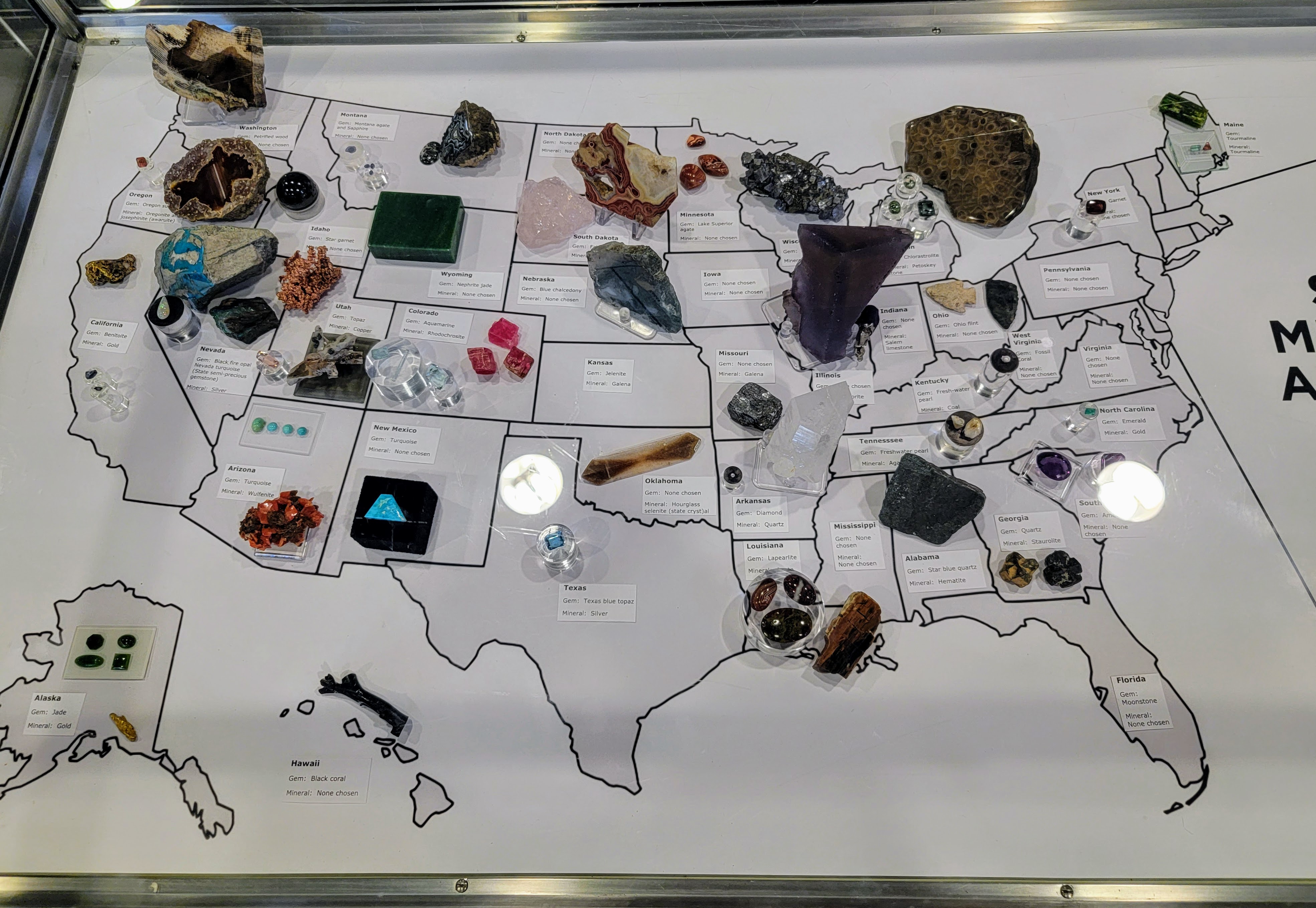
Most of the museum's collections of gemstones and minerals are on display on the upper level, but there was this interesting map of the USA with the most common minerals found in each state.


There were also collections in the lower level from all around the world. This display showed minerals from Europe


Minerals from Africa


Minerals from India, Pakistan, Afghanistan, Australia, and Asia


There are also some displays of fossils in the museum.  An Ursus Spilaeus or Cave Bear skull from Romania is in the photo above.


A Mastodon tusk from Alaska, and two Mastodon teeth.


Various other fossils


A 67-pound Canyon Diablo Meteorite was found in a crater in Coconino County, Arizona.


There was a walk-through mine exhibit in the museum that contained this amazing ultraviolet mineral display.  With the flick of a switch, the minerals on the left would glow with their natural fluorescence under short and long-wave ultraviolet light.


One could spend hours reading all the displays showing mining tools, the ways minerals are incorporated into objects that are in use today, and many other aspects of earth science.  Visiting the Mines Museum of Earth Science is certainly a wonderful way to learn more about the scientific richness of our earth.


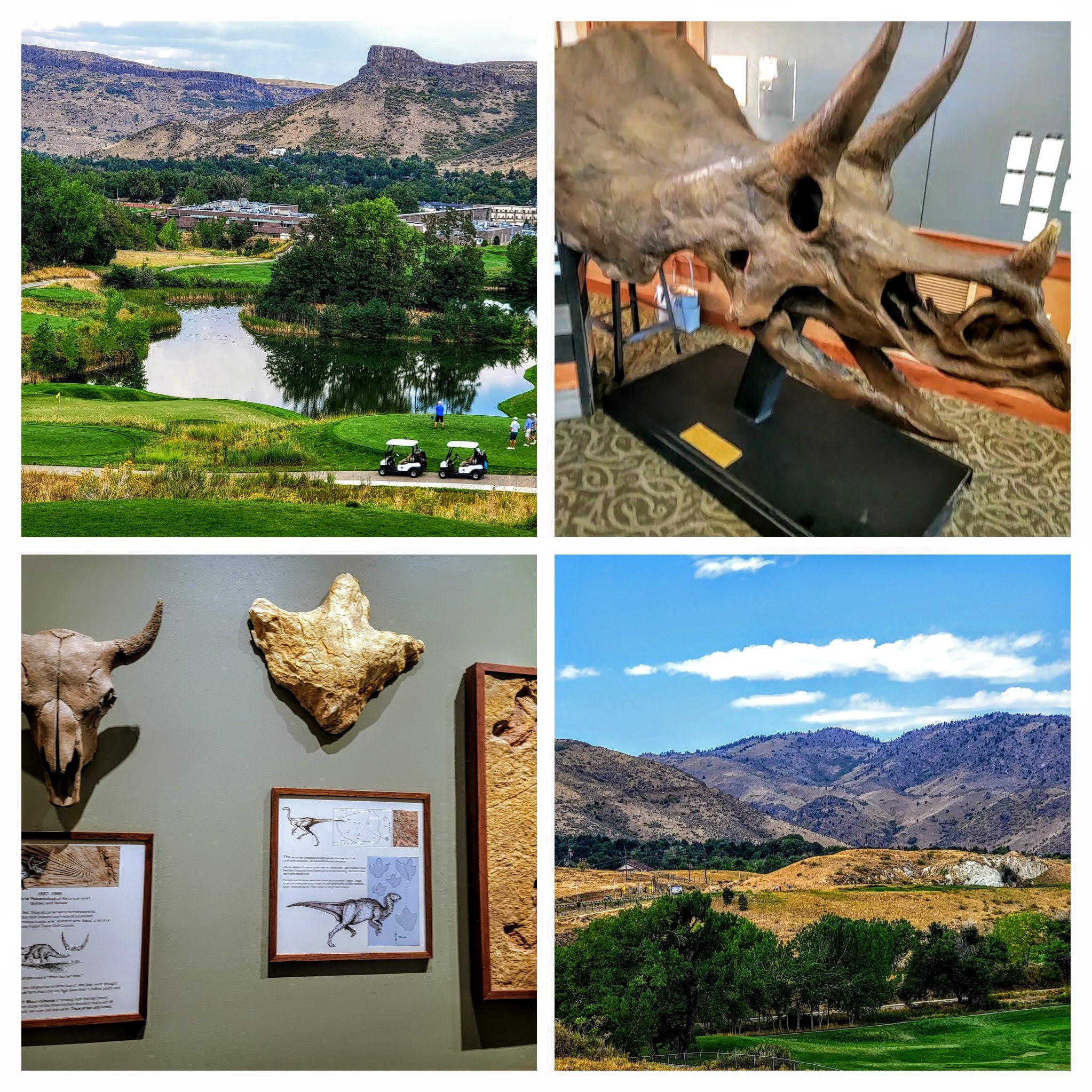
After our museum visit, our friends and my husband and I drove over to the nearby Fossil Trace Golf Course in Golden, Colorado, where we had a delicious lunch at Schnepf's Restaurant inside the clubhouse. The golf course and restaurant views are very scenic and inside are other examples of fossils found in the area.

 It was the culmination of a perfect day out together!


Wishing all who celebrate this week a very Happy Thanksgiving! I'll be taking next week off from blogging as it will be a very busy time for me. I'll be back in December,  See you then!

You can also find me on


Bookmark and Share