Showing posts with label Historical People of Colorado. Show all posts

Monday, May 25, 2026

The Colorado Governor's Residence at Boettcher Mansion


After attending the Rotary Club of Denver Metro South's meeting in April for "Operation Pollination" -- last week's blog post on this link--we were able to take a tour of the Colorado Governor's Residence at Boettcher Mansion in Denver, Colorado.

Designed and built for the Cheeseman family in 1908, and later purchased by the Boettcher family, this mansion was deeded to the state in 1959. The Georgian Revival residence became the Governor's Mansion in 1960.

More about the home's history can be read on this link.


This was not the first time I visited the Governor's Residence. Twice before, my husband and I visited during open houses when the residence was professionally decorated for the Christmas season. You can see those posts here and here.


On this visit, I was looking forward to seeing the home without decorations and with fewer visitors. There were multiple docent tour guides from History Colorado to break up our group into smaller groups to take us on a guided tour.


The entrance door and hall.


The three-story staircase leads to the private quarters. The upstairs portion is 7,000 square feet with six bedrooms and seven bathrooms.

The present Governor of Colorado is Jared Polis, and he and his partner do not live in the residence, as they decided to remain in their home in Boulder, Colorado, because their young children attend school there.


The Library

The library shelves contain the complete works of Thomas Jefferson, a signed copy of A King’s Story: The Memoirs of the Duke of Windsor, and several first editions.


The Library features a rare French Louis XIV-style tulip wood cylinder desk.


The Library carpet depicts Colorado wildflowers, and window shelves looking into the Palm Room display Boettcher era collectibles.


The Drawing Room


 The Waterford cut crystal chandelier, which graces the Governor’s Residence drawing room, hung in the White House ballroom in 1876, when President Grant presided over America’s centennial celebration—the same year Colorado became a state.


More views of the Drawing Room.

After its completion in 1908, the first big event held inside this room was the wedding of John Evans II and Gladys Cheesman, the daughter of Walter and Alice Cheesman. Our Docent told us that the childhood sweethearts wed in front of the fireplace, with Gladys walking down the staircase to meet her groom instead of walking down an aisle.


The Drawing Room features a 1914 Steinway grand piano played by notables such as Liberace and John Denver.


Claude Boettcher and his wife Edna expanded the residence with the addition of the glass and marble Palm Room and furnished the home with the art and treasures they found on their travels throughout Europe and Asia. The room looks out to the SouthTerrace Garden.

On our visit, a portion of the room was filled with a table and chairs set up for a meeting.

The Dining Rooms and Kitchen


Colorado State China on display. The smallest dish had an imprint of the Rocky Mountain Columbine, our state flower.


The Bar Room

The last room we visited was the Bar Room, as our tour of the first floor of the mansion came to an end.
Mr. Boettcher's model ship, the “Cutty Sark,” is on display on the bar.


One wall had portraits of all the past and present Colorado Governors.

More views of the Bar Room.

Situated atop Logan Hill, the magnificent Governor’s Residence at the Boettcher Mansion, and its one-acre grounds, has entered its second century of helping to create Colorado history. 
Known as "Colorado's Home," the Residence has played host to national and world heads of state and dignitaries.

It was a pleasure to revisit it, and I hope you also enjoyed my photo tour.

I can also be found on


Sunday, April 19, 2026

The Higlands Ranch Mansion in Highland Ranch, Colorado


The Highlands Ranch Mansion is located in the Highlands Ranch Community, part of Douglas County, Colorado Highlands Ranch has a long and interesting history, which my husband and I learned about on a lecture and tour we attended at the mansion. 


At one time, most of the Front Range land west of the city of Denver became farm and ranchland, as settlers from the East came West.


Please click on to enlarge. 

The first to settle in this area was Samuel Allen Long, who came from Pennsylvania in 1884 and filed a 40-acre Homestead claim. He expanded his claim to 2,000 acres a few years later and, in 1991, built a barn and farmhouse which he called Rotherwood Ranch.


Please click on to enlarge.

John W. Springer, a wealthy man with ties to politics, banking, and law, became the new owner from 1897 to 1913, and he renamed it to Springer Cross Country Horse and Cattle Ranch. He expanded the home to include a turret and gave it a castle-like appearance.  Springer became the first president of what was then called the National Livestock Association. 
He became the area's largest landowner. He bought the property through a series of purchases while he was married to his first wife, Eliza Hughes Springer. The ranch grew to 12,000 acres, and Springer pursued his interest in show horses, raising rare German Oldenburg Coach StallionsAfter his first wife, Eliza, died, and his second wife was involved in a murder scandal, he sold the Colorado ranch to Eliza's father, Colonel William E. Hughes, in 1913.

Please click on to enlarge

In 1913, Hughes purchased John Springer’s Cross Country Horse and Cattle Ranch, changed the name to Sunland Ranch, and continued to operate it as a working ranch. At the time of his death in July 1918, it was estimated that Hughes was Colorado’s second-wealthiest man (the first being Lawrence Phipps, Sr.). Hughes bequeathed Sunland Ranch to his granddaughter Annie, who sold it two years later to oil tycoon Waite Phillips.


Please click on to enlarge

Waite Philips purchased Sunland Ranch in 1920 and used it as a breeding location for high-grade horses and cattle. He consolidated the ranch with other nearby land purchases to create a prodigious spread called Phillips Highland Ranch, named after the Highland Hereford cattle he raised here.

Please click on to enlarge

In 1926, Frank Kistler purchased Highland Ranch from Waite Phillips, renamed it the Diamond K Ranch, and began breeding operations that specialized in dairy and Angus cattle, sheep, chickens, and hogs. During his time living on the ranch, he did extensive renovations on the ranch, converting it from a castle to an English Tudor-style home.


Please click on to enlarge

The last ranch owner was Lawrence Phipps, Jr., who named it Highlands Ranch. As one of the largest ranches in Colorado, it hosted the Arapahoe Hunt Club for more than 40 years.  Upon Lawrence’s death in 1976, the ranch passed to his estate, which handled its sale to Marvin Davis, head of the Highlands Venturers Corporation. 


In 1978, Highland Venturers sold the property to Mission Viejo Company, and development began of the modern community called Highlands Ranch. Mission Viejo sold Highlands Ranch to Shea Homes in 1997. In 2010, Shea Homes gave the Mansion property and funds for renovation, as well as an endowment to the Highlands Ranch Metro District.
 The Highlands Ranch Metro District became the new owner of the Highlands Ranch Mansion in April.  On June 15, 2012, the Highlands Ranch Metro District hosted the grand opening of the renovated Mansion, inviting the community to enjoy this community treasure.

We toured the open rooms of the mansion...


Full descriptions and historical photos of each of the mansion's rooms can be seen on this link.


Much of the original furnishing remains. I loved the stained-glass lighting fixtures!


The extensive, long hallway is tiled in Italian Terrazzo tile and was used for formal dances by one of the owners.


The multiple dining areas have gorgeous tapestries.


The butler's pantry was filled with interesting period china and other artifacts.


Surrounded by 250 acres of ranchland and tucked away in a beautiful Highland Ranch neighborhood, at 9950 Gateway Dr, Highlands Ranch, CO 80126-3022, the Mansion is less than 20 miles south of downtown Denver, and is a 45-minute drive to Denver International Airport.

Go to the Highlands Ranch Mansion calendar or call 303.791.0177 for more information about free tours or special events held at the mansion. 
The Highlands Ranch Mansion website will also provide information about renting the mansion for special events, such as weddings or business conferences.

It is well worth a visit to learn more about the long ranching and development history of this part of Colorado.


Sunday, January 24, 2021

Horace Tabor and the Tabor Opera House in Leadville, Colorado

The Tabor Opera House. Leadville, Colorado

Leadville, Colorado, is the highest elevation city in North America at 10,152 feet (3094.3 m). It lies among the headwaters of the Arkansas River in the heart of the Rocky Mountains. It was a rough and tumble mining town when the district started out as a gold placer mining settlement during the Colorado Gold Rush and was first called Slabtown. When large amounts of silver were discovered in the 1870s it became one of the world's largest and richest silver producers and its name was changed to Leadville.


 In February of 1878, an election was held in Leadville and Vermont native Horace Austin Warner Tabor (often referred to as H. A. W. Tabor) became the first mayor of the town. Tabor was a local storekeeper in Leadville and was one of the original pioneers of the area in 1860.  As a shopkeeper, Horace Tabor made a habit of grubstaking prospectors that were newly arrived in Leadville (grubstaking was the practice of supplying prospectors with tools and supplies in exchange for a percentage of any discoveries they make). 

Two young German immigrants that Tabor had grubstaked made a fabulous silver strike on Fryer Hill which would become known as the Little Pittsburg mine. Almost two million dollars in silver would be taken from the mine in just two years. Tabor's one-third interest in Little Pittsburg made him a rich man. He invested his returns in additional claims which often proved just as rich. Tabor would ultimately become the leading tycoon of the district and a prominent figure in both Leadville and all of Colorado.


Tabor wanted to bring arts and culture to Leadville so he had the Tabor Opera House constructed in 1879 in just 100 days at a price of $40,000--an exorbitant price at that time. The building materials he wanted weren’t available in Leadville, so he had them brought by wagon over Colorado’s highest mountain passes. Sparing no expenses, the massive three-story opera house was made of stone, brick, and iron, trimmed with Portland cement. Its solid brick walls stand 16 inches thick!  The opera house's ornate interior had richly painted walls and ceiling frescoes, custom carpets, hand-painted stage curtains, and the first gas lights in Leadville.  


Eventually, the Tabor Opera House became known as the finest opera house west of the Mississippi. Luminaries such as Oscar Wilde, John Philip Sousa, Buffalo Bill, actress Sarah Bernhardt, performer Anna Held, and more celebrities appeared at the Tabor.

Tabor lost ownership of the opera house because of the Silver Crash of 1893, as he lost his fortune. In 1893, Judge A.S. Weston bought the Tabor Opera House for $32,000 when the Tabors defaulted on a note to A.V. Hunter.  It has other names and owners through the years--a full history can be read on this link.  The City of Leadville bought the building in 2016 and is making progress on a rehabilitation project estimated to cost $10 million. Leadville's nonprofit Tabor Opera House Preservation Foundation and dedicated community members are finding all possible resources to save the grande dame of Leadville.


Tours of the Tabor Opera House are expected to return in the spring of 2021.  If you watch the YouTube video below you can see some of the interiors and learn more about this beautiful opera house.


Due to his wealth and popularity in Leadville, Tabor was elected as Lieutenant Governor of Colorado in 1878 and served as interim U.S. senator from 1883-1884. Tabor, a married man, had an affair with a young woman, Elizabeth McCourt, who was nicknamed "Baby Doe." He divorced his wife Augusta and married Baby Doe in March of 1883. The entire affair was considered scandalous. Subsequent attempts to run for governor in the 1880s were unsuccessful as Tabor's status among Denver's elite soured, and he lost support for his reelection.  Horace Tabor died penniless, of appendicitis, in 1899. Baby Doe moved back to Leadville to live on one of Tabor's last holdings, the Matchless Mine. She lived alone, in a cabin at the mine, for over 35 years. During the winter of 1935, Baby Doe was found frozen to death in her cabin.  You can see Baby Doe's cabin and the Matchless Mine on my blog at this link.

Leadville is certainly an interesting place to visit, full of rich mining history and legends of the wild west that once walked its streets, such as Horace Tabor, Baby Doe, Doc Holiday, and Molly Brown.

To see more photos and attractions of Leadville on my blog click on this link. To see a beautiful scenic train ride my husband and I took with friends on the Leadville Colorado and Southern Railroad click on this link.


You can also find me on

Bookmark and Share

Monday, July 13, 2020

Mother Cabrini Shrine in Golden, Colorado


Last summer my husband and I finally took a ride up to the Mother Cabrini Shrine in Golden, Colorado. For years we had seen the statue in the distance on the top of a foothill, that you see in the photo above, from Interstate 70 whenever we returned home from a trip to the Rocky Mountains, and we'd both say: "someday we have to take a ride up there!"  Mother Cabrini, officially known as Saint Frances Xavier Cabrini, was well known to us as the "Patron Saint of Immigrants," and was revered in New York City for her work as a missionary sister working to help Italian Immigrants in the late 1800s. In 1889, New York seemed to be filled with chaos and poverty, and into this new world stepped Italian-born Mother Frances Cabrini and her missionary sister companions. Cabrini organized catechism and education classes for the Italian immigrants and provided for the needs of the many orphans. She established many schools and orphanages despite tremendous odds.

You can read more about her on the Missionary Sisters of the Sacred Heart of Jesus web site--the religious order which she founded in 1880.


Mother Cabrini also loved the mountains of Colorado and the foothills west of Denver held a special attraction for her. During her journeys in 1902 to visit the Italian workers and their families in the Clear Creek, Argentine, and South Park mining districts, Frances X. Cabrini discovered a property on the east slope of Lookout Mountain owned by the town of Golden. No reliable source of water was known to exist on the property at that time, although there were two fine barns and a springhouse built in the 1890s. In 1909-1910, she negotiated the purchase of this property as a summer camp for her charges at the Queen of Heaven Orphanage in Denver, Colorado. A farming operation, with poultry, other livestock, and dairy cows, was established and maintained by three of the Sisters of the Sacred Heart who set up living quarters in the loft of the larger barn. During the summer months, groups of about twenty girls, according to age, would spend several weeks at the summer camp. They enjoyed the freedom of the outdoors and recreational activities in addition to tending the animals and performing farm chores.


Please click on photo to enlarge

Mother Cabrini had established Queen of Heaven Orphanage in North Denver in 1902 to take care of orphans of Italian miners killed in accidents in Central City and Blackhawk.  It functioned for over 70 years.


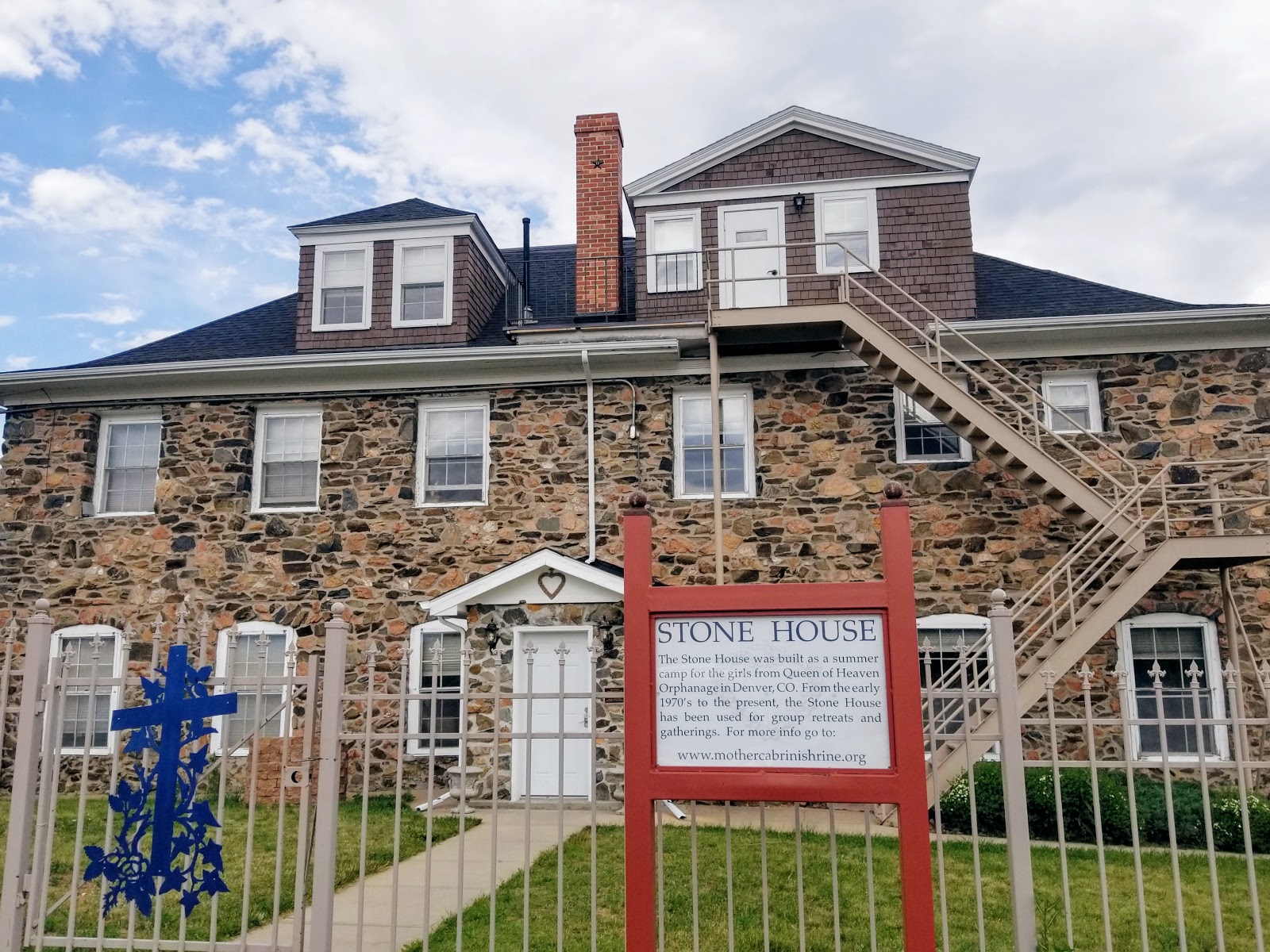
In 1912 during Mother Cabrini’s last visit to the foothills, she and a builder, Thomas Eckrom, drew up the plans for the Stone House that would serve as a dormitory for the girls.  It was completed in 1914. Upon the closing of the Queen of Heaven Orphanage in 1967, the summer camp became a year-round retreat facility and a place for small prayer gatherings.


Moved by faith this land was bought by Mother Cabrini for the orphans but after her canonization as a saint in 1946, and her declaration as "Patroness of Immigrants" by Pope Pius XXII in 1950, it was also turned into a shrine to honor her.  It is now a peaceful place for people of all faiths to gather and reflect and enjoy its serenity.


To reach the top of the shrine one has to climb 373 steps on the Stairway of Prayer.  There are benches along the way in case you need to rest...


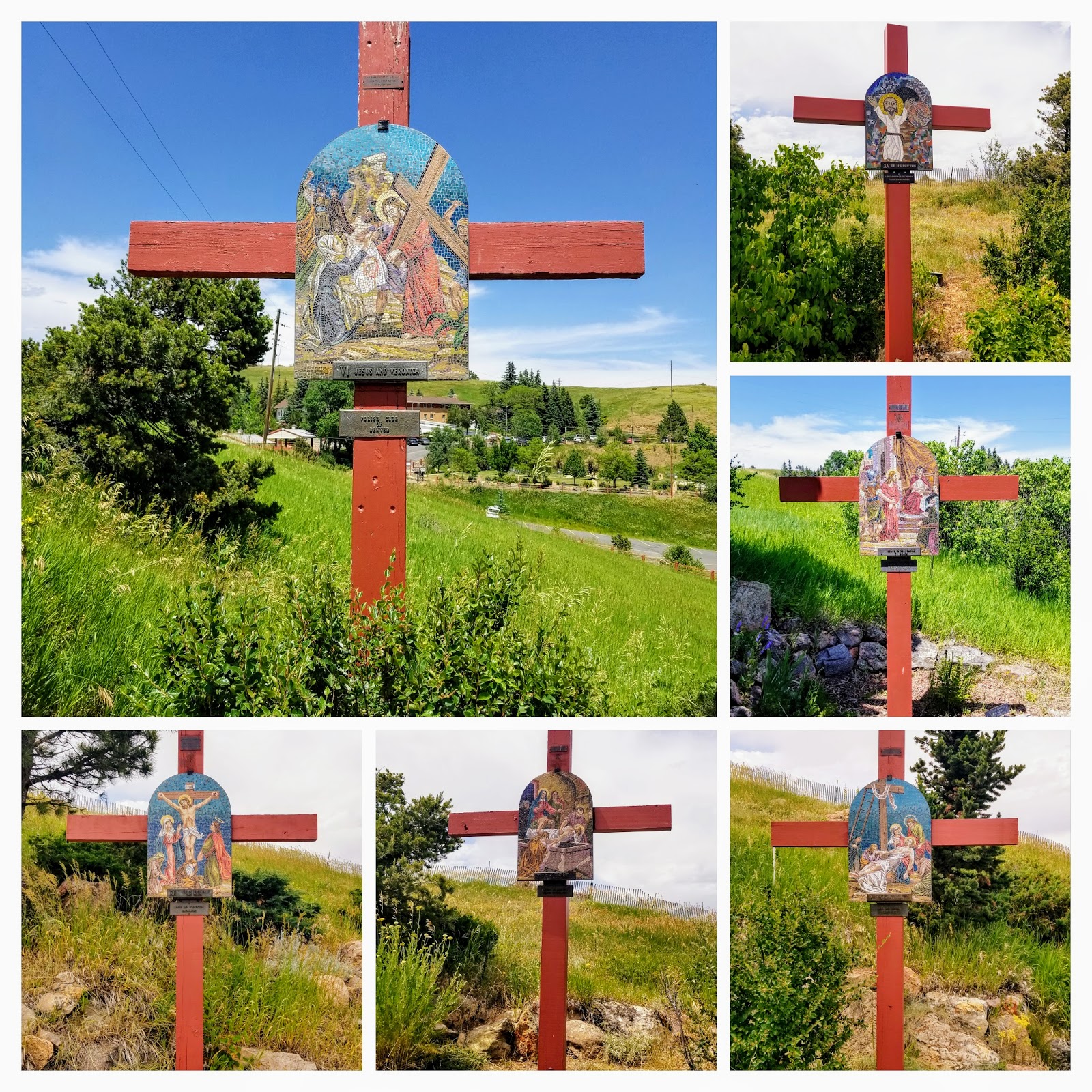
...and there are the 14 Stations of the Cross along the step's path on the ascent.


The stairway follows the path Mother Cabrini, the sisters, and the children took to the top of the mountain.


Each station's picture is made of stone mosaics made in Italy.


As one climbs the steps the city of Denver, can be seen in the distance!


It is quite a view! 


At the top of the hill is this beautiful 22-foot (6.7 m) statue of the Sacred Heart of Jesus, designed by Maurice Loriaux and mounted on an 11-foot (3.4 m) base, which was erected at the highest point of the site in 1954.


Inside the base of the statue is a statue of Mother Cabrini


In front of the statue of the Sacred Heart of Jesus is a heart made of stones enclosed in glass. On her last visit to Colorado in 1912, Mother Cabrini took several sisters and a few of the children from the orphanage by horse and buggy along a cow path to the foot of the highest hill. Leaving the buggy at the base, they climbed to the top where they gathered white stones and arranged them on the mountain in the shape of a heart surmounted by a cross; with the smaller stones, she formed a crown of thorns on the highest promontory, overlooking the city of Denver. Frances X. Cabrini dedicated the hill to the Sacred Heart of Jesus, naming it the “Mount of the Sacred Heart”. Those are the stones still present beneath the glass case and preserved for all to see.


This magnificent statue now looks down on the city of Denver in the distance ...


...and is surrounded by this natural beauty! If you look closely at the photo above or click on it to enlarge it, you can see the snow-capped Rocky Mountains in the distance.  Many people have placed benches at the top in the area around the statue as memorials to their loved ones.


After some prayer and reflection, we walked back down the steps. 


There is a chapel dedicated to Mother Cabrini on the grounds over the water grotto, As you can see by the sign by the altar her birthday is this week--July15th.


At the time the summer house was built for the orphans all of the water needed for drinking and cooking had to be brought up to the summer camp from the stream at the bottom of Mt. Vernon Canyon. In September 1912, the sisters complained to Mother Cabrini that they were dying of thirst and there was no water to be had. She answered, “Lift that rock over there and start to dig. You will find water fresh enough to drink and clean enough to wash.” The spring, which is housed in an 8,000-gallon tank, has never stopped running. Many pilgrims, through their faith, believe the water has brought healing and peace to their lives.  You can see the spigots where this water can be drawn in the photo collage above.

Please click on photo to enlarge

Also, on the grounds is a small museum filled with mementos of Mother Cabrini, including some of her clothes, her writing desk, and some letters.


The work of Mother Cabrini continues in her order.


Last fall my husband and I were invited to attend the 41st Jefferson County Historical Society's Hall of Fame ceremony, as we are members of our community's historical society.  We were pleased to see that Mother Cabrini was one of two "Hall of Fame" award winners for last year, for her good works in Colorado and the fact that her shrine attracts visitors from around the world.  A member of the Legendary Ladies group portrayed Mother Cabrini and told her life story at the ceremony.


This biography of Mother Cabrini and the Hall of Fame plaque will be displayed along with past winners at the Jefferson County, Colorado, Jefferson County Administration and Courts Facility in Golden Colorado.  It is a wonderful and well-deserved honor!

* Edited on 9/30/20 to add that the Colorado Legislature passed Frances Xavier Cabrini House Bill 20-1031 into law, establishing Frances Xavier Cabrini Day as a Colorado State Holiday. The first paid state holiday in the nation that recognizes a woman, Cabrini Day will be observed in Colorado annually on the first Monday in October.

PS: Thank you to all who offered their condolences on the loss of my blog friend, Shelagh, last week.  It was hard to lose a friend who I've known so many years of blogging and who always had a pleasant and uplifting word for me. She will be truly missed!

You can also find me on
 I'm linking this post to the following blog events:

 Mosaic Monday, All SeasonsBlue Monday, Through My Lens MondayLittle Cottage Link PartyHearth, and Soul Link PartyYou Are the Star Blog Hop, Inspire Me Monday,  Good Random FunNature NotesGrand SocialTravel Photos, Photo TunesHappiness Is HomemadeOver the Moon, Our World TuesdayRuby TuesdayTuesday Turn AboutTuesdays With A TwistLet's Keep In TouchWordless Wednesday on a Tuesday,  Party in Your PJ'sWordless WednesdayNanahood WWOh My Heartsie Girl's Wonderful Wednesday, Your Whims WednesdayWednesday My Corner of the WorldWonderful Wednesday Little Things ThursdayThankful ThursdayThursday Encouraging Hearts and Home,  Thursday Thinking Out Loud, Friendship FridaysFriday Features Linky Party, Skywatch FridayPink Saturday

Bookmark and Share