Showing posts with label Dinosaur Ridge. Show all posts

Monday, May 25, 2020

Dinosaur Ridge Geologist Tour


Four years ago my husband and I made our first visit to a nearby scientific attraction in our area, where dinosaurs once roamed, called Dinosaur Ridge. We visited with my daughter and her family--click here--to read that post. Our oldest granddaughter was just 3 at the time!  Last summer we made another visit with a community group that we belong to, on a special tour called "Walk With A Geologist."
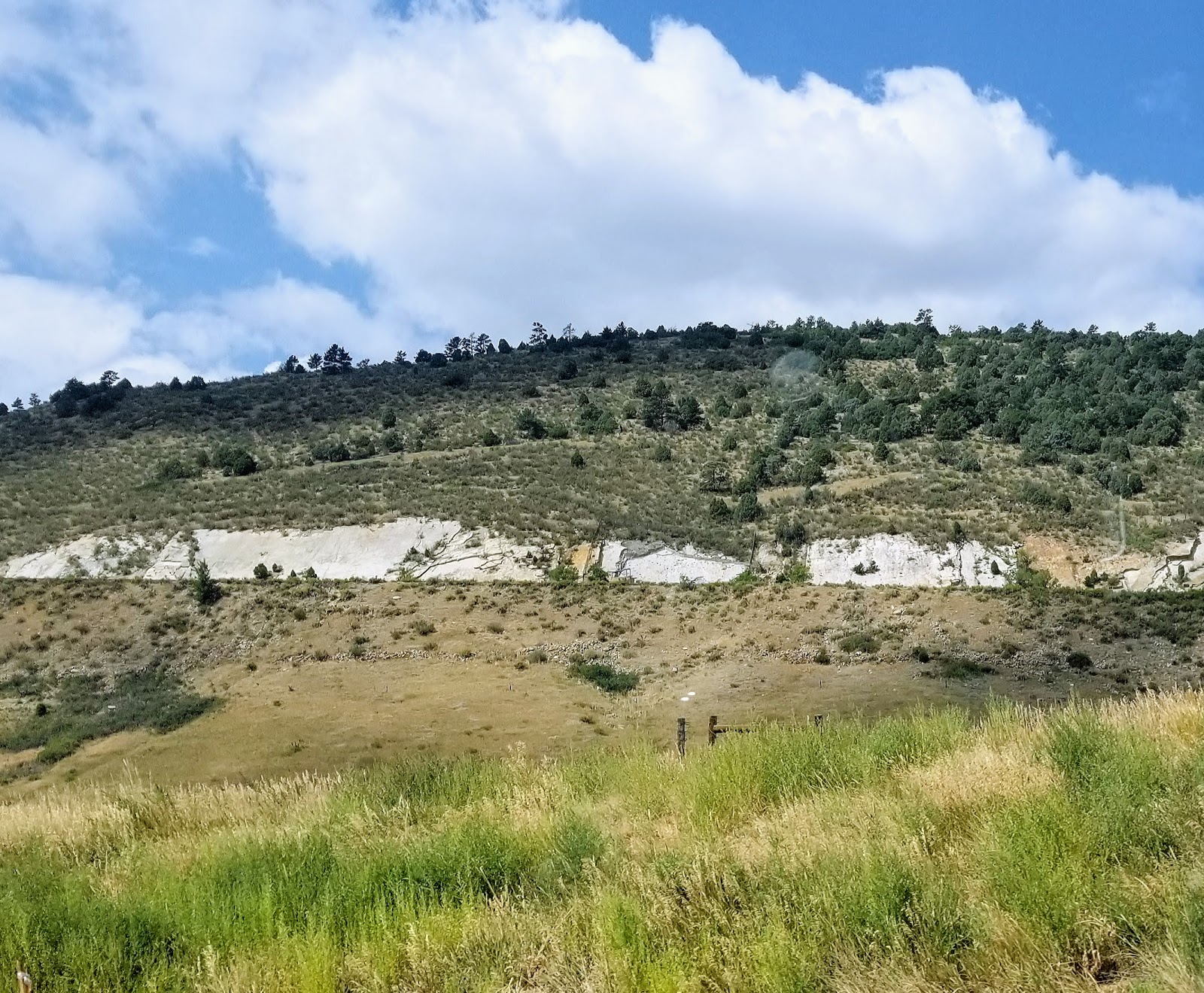


Dinosaur Ridge is located at 16831 W. Alameda Parkway in Morrison, Colorado, and is part of the Dakota Hogback, which you can see in the top left of the photo collage above. It is one of the world's most famous dinosaur fossil locations! In 1877 the bones of many dinosaurs were found here, including Apatosaurus, Diplodocus, Stegosaurus, and Allosaurus. Full-size models of some of the dinosaurs can be seen around the grounds of Dinosaur Ridge. 

In 1973 the Dinosaur Ridge area was recognized for its uniqueness as well as its historical and scientific significance when it was designated the Morrison Fossil Area National Natural Landmark by the National Park Service.


The Dinosaur Ridge Trail (map above--click on to enlarge) is approximately two miles long and has interpretive signs along the way that explain the geologic and paleontological features. The rocks on the east side of the ridge are part of the Cretaceous Dakota Formation. When Alameda Parkway was being constructed in 1937 to provide access to Red Rocks Park, road workers discovered hundreds of dinosaur footprints. along the exposed ridge. The west side of the ridge is called Triceratops Trail and is part of the Morrison Formation of the Jurassic age, and it is where geologist Arthur Lakes discovered the dinosaur bones in 1877.


On this visit, a local resident and retired geologist volunteer with Friends of Dinosaur Risge gave us a very informative tour.  Usually, this is a walking tour, but as we have many seniors in our group we were allowed to drive up the ridge and make stops along the way. The road is now closed to traffic and usually can only be walked or traveled on a shuttle bus service as part of a paid tour.


Here our tour guide is pointing to dinosaur tracks left in what was once the sandy shore of a great sea 100 million years ago during the Cretaceous Period. 


There are many areas on the ridge with hundreds of these footprints left behind by dinosaurs so long ago!


There are also many dinosaur bones to be seen...


... as well as giant imprints of the dinosaurs.   

Dinosaur Ridge is really a fascinating way to travel back in time.


We went up and around the ridge to the western side where we had this beautiful view of the Colorado foothills.


Off in the distance can be seen the famous outdoor Red Rocks Amphitheatre.  The two large red rocks that are seen in the photo above are from its outer walls, with the seating located between them.  I have many posts on my blog featuring concerts we attended at Red Rocks Amphitheatre--here is one--click here--where we saw Josh Groban perform.  It will show what the theater looks like inside.


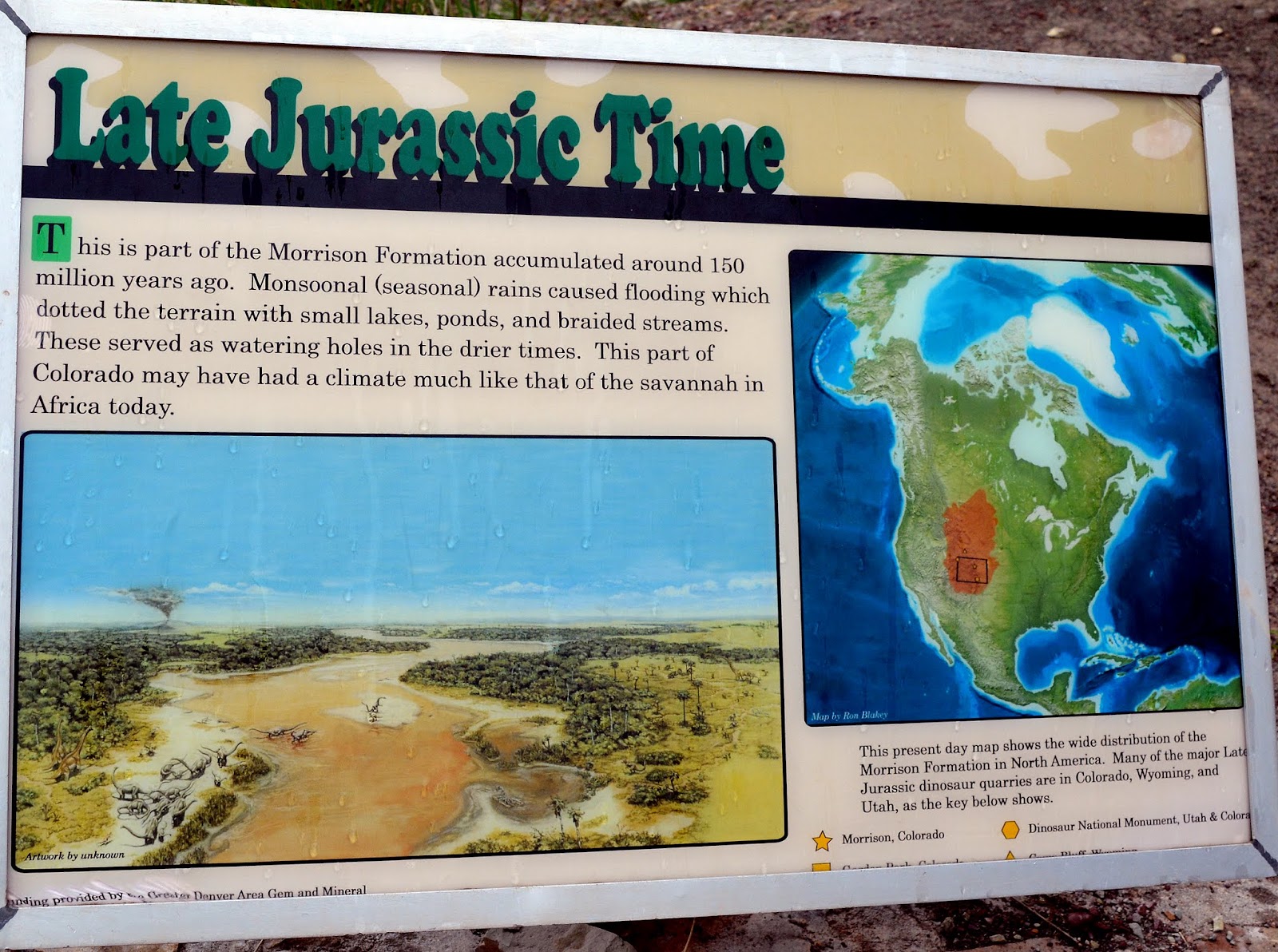
On this side of the ridge, we saw the Morrison Formation.  The Morrison Formation is a distinctive sequence of  150 million-year-old Upper Jurassic sedimentary rock found in the western United States which has been the most fertile source of dinosaur fossils in North America. It is composed of mudstone, sandstone, siltstone, and limestone and is light gray, greenish-gray, or red.


Please click on this to enlarge

The Morrison Formation was named after Morrison, Colorado, where the first fossils in the formation were discovered by Arthur Lakes in 1877. That same year, it became the center of the Bone Wars, a fossil-collecting rivalry between early paleontologists Othniel Charles Marsh and Edward Drinker Cope. In Colorado, New Mexico, and Utah, the Morrison Formation was a major source of uranium ore.


Another area of interest shows the slimy carpet-like beach area where the dinosaurs roamed 92 million years ago. The placard explains that microorganisms created sediment in layers in supratidal zones where the high tide water would saturate and feed the mat and then quickly drain away. This mat was one of the reasons the dinosaur prints were so well preserved.


When the tour was completed we dropped into the Dinosaur Discovery Center to look at the exhibits. They had replicas of scales and horns from stegosaurus, dinosaur claws, casts of footprints, and actual dinosaur bones, as well as other exhibits, and there is also a visitor center and a gift shop.  


Memorial Day 2020
Remembering and Honoring 

You can also find me on


Bookmark and Share

Saturday, June 6, 2015

Dinosaur Ridge


My daughter, son-in-law, and granddaughter invited my husband and me to take a trip with them to Dinosaur Ridge in Morrison, Colorado last week. Dinosaur Ridge is located almost in our backyard--only a short 10-minute drive from our homes and is part of the Dakota Hogbackwhich you can see in the top left of the photo collage above. It is one of the world's most famous dinosaur fossil locations! In 1877 the bones of many dinosaurs were found here, including Apatosaurus, Diplodocus, Stegosaurus, and Allosaurus. Full-size models of some of the dinosaurs can be seen around the grounds of the Dinosaur Ridge Indoor Exhibit Hall.  (All photos and photo collages in this post can be enlarged for easier viewing if clicked on)


As soon as we entered the exhibit hall and my granddaughter saw this skeleton head of a Tyrannosaurus Rex on the wall, she declared"Dinosaurs too scary!" and asked to go back outside with her Mommy and Daddy. Meanwhile, my husband and I took a quick look around the hall.


There were many interesting exhibits, murals, and maps to read with information about the topographical and weather conditions of this location 150 million years ago when dinosaurs roamed the earth. It was quite different from today!


During the late Jurassic time, this land was flat and tropical with the shoreline of a vast sea that sat in the middle. Over the millenniums, earthquakes and volcanoes raised the topography of Colorado to what it is today, and in the process raised the fossils and dinosaur tracks to be in an almost vertical position.


The Dinosaur Ridge Trail (map above--click on to enlarge) is approximately two miles long and has interpretive signs along the way that explain the geologic and paleontological features. The rocks on the east side of the ridge are part of the Cretaceous Dakota Formation. When Alameda Parkway was being constructed in 1937 to provide access to Red Rocks Park, road workers discovered hundreds of dinosaur footprints. along the exposed ridge. The west side of the ridge is called Triceratops Trail and is part of the Morrison Formation of Jurassic age and it is where Arthur Lakes discovered the dinosaur bones in 1877.


The Dinosaur Ridge Trail can be walked......


...or one can take a shuttle bus tour that makes a few stops along the way with a guide for a nominal fee.  We took this option since this was our first visit and we wanted to see the highlights.


This is an example of the multiple layers of rock and sandstone along with the exposed areas.


Our tour guide (man in the hat) would stop the bus at certain points. We would get out of the bus and sit on seats while he described the history of the area and what we were seeing at each point.  My granddaughter was looking for dinosaurs to appear (smile), as we heard about the footprints they left behind, 100 million years ago, that were fossilized in the rock.


She even had the opportunity to step into some of the tracks, with the aid of her Daddy.


This is a good view of some of the dinosaur tracks.


We learned that these trace fossil tracks were left by the Eolambia and the Acrocanthosaur dinosaur.


On these sandstone rocks, preserved ripple marks can be seen that were made by gentle waves and currents in an intertidal zone along what was the western seaway.


Multicolored sandstone rock showing the remains of ancient vegetation and volcanic activity, which has left coal and clay deposits.


A large distribution of dinosaur bones, from 150 million years ago, was found at one point in the sandstone rock wall. At one time this was the sandy shore of a stream, and you can read how they were deposited on the placard in the collage above if you enlarge the photo by clicking on it. We, and other visitors, were able to touch the bones and feel their smooth coolness.


I took a few moments to look around at the view from Dinosaur Ridge and saw this perspective of the Red Rocks Amphitheater in the distance. It was a grey and misty morning but this shows the beautiful natural setting of the amphitheater.


Our tour guide pointed out indentation bulges in the ridge rocks that were the footprints of large dinosaurs, like brontosaurs or Apatosaurus. From studying footprint patterns paleontologists are able to learn much about how dinosaurs lived,  such as they traveled in herds, accompanied by their young.


When we returned to the visitors center we took the time to read more of the interesting informational placards about the geology and background of Dinosaur Ridge.


We also learned that Dinosaur Ridge is a favorite area for scientists and volunteers to do an annual "hawk watch" of migrating hawks. The Red Tail Hawk is most often seen living in this area.


My granddaughter enjoyed the gift shop and digging in the "Backyard Bone Pit, " and identifying more dinosaur footprints on the ground. Dinosaur Ridge is a fascinating place to visit no matter what age you are!

Parking at the visitors center and self-guided walks up Dinosaur Ridge Trail and Triceratops Trail and the gift shop are free. There is a fee to enter the Exhibit Hall and to take a guided tour/shuttle bus ride up Dinosaur Ridge.  The full fee schedule can be seen on this link.


Do you find the days of the dinosaurs fascinating? Come visit Dinosaur Ridge!

You can also find me on 


Bookmark and Share