Showing posts with label Greenwich Village. Show all posts

Sunday, June 8, 2014

The Strand Bookstore, NYC


Do you love a good book store? Unfortunately, in this world of online book warehouse ordering and e-readers, bookstores are becoming a rare sight, even in a mega city like New York City.  I was very happy, recently, to see one of my favorite independent Manhattan bookstores was still open and thriving--the Strand Bookstore. Located at 12th Street and Broadway in Manhattan, the Strand Bookstore, is still selling its legendary "18 miles of new, used and rare books!" (Click on all photos in this post to enlarge them for easier viewing)


The bookstore was first opened on Fourth Avenue in 1927, opened by Ben Brass. It was one of 48 bookstores located in the area called "Book Row." He named the store after London street where writers such as Thackery, Dickens, and Mill once gathered, and where book publishers thrived. In 1957 the Strand Bookstore moved to its present location and is the only bookstore survivor of Book Row's past.


The Strand has four floors of books--an estimated 2.5 million books! Their Rare Books Room on the top floor has shelves filled with leather-bound books--some signed by authors such as Joyce, Chagall, and Twain. It often hosts events with authors and the room can be rented for your own special event.  You can also browse their collection of rare books for sale at this link.


One could spend many hours browsing in the Strand Bookstore. They also sell books online at this link, and you can also spend hours perusing the many books they offer in different categories, from Americana to Weddings! In addition, they offer a selection of Audio Books, DVDs, Blu-Rays, and Music CDs through their online shop.


Assorted literary-themed merchandise and giftware can also be found in their aisles and online. Their canvas tote bags are carried by many New Yorkers and are one of their best selling items.


One of my favorite sections in the Strand Bookstore is the travel section! Here, I can pack a virtual suitcase and travel through the many enticing books about all the places I would like to visit one day. What is your favorite section of a bookstore?

You can see an interesting 1996 video with Mr. Bass' son talking about the Strand Bookstore at this C-Span video link.


If you are fortunate enough to be able to visit the brick and motor Strand Bookstore you will also be in an interesting older area of Manhattan, in the Greenwich Village neighborhood. As you can see in the photo collage above, this neighborhood has views of both the Empire State Building and One World Trade Center. I've done quite a few blog posts about this area, which you can read under this blog label link. It is definitely one of my favorite neighborhoods in New York City and one I'd encourage all to include on a visit to New York!

s!

Bookmark and Share

Friday, May 16, 2014

The Jefferson Market Library, Greenwich Village, New York


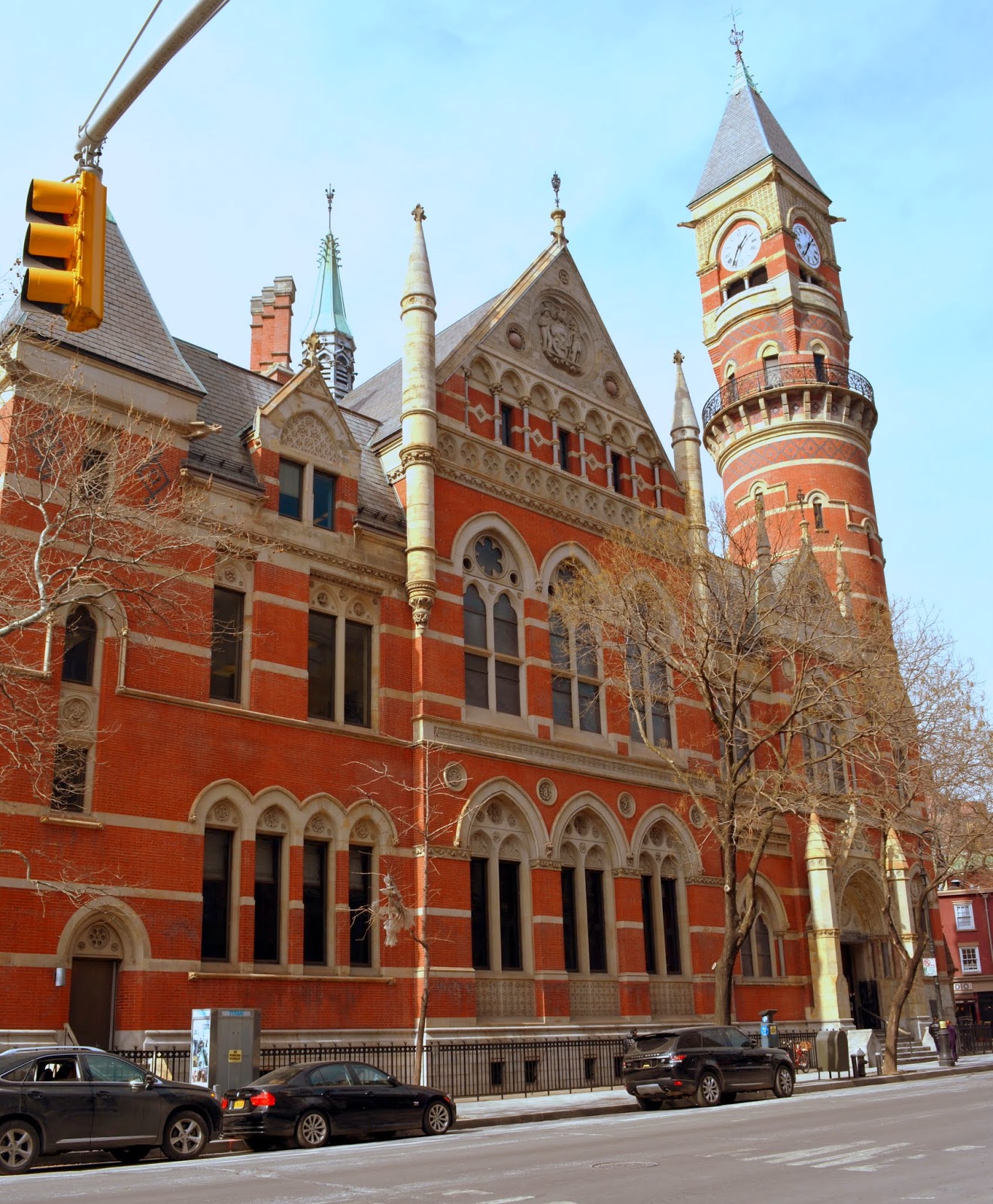
Can you believe this beautiful Victorian Gothic building located in the Greenwich Village neighborhood of Manhattan, located at 425 Avenue of the Americas and 10th Street,  is a branch of the New York Public Library? (All photos in this post will enlarge, for easier viewing, if clicked on)

Placards on the outside wall of the building

The Jefferson Market Library has a long and varied history.  It was built in 1876 and served as both the Third Judicial District courthouse, and then solely as women's court until 1932.


The 172-foot high turret of the building has clocks on all four sides and was used as a fire watch tower, as it once towered over the Greenwich area as the neighborhood's highest edifice. The bell that summoned the firemen at the time still hangs in the tower. There were many high profile trials that took place here, including the trail of Harry Thaw in 1906, for the assassination of an acclaimed architect Stanford White. It was a highly salacious trail of passion of the time, which you can read about on this link, as well as more interesting history about the building.


By 1945, through redistricting, the court was no longer held at Jefferson Market, and the building was used by various other agencies, including the police academy. The Academy left in 1958, leaving the courthouse empty destined for demolition. A group of community preservationists encouraged public outcry and led to its remodel and reuse as a branch of the New York Public Library. In 1961, the New York Public library agreed to the plan and architect Giorgio Cavaglieri was brought in to restore the exterior and redesign the building's interior for its new use.


The library opened in 1967, and the police court became the Children's Reading Room.


The Civil Court became the Adult Reading Room.


The building retains much of its interior architectural charm.


Some of the magnificent stained glass windows throughout the library.


If you remember, if you read this post, e.e cumming is one of my favorite poets, and when I was high school  age I was thrilled to learn that he lived for forty years in a little row house in a blind alley across the street from the Jefferson Market, from 1923 until his death in 1962.  Cummings was one of the preservationists that worked hard to save the Jefferson Market and have it turned into a library, although he did not live to see it happen.


Whenever I visit Greenwich Village I try to make a visit to Cumming's former home, just for nostalgia's sake.  I wonder who lives there now?


If you believe in "orbs" then this photo of e.e.cummings former home shows that his spirit may live there still!


In fact, I found it a little eerie when just a few blocks away I saw this balloon delivery man walking down the street...


.....I blurred his face for privacy.  I could not help but think of e. e. cummings poem "In Just, " which you can read on this Poetry Foundation link


It is wonderful to wander around the streets of Greenwich Village and see all of its eclectic architecture from different eras. 


I loved how the Vespa parked in front of this pink-hued house matched the house's turquoise blue shutters and had a pink seat!


Also, the vintage painted sign on the side of this building with its long-ago exchange name telephone number!  I remember when my childhood telephone number began with "Hickory"!


I really enjoyed my re-visit to the Jefferson Market Library, as many years ago I worked at the nearby St.Vincent's Catholic Medical Center (now sadly closed), and very often on my lunch break I would visit this library to borrow a few books.

My stroll through Greenwich Village also brought back many memories. There is a timeless feel to much of this neighborhood, even if expensive condos, and big box and chain stores are slowly edging their way into it. Thankfully, there are still many independently owned and operated stores, bookstores, restaurants, cafes and boutiques still in business and it is a wonderful area to wander around and look for surprises. Perhaps on a visit, you will also see a balloon man on a "mud-luscious, puddle wonderful" day?


Bookmark and Share

Thursday, March 24, 2011

100 Year Anniversary of the Triangle Fire


I would be remiss not to mark with special recognition the 100th Anniversary of the tragic Triangle Shirtwaist Factory fire that took place in this building located at the corner of Washington Place and Greene Street in the Greenwich Village neighborhood in Manhattan on March 25, 1911.  This event caused the eventual transformation of the labor code of New York State and to the adoption of fire safety measures that served as a model for the whole country.


The factory was located in the what was then the Asch Building, at 29 Washington Place, and now known as the Brown Building, part of New York University, and as you can see from the photo above, is located a block east from Washington Square Park.

 (double click on all photos to enlarge them)

On Saturday, March 25, 1911, near closing time, a fire broke out at the Triangle Shirtwaist Factory and within a mere 18 minutes, 146 people were dead.  Over six hundred people were crowded into the three upper floors of the building, working six to seven days a week under sweat shop conditions.  Five hundred of the workers were young women and girls, the majority ages eleven to twenty three years old, mostly immigrants from Italy, Russia, Germany and Hungary. Most were the main wage earners for their struggling families. They were employees of the Triangle Shirtwaist Factory owned by Isaac Harris and Max Blanck.  They worked long hours at their sewing machines making shirtwaist blouses which were popular fashion at the time.  At approximately 4:45 PM a fire quickly flared up in a scrap bin under one of the cutter's tables at the northeast corner of the eighth floor, reportedly caused by an extinguished match or cigarette. Employees on the tenth floors were able to be notified of the fire by a bookkeeper by telephone but there was no way to send an alarm to the women on the ninth floor. The fire department arrived within minutes but the fire truck ladders in that era only reached up to six floors.

Photo source: NYPL Digital Collection direct link.

To escape the fire the workers jammed into a small freight elevator which was able to make three complete trips, and onto the lone fire escape which soon twisted and collapsed from the heat and overload -- see photo above -- spilling victims nearly 100 feet to their deaths.  Some workers escaped by running up the one open staircase on the Green Street side of the building to the roof, where they leaped onto an adjoining building, but that staircase soon filled up with fire and smoke and was impassable. The other factory door at Washington Place was locked.  The owners had been trying to prevent theft and required each worker to pass inspection as they left work each day by one exit, and had ordered the other door locked. The employee who held the key to the locked door had already escaped the fire.  The women on the ninth floor, who were unaware of the fire until the last minute, desperately tried all means of escape.  Many squeezed into the last elevator that was able to make the ascent to the floor of the fire, and many jumped into the elevator shaft in an attempt to ride the elevator down on its roof but perished. The weight of those bodies prevented the elevator operator from making any more attempts to operate the elevator.

The only way out for the trapped workers still alive on the ninth floor was to jump. A large crowd of bystanders, many who had been enjoying a pleasant spring day in the park, gathered on the street and with horror witnessed sixty-two people jumping or falling to their deaths from the burning building. Since so many jumped at once the firemens' nets were worthless and ripped as the bodies hit them.

Photo Source; NYPL Digital Collection direct link.

Those that did not jump were overcome with smoke and burned to death. Fifty bodies were recovered on the ninth floor, so badly burned that it was not until February 2011 that six of those victims were identified. Those six victims had been buried together in the Cemetery of the Evergreens in Brooklyn, New York.

Photo Source: NYPL Digital Collection direct link

This montage from the New York Public Library digital collection shows of newspaper photos of the sad aftermath of the fire.  Most of the public were outraged at the tragedy and there was a large turnout for the memorial service. Nearly 400,000 New Yorkers filled city streets to pay tribute to the victims and raise money to support their families. The ensuing public outrage forced government action. The Triangle Shirtwaist Fire helped to solidify support for workers' unions like the International Ladies' Garment Workers' Union. The owners, Isaac Harris and Max Blanck, were tried for manslaughter but were acquitted in 1914. The fire became a rallying cry for the international labor movement and many of our fire safety laws were created in response to this tragic event.


Each year, Workers United sponsors a commemoration of those who died in the Triangle Fire. More information is available on their web site: Workers United. Several commemorations of the 100th anniversary of the Triangle Fire will take place in New York City and across the country. The Remember the Triangle Fire Coalition makes available an online listing of upcoming events.

The ILR School Kheel Center, a division of Cornell University, has an extensive collection of material about the Triangle Fire and is worth exploring for information, names of the victims, photos and first hand accounts of the fire.


It is fitting to remember the young women and men who senselessly lost their lives that day. After the Triangle Fire tragedy, many work place reforms and fire safety laws have undoubtlessly saved many lives.  It remains one of the worst fires this city has ever witnessed.


Bookmark and Share

Saturday, February 5, 2011

A Stroll Through Greenwich Village

Whenever I stroll through the Greenwich Village neighborhood of Manhattan I often see historical markers on many of the buildings or interesting architectural details that make me stop to take a photograph. Later I'll do research to see if I can find something interesting about the building. I took many of the following photos in November, but haven't had a chance to blog about them until now. Here are few fascinating buildings I saw during this walk:


This building is C.O. Biglow, located at 414 6th Ave.  Founded in 1838, it is the oldest apothecary-pharmacy in the U.S.  It has earned an iconic status for its unparalleled selection of hard-to-find cosmetics and homeopathic remedies, including Bigelow's own brand of affordable, smartly-packaged soaps, toners, and essential oils—many made from historic recipes. They also have an online catalog. (All photos will enlarge when clicked on once, and then again when they open on a new page.)


Next, we see The Cherry Lane Theatre, located at 38 Commerce Street. As you can read on the historical plaque on the top of this photo collage, this threatre has an illustrious history as New York's oldest, continuously running Off-Broadway theatre. Playhouse productions featured an equally illustrious group of actors and directors, including John Malkovich, Barbra Streisand, Geraldine Fitzgerald, James Earl Jones, Tony Curtis, Ruby Dee, Gene Hackman, Bea Arthur (making her stage debut), Burl Ives, Bob Dylan, Kevin Bacon, Kim Stanley, Frank Langella, Tyne Daly, John Epperson, Nancy Marchand, Robert Loggia, Dennis Quaid, Joan Cusack, among others. I saw the play Nunsense here, years ago with friends, and the 25 anniversary revival of this hilarious production is scheduled for this summer.


Gay Street extends from Christopher Street one block south to Waverly Place, between and roughly parallel to Sixth and Seventh Aves. It was named after an early landowner from the late 1700's. This charming, slightly bent street began as a street lined with horse stables for the wealthy. It then became low class housing for their servants. By the turn of the 20th century it developed into a mini-haven for artists and writers.  Gay Street was the setting for Ruth McKenney's novel "My Sister Eileen," and the film "Carlito's Way."  The address 12 Gay Street, the building with the blue shutters seen in the bottom middle of the photo collage above, was originally built in 1827 and was formerly a speakeasy called Pirate's Den.  The property was later converted into a three-story residence for former New York City Mayor, Jimmy Walker. Later, it was home to puppeteer Frank Paris, designer of the original Howdy Doody marionette.  It is also reportedly haunted.


The plaque above describes the Greek Revival homes in the adjacent photo. Many examples of  preserved "old New York" can be found in Greenwich Village.


This beautiful edifice on 95 Bedford Street, marks the former home of J. Goebal & Co., a factory that produced crucibles--containers for holding molten glass--founded in 1865. Notice the three glasses in the edifice design.


Built in 1831, the Northern Dispensary is the only building in New York City with one side on two streets, Christopher and Grove Steets, and two sides on one street, Waverly Place.  The property was used as a clinic to provide medical care to the “worthy poor.” Poet Edgar Allen Poe was treated here for an illness in 1837. Sadly, this remarkable building has been unoccupied for about 15 years when real estate investor William Gottlieb purchased it. He passed away in 1999 and his heirs have declined to do anything with the building. You can read more about this building on this link.


Ye Waverly Inn located at 16 Bank Street at Waverly Place, has been a landmark in New York’s Greenwich Village since the 1920’s. In 2006, Vanity Fair editor Graydon Carter bought and refurbished the restaurant, and made it into one of the most sought after places to dine in New York City, although the food critic at New York Magazine does not give it high ratings in his review. Of course it helps that the restaurant has its own blog on the Vanity Fair Magazine web site to keep the hype going, and although reservations are currently handled only via a private number, it is reportedly full every night. According to the New York Times: "On any given evening the restaurant plays host to some combination of billionaires, movie stars, intellectuals and fashion designers, with a rock icon or sports legend thrown in."


I couldn't resist taking a photo of this interesting graffiti on a red door!
 
Greenwich Village is a fascinating place to visit, always full of new discoveries. Be sure to take the time to do your own stroll around if you ever visit New York. If you'd like to see more I have quite a few more posts about this area of Manhattan in my blog's Greenwich Village labels and also my East Village labels.

Linking to Mosaic Monday on Mary's blog My Little Red House and My World Tuesday hosted by Klaus, and the My World team. Thanks to all for hosting such nice events for us to join every week!


Bookmark and Share

Friday, December 3, 2010

Pink Saturday Scooter


When my husband and I were driving home from the Macy's Thanksgiving Day Parade last week (which you can read about by clicking on the highlighted words) we saw this wonderful pink Vespa scooter parked on a street in the Greenwich Village neighborhood of Manhattan! If you have ever visited Italy you'll know that this is the vehicle of choice in many cities, especially Florence and Rome, but it is a rare sight to see in New york City!

Of course when I saw it I yelled out "Pull over!  Pink Saturday!" almost as a reflex, and then jumped out of the car to take these photos.


Wouldn't you love to tool around NYC on this pretty pink number? I would -- but I'd make sure to stay on the quiet side streets!

Beverly asked that we share a favorite holiday recipe today so please click on this link if you'd like to see a post I did two years ago about my favorite Christmas cookies.  I make them every year!
To see more Pink Saturday posts please visit Beverly at the How Pink the Sound blog.  Thanks Beverly for another week of pink fun!

I'm also having a give away for a 2.2 pound Jacques Torres dark chocolate "Big Daddy" bar on this post.
You have until midnight of December 9th, 2010 to enter by leaving a comment on that post!

Would you also like a chance to win $500 worth of books from Chronicle Books in their "Happy Hual-idays" promotion ending December 12th, 2010?  See My Back Page blog for further information!


Bookmark and Share

Friday, June 4, 2010

Bonnie Slotnick Cookbooks Shop


Bonnie Slotnick Cookbooks is a used and out-of-print vintage cookbook store located at 163 West Tenth Street, in the Greenwich Village neighborhood of Manhattan.


It is one of my favorite places to visit whenever I am in the area.


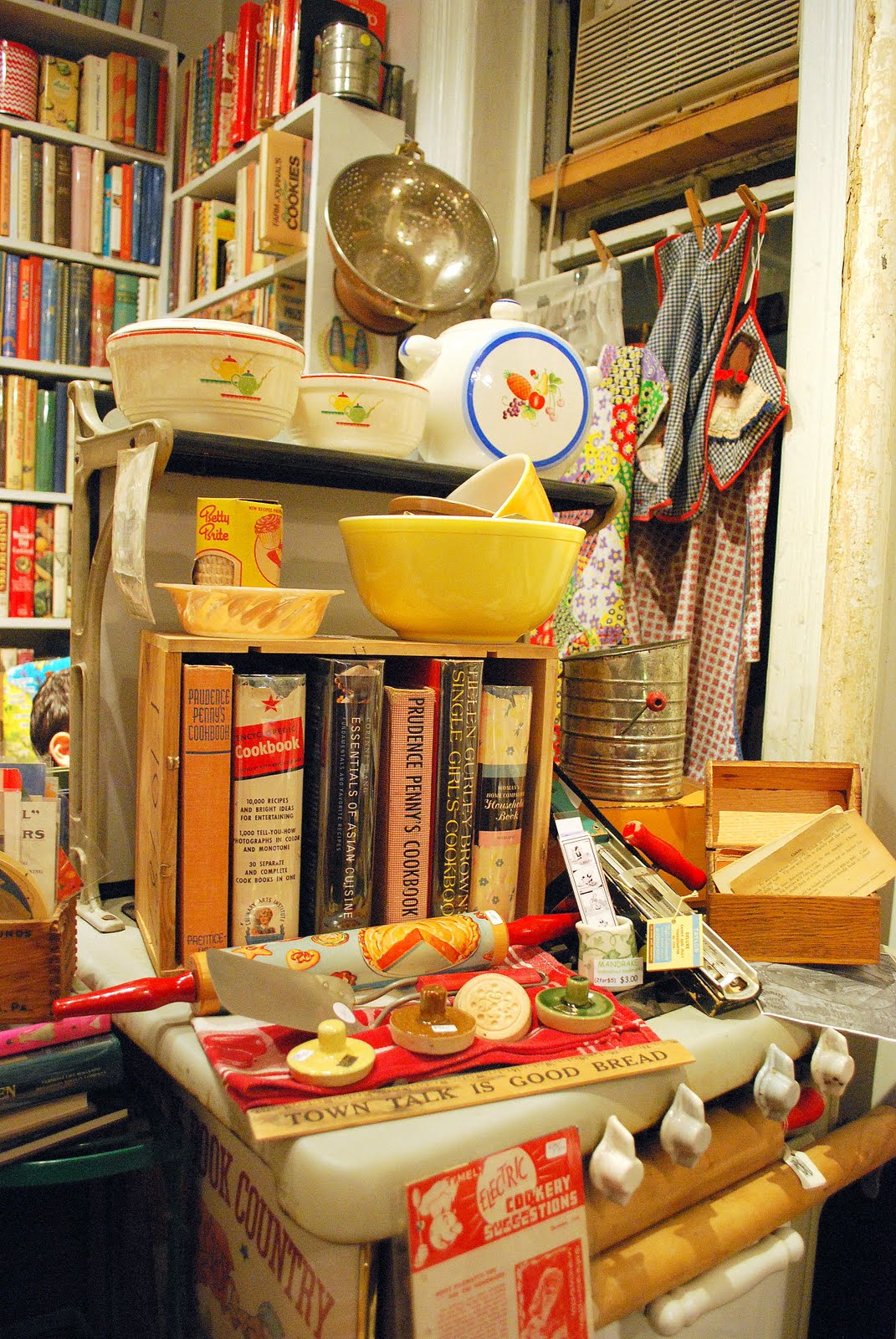
It's a cozy little store crammed with cookbooks of all genres. some dating back to the 1800s.


There are also many nostalgic vintage collectibles on display.


Bonnie's cookbook specialties are New York restaurants and food, culinary ephemera, etiquette books, housekeeping manuals, baking books, Jewish cookbooks, restaurant postcards, and handmade greeting cards.


Ms. Slotnick opened her shop in October 1997, after careers as a freelance artist and a cookbook editor.


The majority of the cookbook are American, but there’s also a generous selection of European titles, and some antiquarian culinary magazines, both American and foreign.


The day I visited this little boy happily played while his mother searched for a certain book title. 

There is an interesting interview with Bonnie Slotnick on this NPR "All Things Considered" show, along with a fascinating 1911 "Scripture Cake" recipe copied from one of the cookbooks that were for sale in her store.


The over 4,000 cookbooks are well organized by genre on the shelves and Bonnie has extensive knowledge of her inventory.  She also welcome telephone inquires if you are searching for a rare or out of print cookbook.  Her books are not used book bargains, but they are not overly expensive either.  If you find a copy of a cookbook that you've been searching for, that you remember your Mother or Grandmother using, perhaps it would be a priceless treasure for you!


photo source:  Bonnie Slotnick Cookbooks web site

Bonnie Slotnick Cookbooks is usually open six days a week, but Bonnie highly recommends calling ahead, 212-989-8962, for the store hours, as they vary.

 I enjoyed looking at her collection of children's cookbooks, as many of their illustrations were delightful!  Bonnie told me that early copies of the Betty Crocker cookbook are often the ones most searched for in her store. If you visited Bonnie's store what type of cookbook would you look for?

*Update January 2015
Bonnie is moving her cookbook shop to a new address.  She will be located at 28 East 2nd Street in Manhattan, beginning sometime sin February 2015.  It will be a larger space than what she had here. Wishing her the best of luck in her new location!


Bookmark and Share