Showing posts with label Haunted New York. Show all posts

Friday, May 16, 2014

The Jefferson Market Library, Greenwich Village, New York


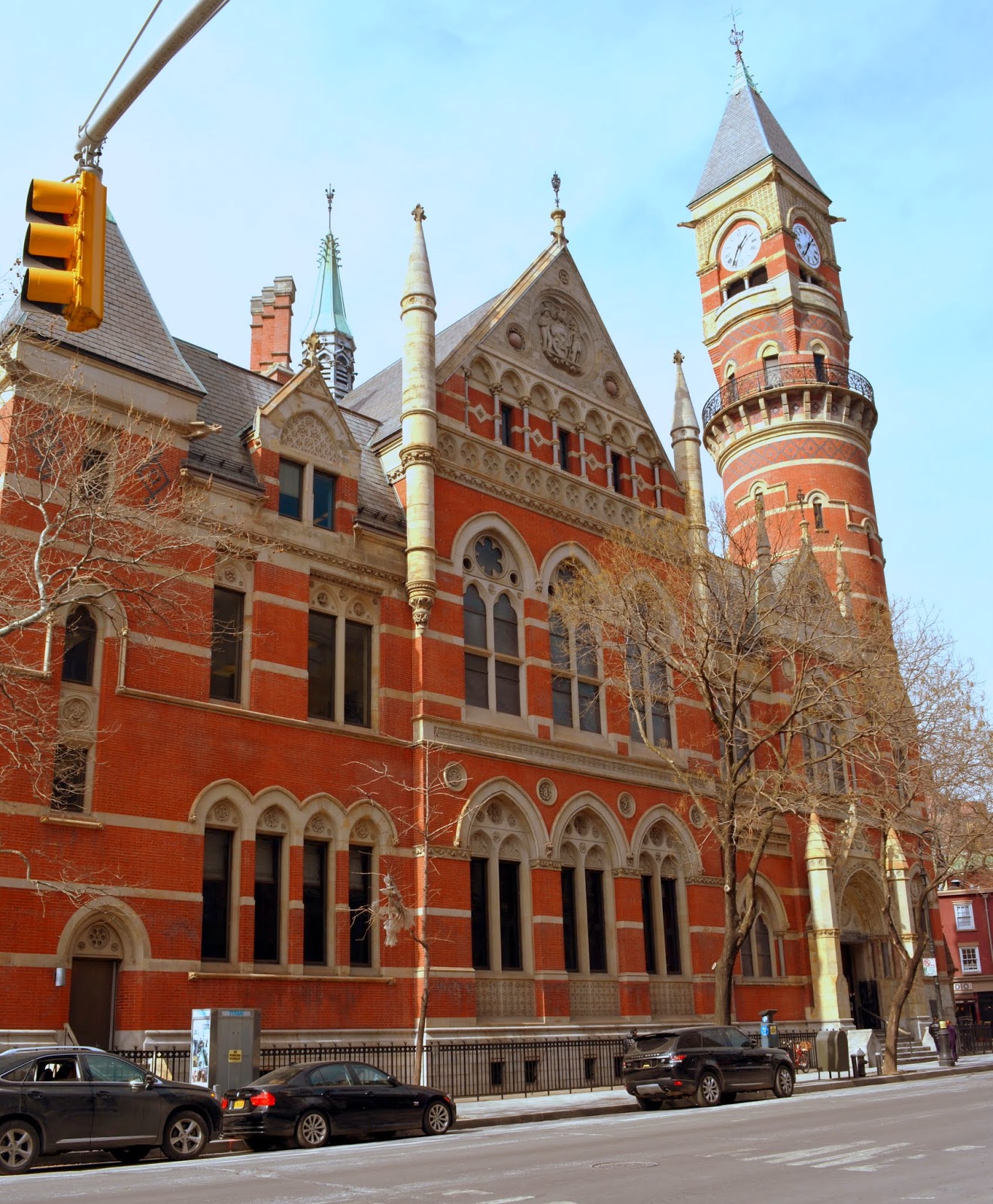
Can you believe this beautiful Victorian Gothic building located in the Greenwich Village neighborhood of Manhattan, located at 425 Avenue of the Americas and 10th Street,  is a branch of the New York Public Library? (All photos in this post will enlarge, for easier viewing, if clicked on)

Placards on the outside wall of the building

The Jefferson Market Library has a long and varied history.  It was built in 1876 and served as both the Third Judicial District courthouse, and then solely as women's court until 1932.


The 172-foot high turret of the building has clocks on all four sides and was used as a fire watch tower, as it once towered over the Greenwich area as the neighborhood's highest edifice. The bell that summoned the firemen at the time still hangs in the tower. There were many high profile trials that took place here, including the trail of Harry Thaw in 1906, for the assassination of an acclaimed architect Stanford White. It was a highly salacious trail of passion of the time, which you can read about on this link, as well as more interesting history about the building.


By 1945, through redistricting, the court was no longer held at Jefferson Market, and the building was used by various other agencies, including the police academy. The Academy left in 1958, leaving the courthouse empty destined for demolition. A group of community preservationists encouraged public outcry and led to its remodel and reuse as a branch of the New York Public Library. In 1961, the New York Public library agreed to the plan and architect Giorgio Cavaglieri was brought in to restore the exterior and redesign the building's interior for its new use.


The library opened in 1967, and the police court became the Children's Reading Room.


The Civil Court became the Adult Reading Room.


The building retains much of its interior architectural charm.


Some of the magnificent stained glass windows throughout the library.


If you remember, if you read this post, e.e cumming is one of my favorite poets, and when I was high school  age I was thrilled to learn that he lived for forty years in a little row house in a blind alley across the street from the Jefferson Market, from 1923 until his death in 1962.  Cummings was one of the preservationists that worked hard to save the Jefferson Market and have it turned into a library, although he did not live to see it happen.


Whenever I visit Greenwich Village I try to make a visit to Cumming's former home, just for nostalgia's sake.  I wonder who lives there now?


If you believe in "orbs" then this photo of e.e.cummings former home shows that his spirit may live there still!


In fact, I found it a little eerie when just a few blocks away I saw this balloon delivery man walking down the street...


.....I blurred his face for privacy.  I could not help but think of e. e. cummings poem "In Just, " which you can read on this Poetry Foundation link


It is wonderful to wander around the streets of Greenwich Village and see all of its eclectic architecture from different eras. 


I loved how the Vespa parked in front of this pink-hued house matched the house's turquoise blue shutters and had a pink seat!


Also, the vintage painted sign on the side of this building with its long-ago exchange name telephone number!  I remember when my childhood telephone number began with "Hickory"!


I really enjoyed my re-visit to the Jefferson Market Library, as many years ago I worked at the nearby St.Vincent's Catholic Medical Center (now sadly closed), and very often on my lunch break I would visit this library to borrow a few books.

My stroll through Greenwich Village also brought back many memories. There is a timeless feel to much of this neighborhood, even if expensive condos, and big box and chain stores are slowly edging their way into it. Thankfully, there are still many independently owned and operated stores, bookstores, restaurants, cafes and boutiques still in business and it is a wonderful area to wander around and look for surprises. Perhaps on a visit, you will also see a balloon man on a "mud-luscious, puddle wonderful" day?


Bookmark and Share

Friday, July 16, 2010

The New York Marble Cemetery


An interesting place I visited in Spring, but did not had time to blog about until today, is The New York Marble Cemetery, located at 41 and 1/2, Second Avenue, in the borough of Manhattan.  It is a small burial ground in Manhattan's East Village, and it is the oldest public non-sectarian cemetery in New York City.

(All photos can be enlarged for easier viewing by clicking on them once, and then again when they open on a new page. Use your browser's back arrow to return to the post.)


An informational plaque located on the front gates.  

The cemetery is usually open to visitors on fourth Sundays, April through October, from 11 until 3, as well as several other weekends throughout the year - check the schedule on this link.


Most of the cemetery is shielded from the avenue by the buildings that have sprung up around it over the years. Enter from 2nd Avenue between 2nd and 3rd Streets through a circa 1908 wrought iron gate. It leads to a walkway that is one hundred feet long leading to a circa 1854 gate with cast iron decoration .


Once inside you can see a large open garden space covered by grass.  An exhibition about the history of the cemetery was going on at the time of my visit. The cemetery was incorporated in 1831 in response to fears about yellow fever outbreaks at the time, when legislation had outlawed earth graves.  Marble vaults the size of small rooms were built ten feet underground in the excavated interior of the half acre of land that comprises the cemetery.


According to the cemetery's web site: "Half of the older caskets were tiny, holding children aged six and under. Contagious diseases such as scarlet fever, measles and whooping cough, as well as infections for which there were not yet antibiotics (erysipelas, pneumonia, cholera, etc.) contributed to a level of early mortality fortunately forgotten in most parts of the world. What would be termed symptoms today were then considered primary causes of death: dropsy (edema), congestion or inflammation of the lungs or brain, and dysentery or diarrhœa. For adults, the leading cause of death by far was tuberculosis, then known as consumption or phthisis pulmonalis. A surprising number of people who reached maturity, however, lived into their eighties and nineties, and invariably died of 'old age.' "


The walls of the cemetery are made from Tuckahoe marble, which was also used for the vaults, plaques and lintels, and gave the cemetery its name. Unfortunately, the marble is relatively soft material and many of the walls are rapidly disintegrating from time and acid rain.  Funds are being raised by the cemetery's board of trustees for the constant upkeep and renovations needed to preserve the cemetery.


All of the vaults are underground and the only name and vault makers are tablets like these on the walls.


Please enlarge this photo of a diagram that shows what the procedure for burial in the underground vaults would entail.


Above and below are part of the display in the cemetery the day I visited that shows portraits of the many of first people buried in the New York Marble Cemetery. 


One of the illustrious people buried in the cemetery is Doctor David Hosack, 1769-1835.  He was one of New York's most famous citizens of the time. Hosack was a founder of several New York institutions that survive to this day, including Bellevue Hospital and The New York Historical Society, and was a friend and confidante of some of the more distinguished citizens of the early Republic, including General Alexander Hamilton.  As the attending physician at the General’s duel with Aaron Burr in 1804, he cared for Hamilton in his last hours on earth. When Hosack bought a vault at the marble cemetery a few years before his death, other early New Yorkers flocked to do the same and, before too long, the cemetery had became the place to be buried in Manhattan.

By 1838, rural cemeteries, such as Green-Wood Cemetery in Brooklyn, quickly became the preference of most New York families, and soon the use of the Marble Cemetery declined. Most of the 2,070 interments took place between 1830 and 1870.  Now the cemetery’s quiet, half-acre grounds are available for rent for appropriate private or corporate events.

I found it a fascinating place to visit and another unexpected quiet green space amongst the bustling city streets. It was interesting to reflect upon the men and women buried there who were so influential in early New York history. Although I've lived in New York City my entire life I am constantly amazed by new discoveries that I make sometimes just by walking down a different street.  There is always something new to learn in this great city!


Bookmark and Share

Thursday, October 29, 2009

The Haunted White Horse Tavern in Greenwich Village

The White Horse Tavern, located at 567 Hudson Street and West 11th Street, in the Greenwich Village neighborhood of New York City, does not look too eerie, does it?
It is, in fact, a pleasant place to stop and have a quick burger and a brew, but it is also well known as being haunted!

Let's go inside, shall we?

Inside the first room of the tavern there is a large, well stocked bar. There was lots of convivial conversation going on in this crowded room, although it was a little loud, as large screen TVs were blaring a football game.
How could it be that such a raucous place could harbor a ghost?

Even the little white horse memorabilia decorating all the nooks and crannies of the tavern looked so innocuous, almost cheerful.

Now let's walk into the middle room. Ah! This is the spot the ghost haunts!
Here is the favorite little corner table where the poet Dylan Thomas frequently sat during his visits to the tavern when he came to New York City. It was in this spot where, in 1953, he unfortunately drank himself into a stupor. He collapsed outside the tavern and was brought to the Chelsea Hotel, and later died on November 9, at St. Vincent's Hospital, at the young age of 39. There is a legend that his last words were: "I've just had eighteen straight whiskies, I think that's a record." His spirit is said to rotate this favorite corner table, as Thomas liked to do when he was alive.

Do not go gentle into that good night
~ Dylan Thomas


Do not go gentle into that good night,

Old age should burn and rave at close of day;

Rage, rage against the dying of the light.

Though wise men at their end know dark is right,

Because their words had forked no lightning they

Do not go gentle into that good night.

Good men, the last wave by, crying how bright

Their frail deeds might have danced in a green bay,

Rage, rage against the dying of the light.

Wild men who caught and sang the sun in flight,

And learn, too late, they grieved it on its way,

Do not go gentle into that good night.

Grave men, near death, who see with blinding sight

Blind eyes could blaze like meteors and be gay,

Rage, rage against the dying of the light.

And you, my father, there on the sad height,

Curse, bless, me now with your fierce tears, I pray.

Do not go gentle into that good night.

Rage, rage against the dying of the light.


My husband and I sat at the corner table and offered a toast to Dylan, not with whiskey but with Guinness. Were those glowing orbs reflected on the table Dylan's ghost eyes smiling in approval? I'd like to think so!


My post is part of Elizabeth of the The World Examining Works blog's first annual Halloween Party, and for more halloween themed blog posts join us at Theme Thursday.

Bookmark and Share